words: Paulo Carmona (freely translated by Raquel Pinheiro); photos: Nuno Lopes
With characteristic mastery, Samuel Úria prepared his transition towards solo performances on iconic stages, and the Coliseus were no exception.
Samuel appeared in full splendour, surrounded by a panoply of settings, stages and instruments, all enriched and animated by special guests and a chorus of celestial voices. Everything was in place for the night to be memorable, and indeed, it was.
It all began with 2000 AD, the title song of his latest work, and straight away the breath became a complement to the syncopated rhythm of my shoe soles. There was a touch of spaghetti western about the song, and a festive spirit swept through the entire hall of Coliseu do Porto.
Soon after came Pedra e Cal, and someone whispered in my ear, “Samuel does whatever he wants with his voice.” The procession was only just beginning when he announced the first guest – the Queen of Hearts herself: Carol. The song, inspired by Xico da Ladra, a character from the alleys and narrow streets where the artist once roamed and drew inspiration, unfolded like a fable. Imagination is something Samuel knows how to translate into song, and those who listen closely can feel it.
The audience responded instinctively; the atmospheric intensity rose with every beat, every sway of the hips. Samuel is, by nature, an entertainer, a consummate performer. He communicates with ease, radiates genuine warmth and just the right measure of humility, deeply endearing qualities. The crowd loved him for it, answering his gestures with bursts of applause.
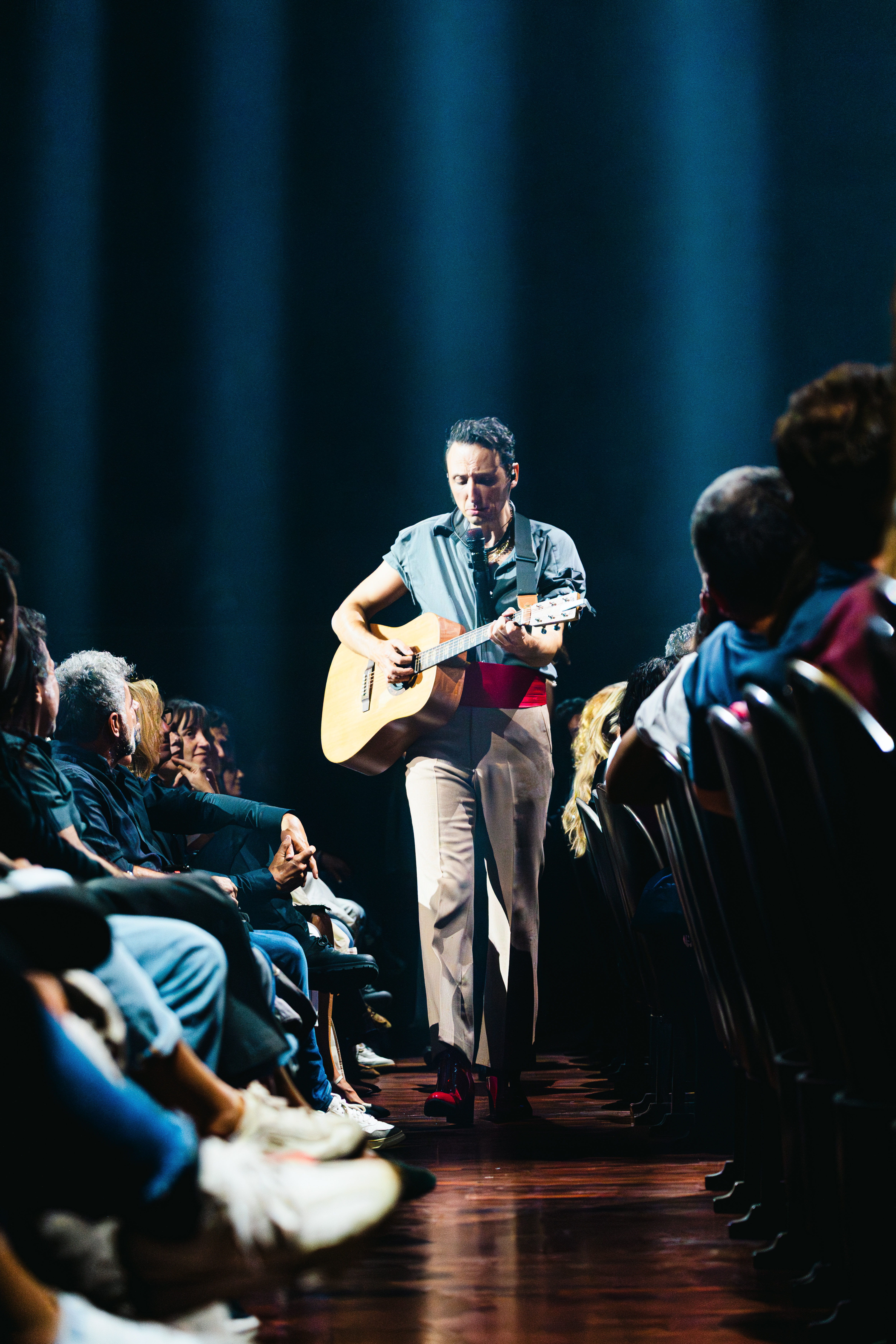
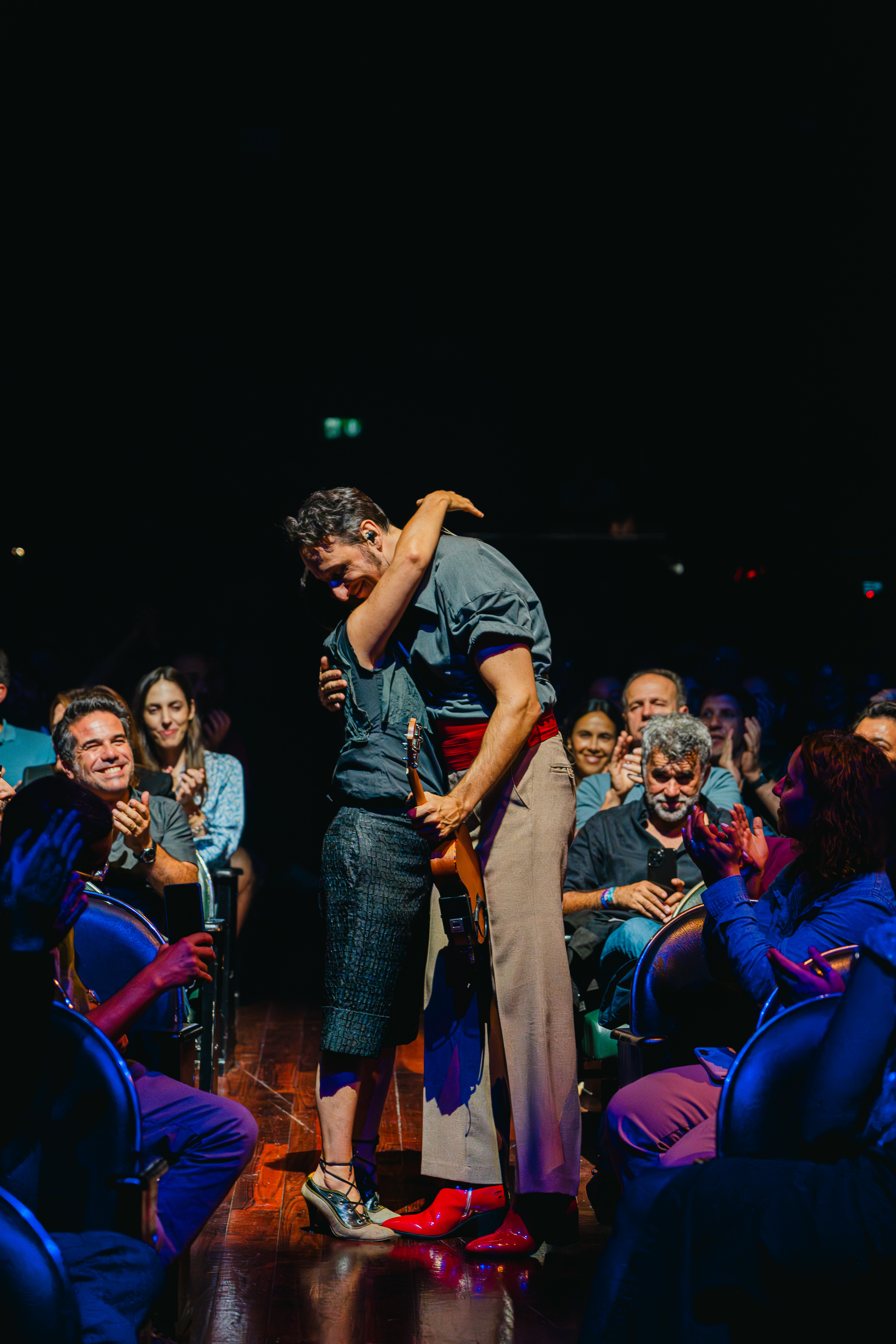
There were more surprises and more guests joining Samuel on stage: Margarida Campelo; Manuela Azevedo, with whom he ventured into the middle of the audience to perform Carga de Ombro in a completely acoustic version, a moment that set the Coliseu ablaze.
Then came Milhanas and Gisela João. Each of them wonderful, each unique. One could not have asked for more. The stage even shifted hands, as the band from earlier days – Flor Caveira – filled the air with rock’n’roll à la carte. Like a chameleon slipping between parallel worlds with a diplomat’s passport, Samuel moved through genres that met and mingled here and there.
A special note must be given to É Preciso Que Eu Diminua, in which the artist seemed to perform a near-penitential act. With the wisdom and craft of a poet, he offered his reflection on what it means to accept one’s own place when standing in the light, gently criticising the hollow vanity and narcissism that often accompany it.
He closed the concert, as he must, with Um Adeus Português. It belonged there, perfectly attuned to the moment.
I left Coliseu do Porto as one might leave a banquet of the gods, with a full soul. And I caught myself thinking: “If this man keeps going like this, what more could I possibly say?” Oh captain, my captain?
Good morning with our Middle of the Week Song – I Wish by Miranda. Miranda is João P. Miranda’s one-man studio project to which several female singers give voice to. I wish is sung by Liliana Bernardo. Have a nice day.
Forms of Witness in Light and Sound by Raquel Pinheiro
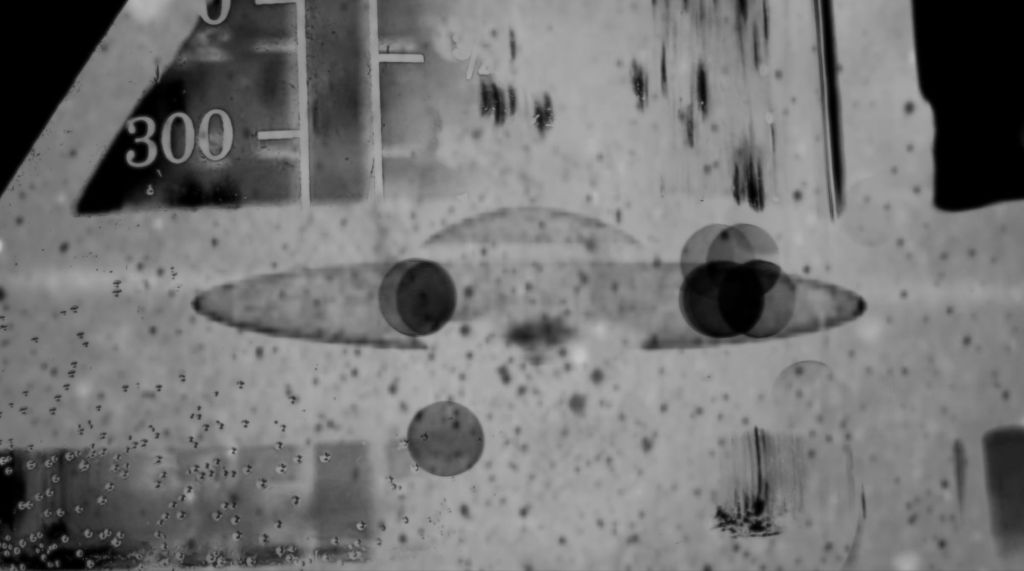
Elemental Studies is a cycle of twelve short films by TJ Norris that explore the four natural elements through shifting imagery and sound. Filmed in black and white, these studies move between stillness and turbulence, abstraction and form. Each piece was later interpreted by a different composer, whose response became both soundtrack and dialogue.
The resulting body of work, presented as a double album of original and reworked scores, forms a collective meditation on the relationship between human perception and the living world.
TJ Norris’ camera listens as much as it sees, tracing the elemental in its raw and transient states. Across these films, beauty, tension, and uncertainty coexist, suggesting that to witness the Earth is also to encounter ourselves. Our fragility, resilience, and capacity for renewal.
Elemental Studies soundtrack by 25 artist is released by Carpe Sonum Records with liner notes by Massimo Ricci of Touching Extremes.
What first compelled you to translate the elements into film and sound? Was there a moment of recognition, an image, or a feeling that began this cycle of work? I’m pretty passionate about the environment, and aside from man’s imprint on Earth the elements are cause and effect on how our surroundings are shaped. Climate change is a very serious (all hands on deck) situation, a conundrum in our times. Somehow, oddly, it has become an ‘issue’ for political theater as well these days. In relating to all things in nature, and how we interact with our fragile ecosphere, it seemed like a critical time to create work that distinctly responded to this existential crisis, in my own way.
Do you see Elemental Studies as an act of witnessing, a response, or a form of repair in relation to what’s happening on the planet? Yes, and no. It’s more deeply embedded, the relationship we each have with the planet, it’s sacred really. And not in a religious way. Though, not literal, there is this quasi ‘speaking in tongues’ thing between myself and all earthly things, however tiny or huge – it’s that surreal. Though I do consider myself a witness to all this change, we all should.
When you speak of the “changing, sometimes fragile ecosystem,” do you mean the Earth itself, or also the human spirit, the inner climate we inhabit? All of the above, sure. Though, as far as this project is concerned, it extends to creative relationships, collaborations without borders. As you might know there are twenty-six artists involved in Elemental Studies, from eighteen different countries. During the process of developing this work, which still has a big road ahead, there were exciting creative differences that helped fuel the outcome. We are all, in essence, doing our part to better understand how the mighty elements deploy themselves in the twenty-first century.
How do you balance urgency – the need to respond to ecological crisis – with the quiet attention and restraint that your films embody? Exactly. We need voices that speak in tones that both rage and whisper, and the more intimate, in this case, the better. It draws people in and gives them a break from sitting behind a monitor and scrolling endlessly.
What place does intuition hold in your creative process? Is it the first movement, or the current that carries you once the work begins? The process of making the films, and working with sound composers was quite fluid, actually, fluid like a wave, a drift of wind, etc. In this way we mirror our subject matter, however intuitive the working relationships were. And, to be honest, there wasn’t much post-production, just a few tweaks here and there. Making the films, pairing them with scores by a dozen sound artists I trust, and allowing for creative freedom led to their trusting me to pairing their works with a second set of composers who then reshaped the original scores into what we call ‘Reworks’ (disc two of the soundtrack).
When you began filming, were you seeking to reveal the world, or to listen for what the world wanted to reveal through you? That is a lovely question. I’m an empath, so I am always listening, always thinking, always questioning, reasoning, etc…. The films are somewhat layered amalgamations of time and space – kind of like daydreams. Originally I wanted to follow the surrealist ‘exquisite corpse’ technique to piece this altogether by chance, but in the end there were formal considerations I had to make with both the subject and for the audience. These short films are completely non-narrative, so they are meant to evoke a bit of a chance to just ‘breathe’ into what you are seeing.
Does the act of filming the elements feel more like collaboration or surrender, and to whom, or to what, do you surrender? I surrender to, and participate with the elements on a regular basis….though to share this work, again, it was more about collaborative trust than surrender per se.
Did the collaboration with sound artists shift your original motive, did their interpretations reveal something you hadn’t consciously intended? Not necessarily as I was fairly familiar with the work of most of the sound makers involved. Though, after hearing some of their responses to the films, I may have added a cinematic ‘ghost’ in a framed corner or two.
What kind of dialogue did you want between the visual and the sonic? Were they meant to mirror each other, or to reveal what the other could not say? Oh, yes, there is a gratifying sense of audio-visual harmony, for me, for sure. For whatever reason this question had me replaying ‘Look Back In Anger’ by Bowie. I don’t think I could elaborate much on that.
The composers’ interpretations seem to hold both reverence and disquiet. How did their responses change your own understanding of the material? It did not change my understanding, just literally imbued the larger project with a sweet sense of creative camaraderie. The process honors the visual and the auditory, and they can exist without each other, they just have a certain palpable synchronicity when paired.
Do you experience sound as a form of seeing, a way of touching what light can’t reach? You could say that. Sound art has always been my muse, my prima ballerina so to speak.
How do you experience beauty in this context, as solace, as disruption, or as a form of truth-telling? Again, all of the above, and then some. I truly believe that active, deep listening experiences can probably strengthen your psyche.
Was there a personal threshold you crossed in this work? Something that asked you to see or feel differently than before? Thank you for asking. Yes, as I join the sexagenarians this month I realize that while I’ve long embraced collaboration as one of my primary mediums in the studio, I want to branch further from the still image to the cinematic. This work allows me to make considerations for how this is presented. Some of the shorts have been individually included in film festivals, the dozen films were screened as a one-hour piece at Gallery X in Dublin in early Autumn.
So this work has truly allowed me a sense of flexibility and different applications of the same material or portions thereof. However, the quintessential way of presenting this work is in a 4-channel installation format, so that a space can be fully devoted to each individual ‘element’. I’m hoping to work with some savvy curators to see this through into 2026 and beyond.
Do you sense that creating Elemental Studies changed your own internal climate, your way of being in relation to change itself? Other than already accepting that change is a constant, no. Keeps us all guessing.
Did this project shift your relationship with the world itself, with weather, air, silence, or time? Time, yes. I did not expect how much time it would actually take to get this project out to the world as an independent artist. There’s a lot that goes into building trust with such a vast cast of artists, a record label and the ongoing reach to curatorial experts and institutions. Sometimes I wish there were infinite amounts of time, and, in between, I love taking a daily siesta to shut down.
How do you keep your creative process free from cynicism or despair, especially when addressing something as immense as planetary change? This is so personal, and I’m a ‘glass half full’ kind of guy. In the past my work has taken me to rough neighborhoods, trainyards, industrial spaces, in other words – broken landscapes. I kind of covered some of that in my previous work and book ‘Shooting Blanks’ (2018). This project is far more elusive and ∞.
There is a bit of ‘calm before the storm’ that went on while approaching this work, in that I feel an interactive, and almost electric connection with the elements. At times it was like staring at a blank canvas, and suddenly some of that negative energy actually fueled the creative process in a disarming and ecstatic way.
Sometimes that is when I feel like a conductor, and a good example was making the short Ventilate with Guido (Das Synthetische Mischgewebe). Knowing some about his physical process for making soundscapes likely inspired me to use some footage from a trip to Spain where I came across lots of agitated street graffiti, in particular the use of the phrase ‘L’artista Vandalo’ which has a certain creative license.
Is there a spiritual dimension to your process, not in a religious sense, but as a kind of devotion or communion? It’s a very private thing.
When you look at the state of the world through the lens of Elemental Studies, do you feel hope, or simply clarity? Hmmmm. I wouldn’t make that comparison honestly. Instead I can only hope that this project will find its audience, like an individual finds his/her/their own tribe. Yes, that would be a cyclical and satisfying outcome.
If the Earth could respond to this project – if she could answer – what do you imagine she would say? Repeat, Renew, Reuse.
Do you think art can still heal, or does it simply reveal what has already begun to heal itself? Of course it can, there are so many beholders out there, so many compassionate thinkers, so many willing to allow for a creative experience. So, yes, art is quite powerful, and I recommend losing yourself within this sphere.
You can read more about Elemental Studies on TJ Norris site and listen to its soundtrack on Carpe Sonum Records Bandcamp.
Elemental Studies Soundtrack:
Jos Smolders – Airborn
Darren McClure – Flow
Das Synthetische Mischgewebe – Ventilate
Vitor Joaquim – Dust (a reinterpretation of “Lascia Chio Pianga” from GF Handel)
Charlotte Fröling, Still Life with Lemons, Oranges and a Grapefruit, 2015
After The Noise is a small note at The Polymath on how beauty returns through simplicity after noise — sunlight, rain, a guitar chord, a paintbrush, a quiet moment.
All my maps, readings, and analyses – the midlife loops, the physiology, the rhythms – are tools. They are precise, elegant, even beautiful. But, tools are not the point. They are only meaningful if they lead back to what matters most: connection, presence, and the living pulse of life.
That is the first paragraph of my new post on The Listening Room HQ. You can read the rest here.
The Midlife Cycle: Written Map of Loops, Physiology, and Environment a new post on The Listening Room HQ is a practical, text-based map of the midlife cycle, showing how behavior, physiology, and environment interact.






 Mondo Bizarre Magazine