
A Journey Through Layers and Light
by Raquel Pinheiro
We spoke with painter and artist Juliana Ferreira about her exhibition S03Ep02 series and her work.
Juliana generously revealed the thoughts, impulses, and intentions behind her work. Alongside her responses, we are also gifted with her reflections. Intimate insights into the processes, emotions, and moments that gave rise to the S03Ep02 series. These reflections illuminate not only the making of the paintings but the personal and artistic journey that informs them.
S03Ep02 is currently on display at Auditório Municipal Carlos Paredes in Vila Nova de Paiva, where it will remain throughout October. In November, the exhibition will travel to Viseu, followed by Régua in 2026, and other locations – see calendar at the end.
The first thing that drew my attention were the slogans/phrases and the canvases colour backgrounds. If any, what was your intention for the use of the slogans/phrases?
The texts appeared very organically. I didn’t start the canvases thinking about slogans; they emerged like breaths or thoughts spoken aloud. Some phrases are quotations – Adília Lopes, Sartre, Leminski, Saint-Exupéry* – and others were born in the very moment of painting.
They function as anchors, summarising emotions, states, or memories underlying the image. The saturated colours create an emotional field for each piece; they are atmospheres. It’s almost as if each canvas were a cinema screen with a line at the beginning of the scene.

All the paintings are large format, 120 x 160cm, from July/August 2025. SO3Ep opened late August. How was the process of creating the 8 paintings in such a short time? Did the the paintings or the exhibition name?l came first?
It was a very intense, almost physical process. I wasn’t producing for an exhibition; I was painting to understand myself. Each canvas was an emotional catharsis. Before I realised it, I had nine canvases – unplanned, but inevitable. Only afterwards did I see that they formed a series. The name S03Ep02 came at the end.
It is a title born from within, slightly ironic and intimate — a kind of code illustrating my current phase. It evokes the pop culture of TV series and suggests an episode in a larger journey. The paintings came first; the title is a meta-commentary on the fact that it is an episode, not a destination.
The promotional photos have the paintings mounted in wheeled scaffolding. What was the intention behind that idea?
I wanted to emphasise the idea of process, of something in construction. The canvases are not fixed to the wall, but on a support that resembles a workshop, a place of mutation. It was important to break the solemnity of the hanging painting and create a living exhibition that could be rearranged.
It also underlines the performative side: these are large works, created in a short period, like pieces in progress. It is a way of telling the audience: this is not definitive; it is a passage.
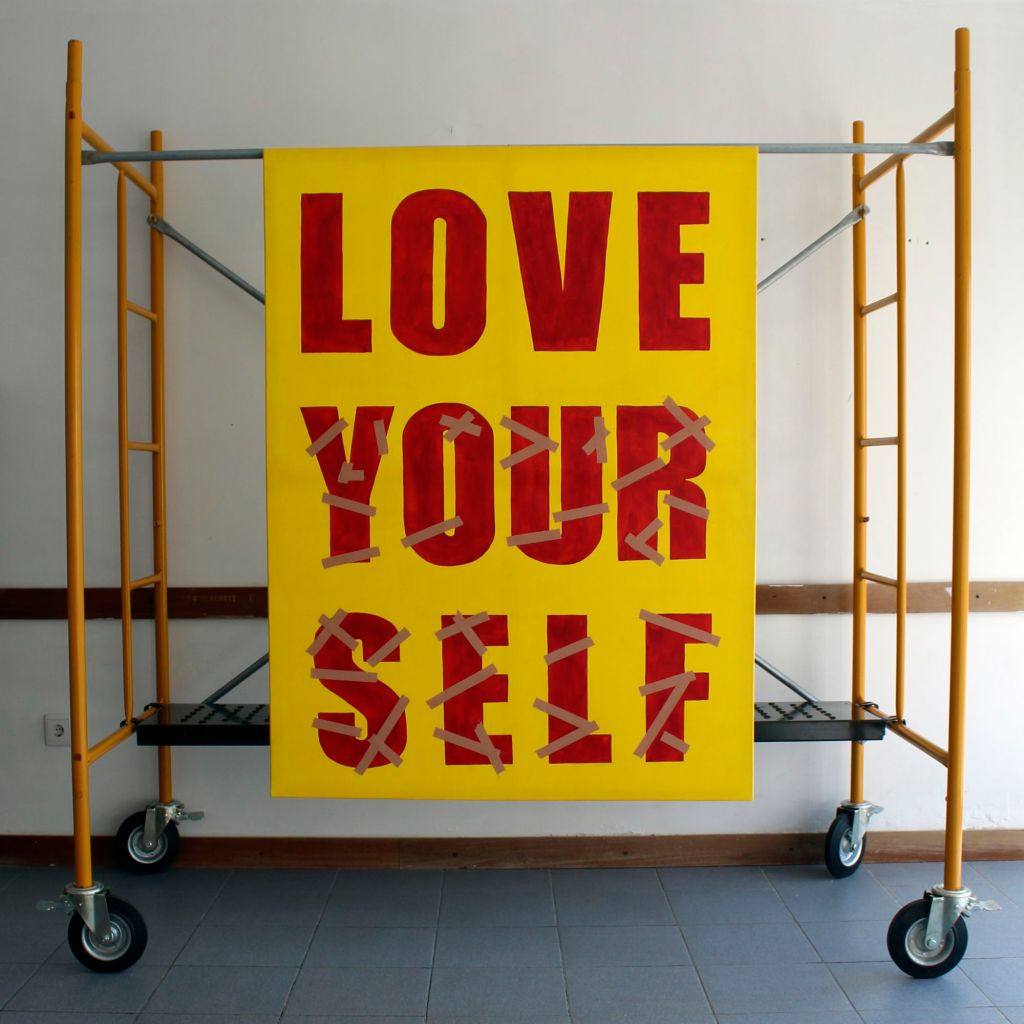
Five of the painting have words, slogans, phrases. Some like Love Your Self easily recognisable. Others are your making, and O Inferno São os Outros (Hell is Other People) a Jean-Paul Sartre quote. The two last words of Love Your Self have masked tape on it, as if bandaid, bandages, fissures. What is the meaning of the masked tape? Are other people really hell?
The tape is a literal gesture of mending. I wanted it to be visible that self-love is neither clean nor perfect. There are fissures, scars, patches. It is a process of piecing oneself together, rebuilding. Regarding Sartre: I did not use the phrase as an absolute statement. For me, “others” are also mirrors, challenges.
The phrase is there to provoke reflection on the relationship between the self and the collective. I do not believe that people are necessarily hell; I believe that encounters with others are always transformative, and sometimes painful.
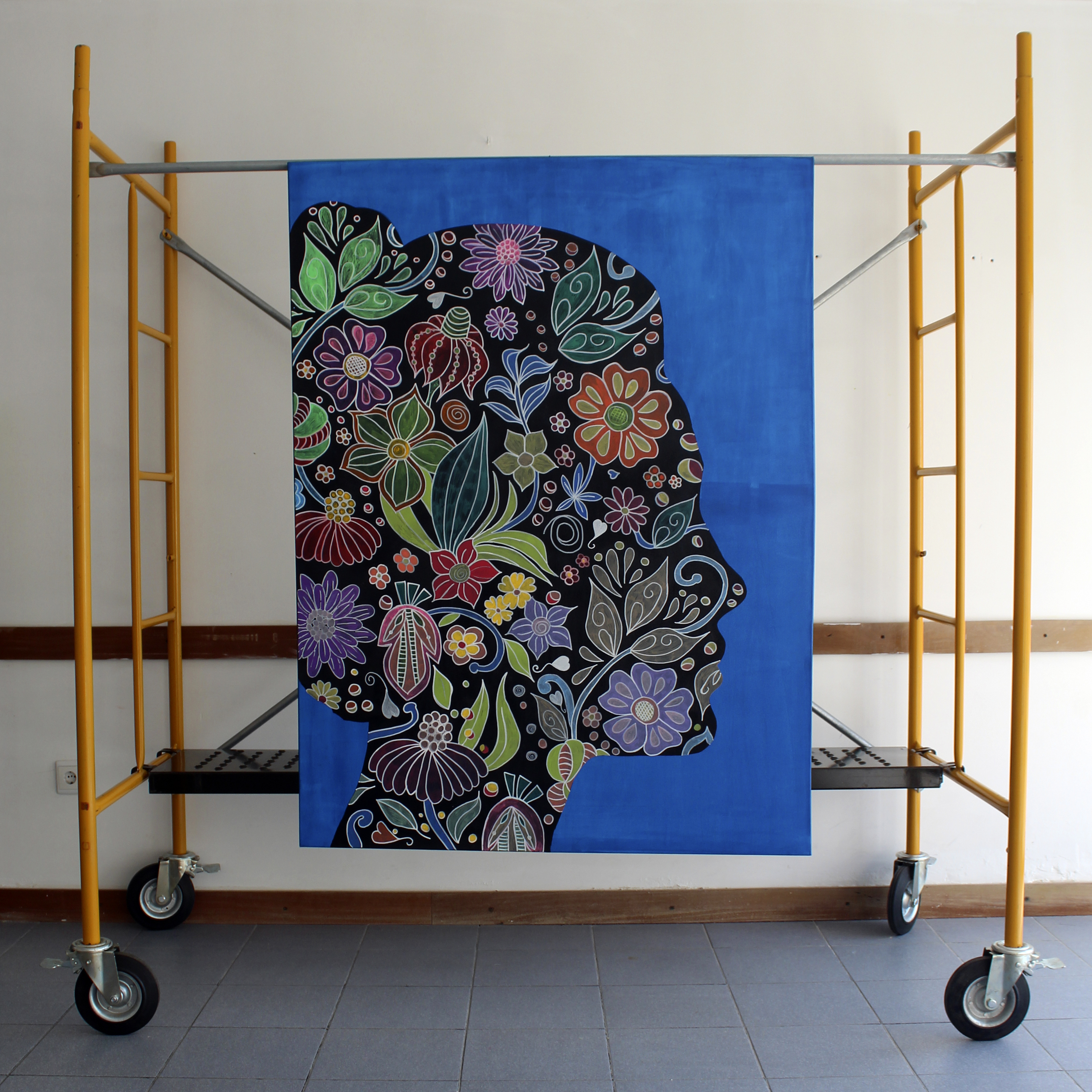
The head and upper neck in inside with it’s plants motifs and the way they give texture to the portrait remind me the paintings of Giuseppe Arcimbold. Was he an inspiration for the painting? Do you like and connect with his art works?
I didn’t think directly of Arcimboldo while painting, but I understand the association. He constructs faces from natural elements — fruits, flowers, objects — and in my case, the head filled with floral elements also speaks to that fusion of interior and exterior. I like the idea that we are made of layers and of nature, of chaos and order.
I also see echoes of contemporary artists such as Tracey Emin, Jenny Holzer, or Kara Walker, through the use of words, silhouettes, and vulnerability. This mixture is very important to me.
You said “Pintei para libertar — mesmo quando não sabia de quê.” (“I painted to to release – even when I didn’t knew from what”). What lead you to that release urgency? How did it transmuted into the paintings?
The painting emerged without plan or strategy. I believed I was going to do another type of work, but the body brought this. It is the result of past experiences and a process of personal evolution. Painting became the most direct way to record that inner movement.
Each canvas was a space where I could release excess, confusion, memories, desires. When I finished, I realised it was an organised emotional catharsis in nine windows. Today, looking at the series, I see a journey – an echo of my interior at that moment.

* Phrases on the Paintings in Juliana’s own Words:
In the S03Ep02 series there are nine paintings. Five of them contain words or phrases; some are my own creations, others come from authors I admire.
- “LOVE YOURSELF” – my own creation; the masking tape on the last words reinforces the idea of fissures, scars, and reconstruction.
- “My story is different and begins now. I am always beginning” – by the Portuguese writer Adília Lopes.
- “BREATH” – created by me, in a work that addresses overload, exhaustion, and the need to breathe.
- “EVERYTHING” -repetition created by me, associated with the idea of fullness, intensity, and childhood.
- “Hell is other people” – by Jean-Paul Sartre, from the play No Exit (Huis Clos).
- “They leave a little of themselves, they take a little of us” – by Antoine de Saint-Exupéry, from The Little Prince.
- “Were it not for this it would be less, were it not for so much it would be almost” – by Paulo Leminski.

Juliana Ferreira Reflections on S03Ep02 and Her Work.
The large-format canvases (120×160 cm) emerged because I feel that each painting is a space one can enter. By working on an almost bodily scale, I create a physical relationship with the work — it’s a size that compels me to paint with my whole body, not just my hand. This physicality is part of the cathartic process that gave rise to the series.
In S03Ep02, the phrases are not captions for the image. They are part of it. Sometimes the word came first, sometimes later; but they have always functioned as an echo of what was happening within me. I like to create tension between text and image — a practice that dialogues both with conceptual art and with pop culture.
When I named the series, I realised it resembled the code of a TV series episode. That fits because each painting is an episode within the same emotional arc. It is also a way to avoid dramatic titles and allow viewers to project their own narratives. It is a title born from within, slightly ironic and intimate — a kind of code illustrating my current phase.
Although I paint physical canvases, pop culture is present: in the saturated colours, the short phrases, the graphic elements. It is a contemporary language that engages with social media, advertising slogans, and pop music. By bringing it into a large-scale painting, I also question the boundaries between high art and popular culture.
I feel an affinity with artists who use text or the body as material — Tracey Emin and Jenny Holzer for their confessional or incisive use of words, Basquiat for the graphic rhythm and intensity of colour. In two paintings, the filling of the head with natural elements inevitably recalls Arcimboldo, but this reference arises more as a coincidence of language than as an explicit homage.
I do not expect viewers to find answers. I hope they recognise themselves in the fissures, the colours, the phrases. That they take away the sense that they, too, can repair themselves, piece themselves together, breathe. S03Ep02 is a series about what remains after the storm — and perhaps it can serve as a mirror or a refuge.

The series was born from an intense personal process. It was not conceived as an exhibition. I painted to release — even without knowing precisely what. Today I realise that each painting is a window into that journey and, at the same time, a space for others to project their own stories.
This series closed one cycle and opened another. I am exploring new supports and processes, while maintaining the idea of word and image as a single gesture. I like to think of each series as a season: I do not know what the next will be, but I know it will emerge from the same sincere place.
S03Ep02 exhibition calendar:
2025:
Sep – Oct: Centro de Artes, Vila Nova de Paiva
03 Nov – 31 Dez: Biblioteca Municipal, Viseu
2026:
09 Jan – 27 Fev: TBA, Régua
06 Mar – 30 Apr: Museu Municipal, Oliveira de Frades
01 – 30 May: TBA, Mangualde
01 Jun – 31 Jul: Estúdio N16, Torredeita
Ago: TBD
Sep – Oct : TBD
06 Nob – 31 Dec: TBA, Galiza, Spain

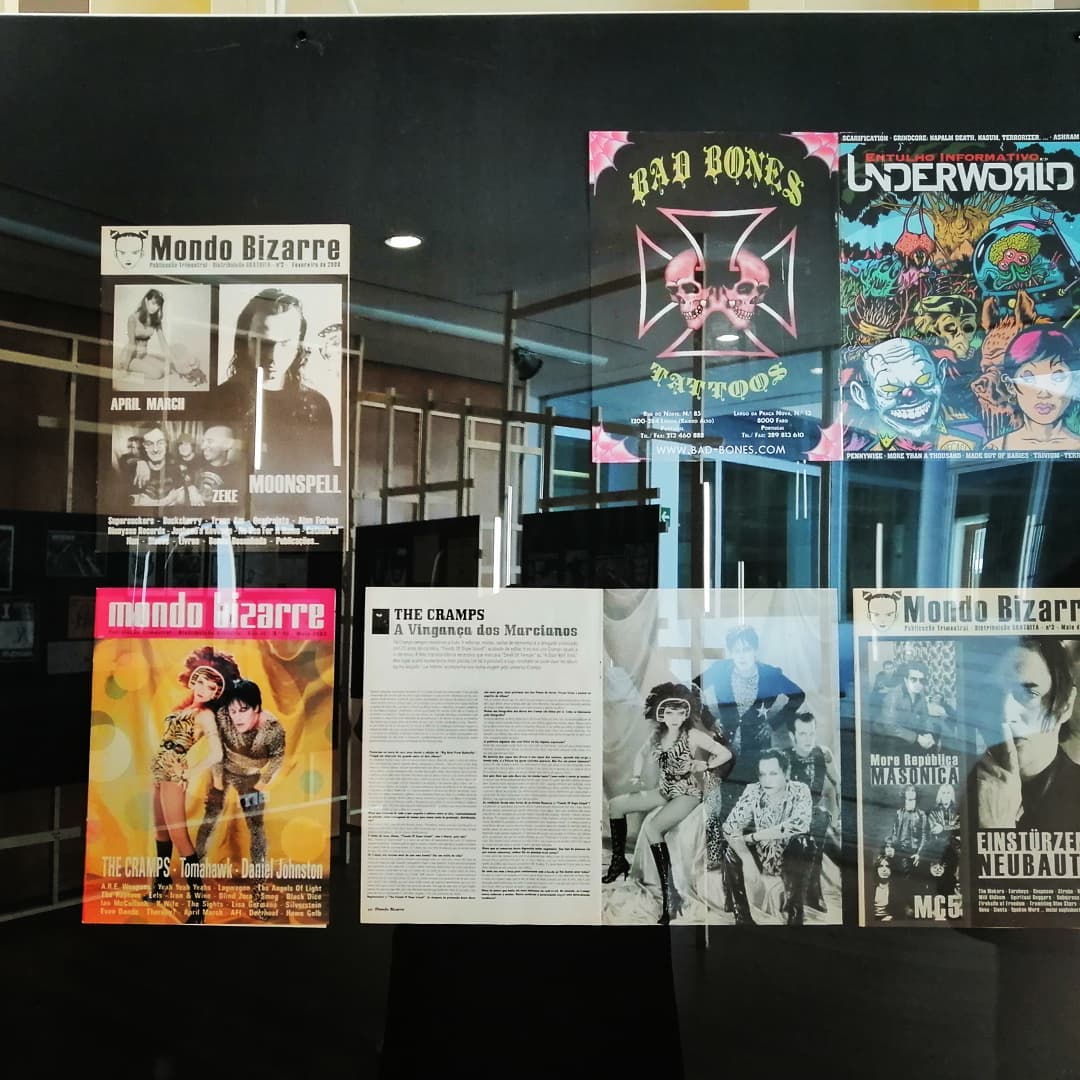





 Mondo Bizarre Magazine