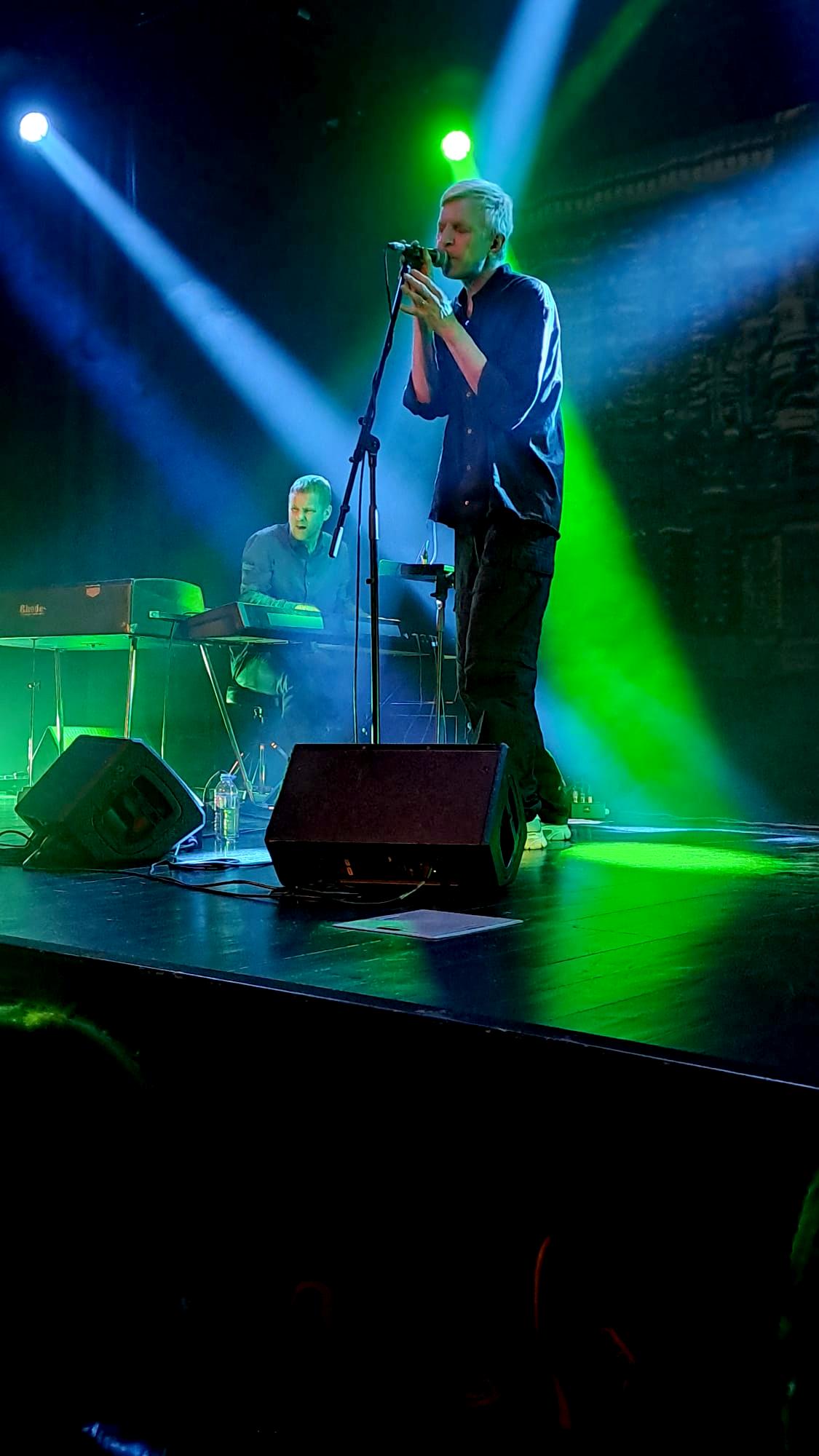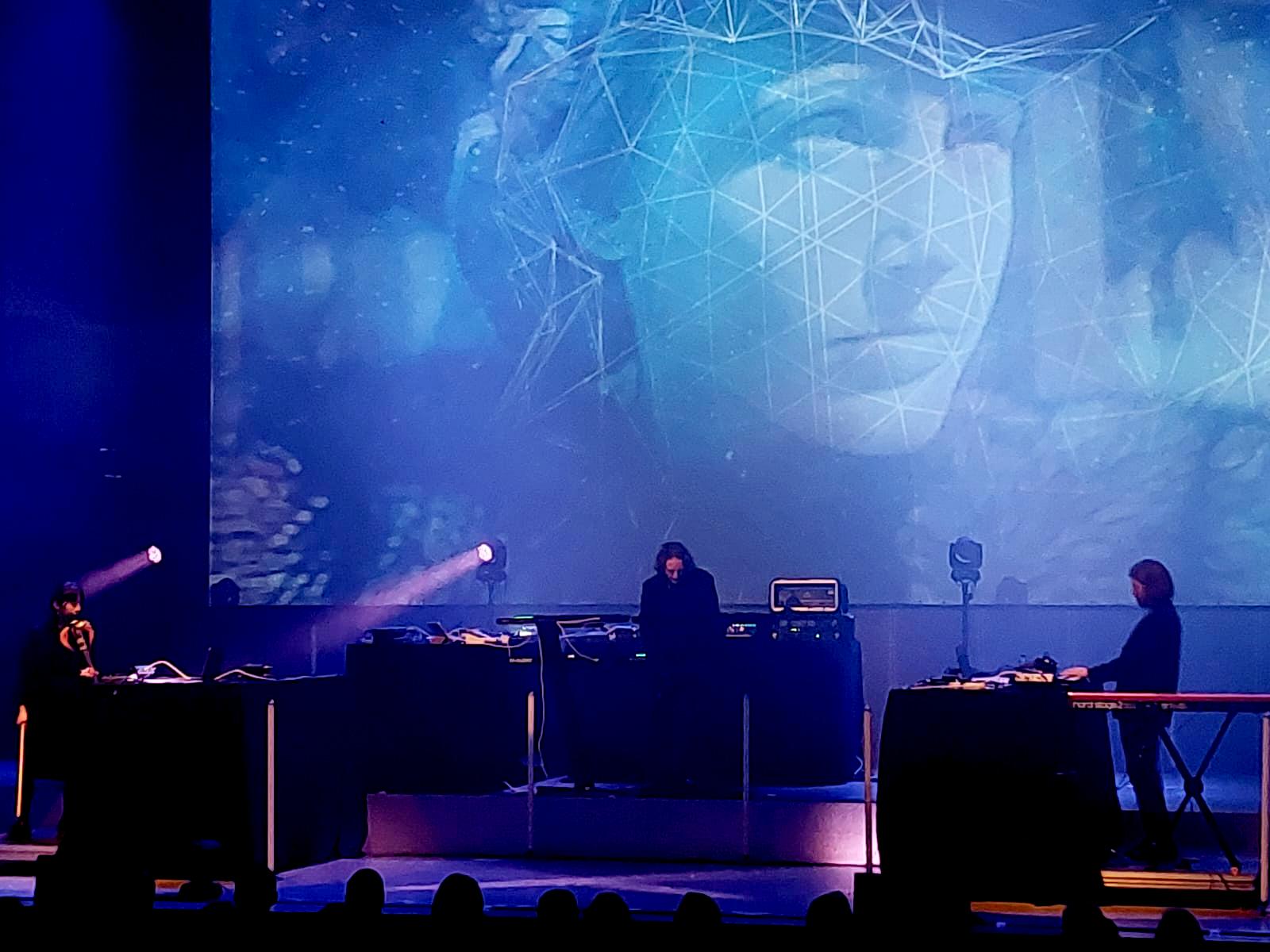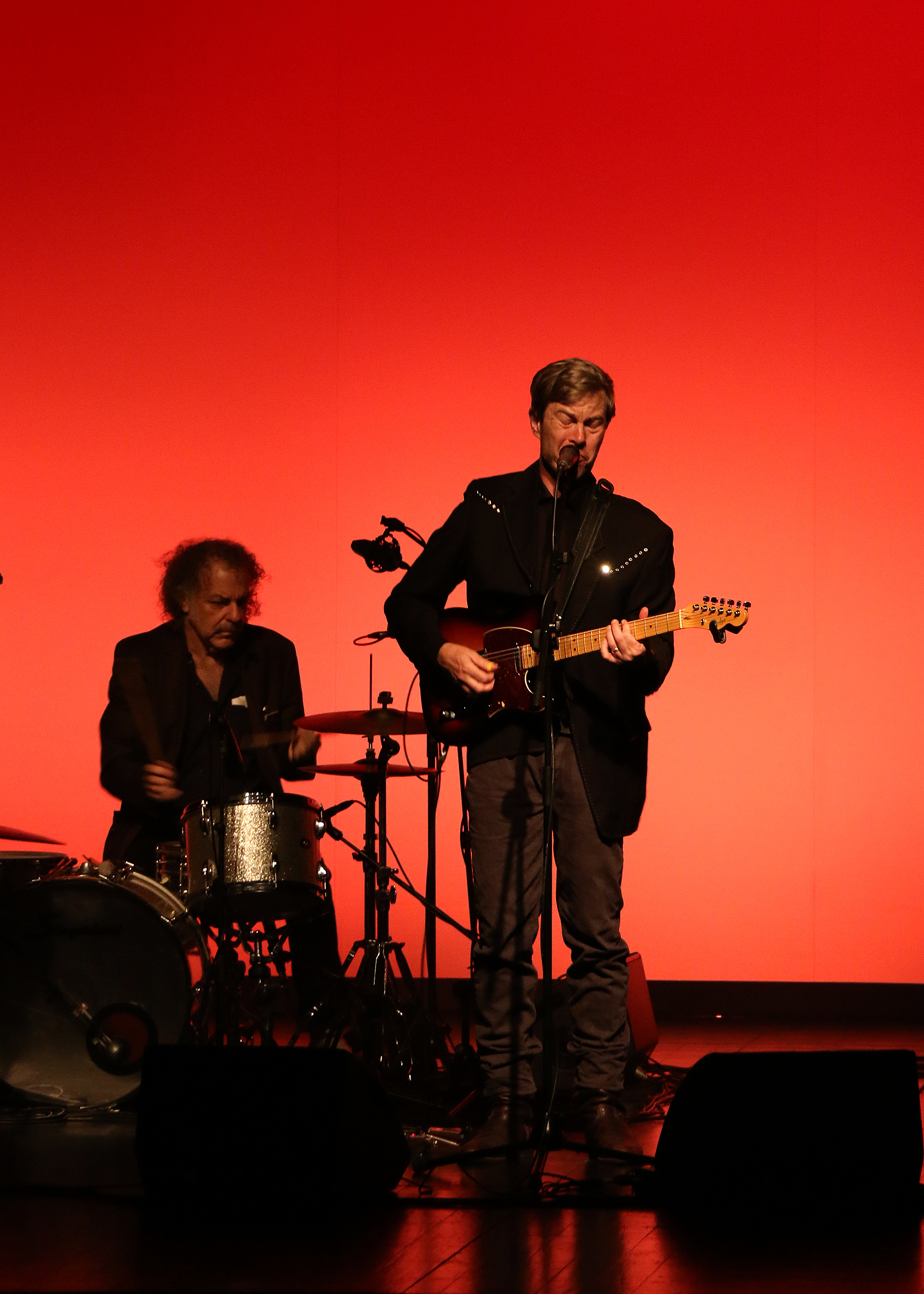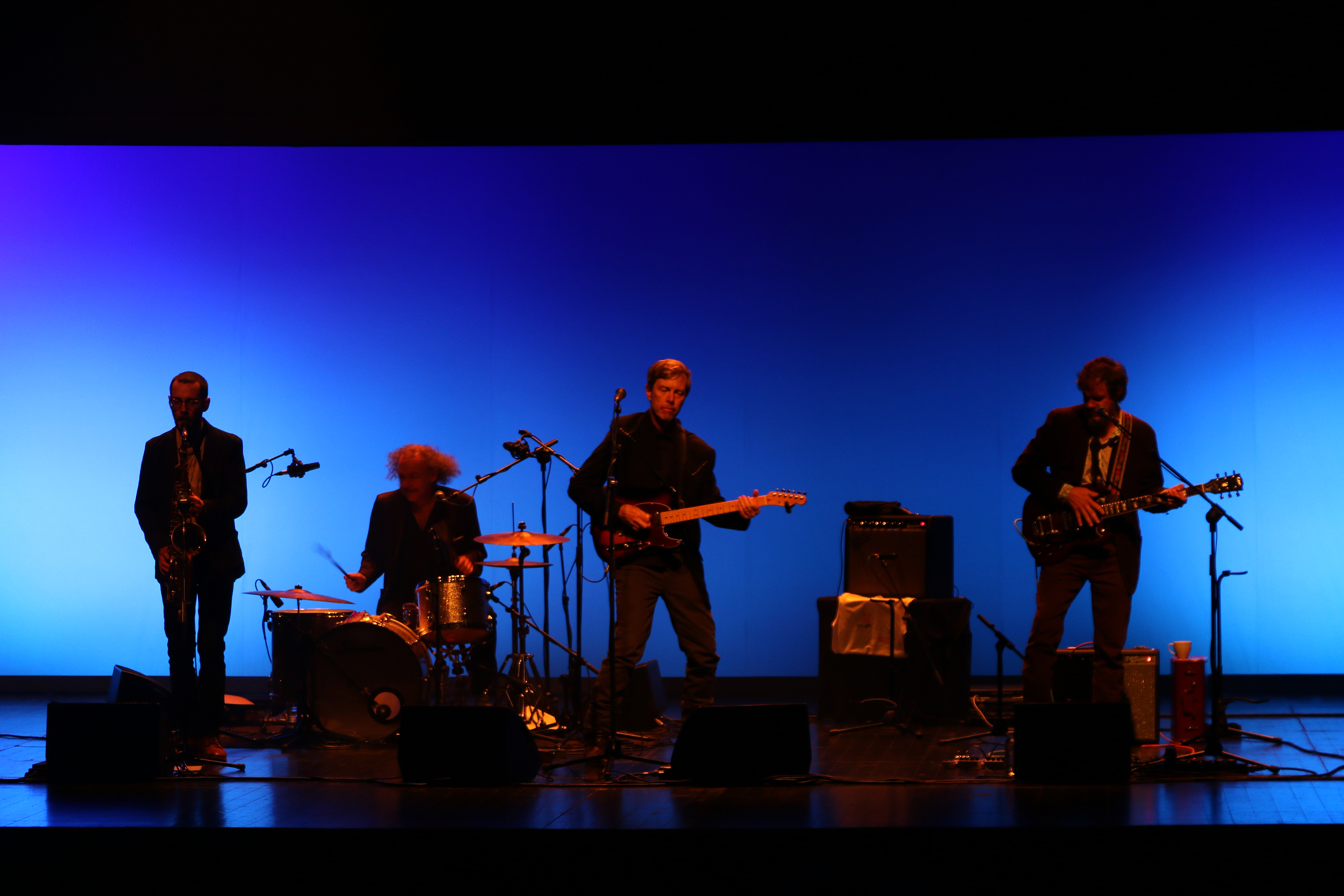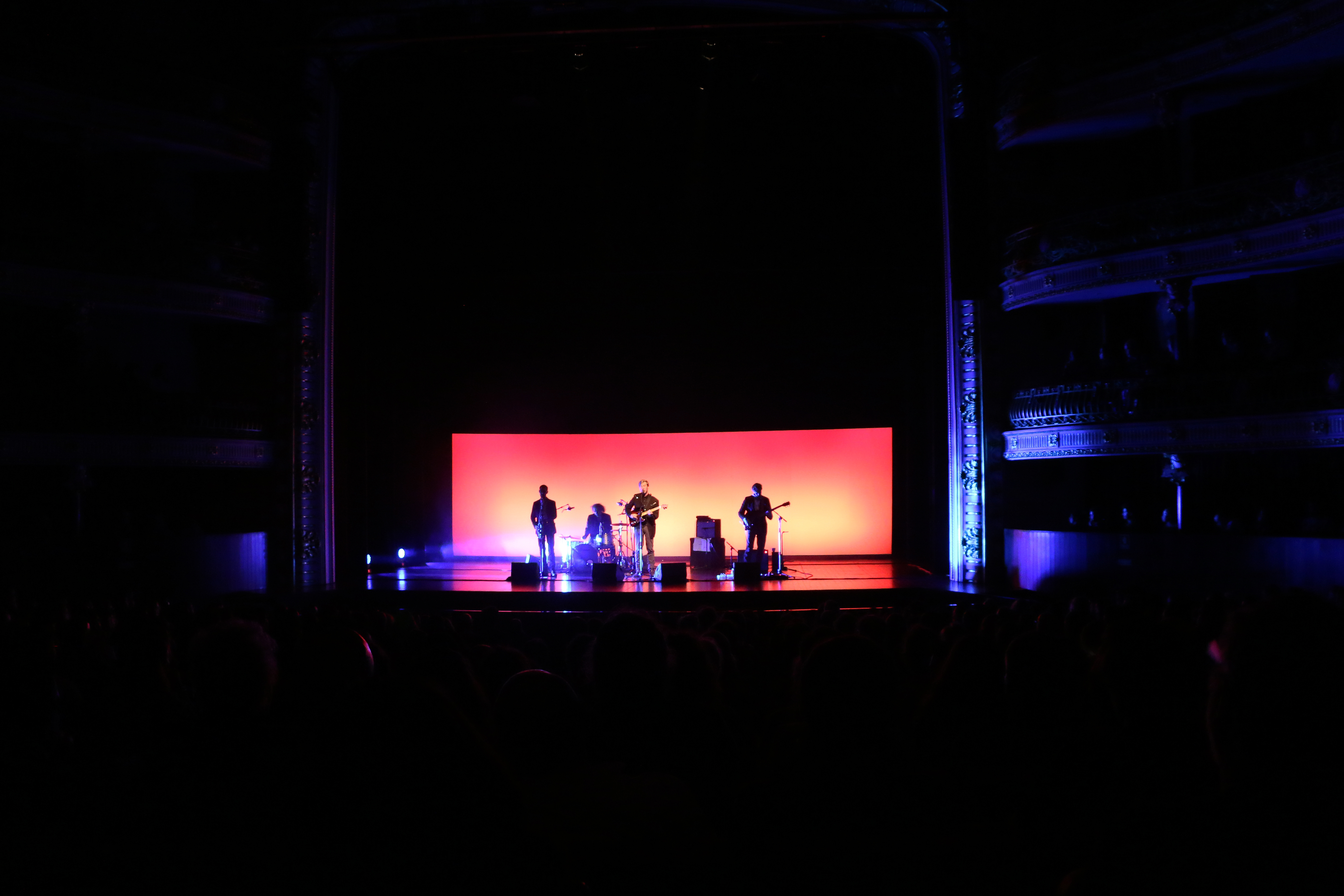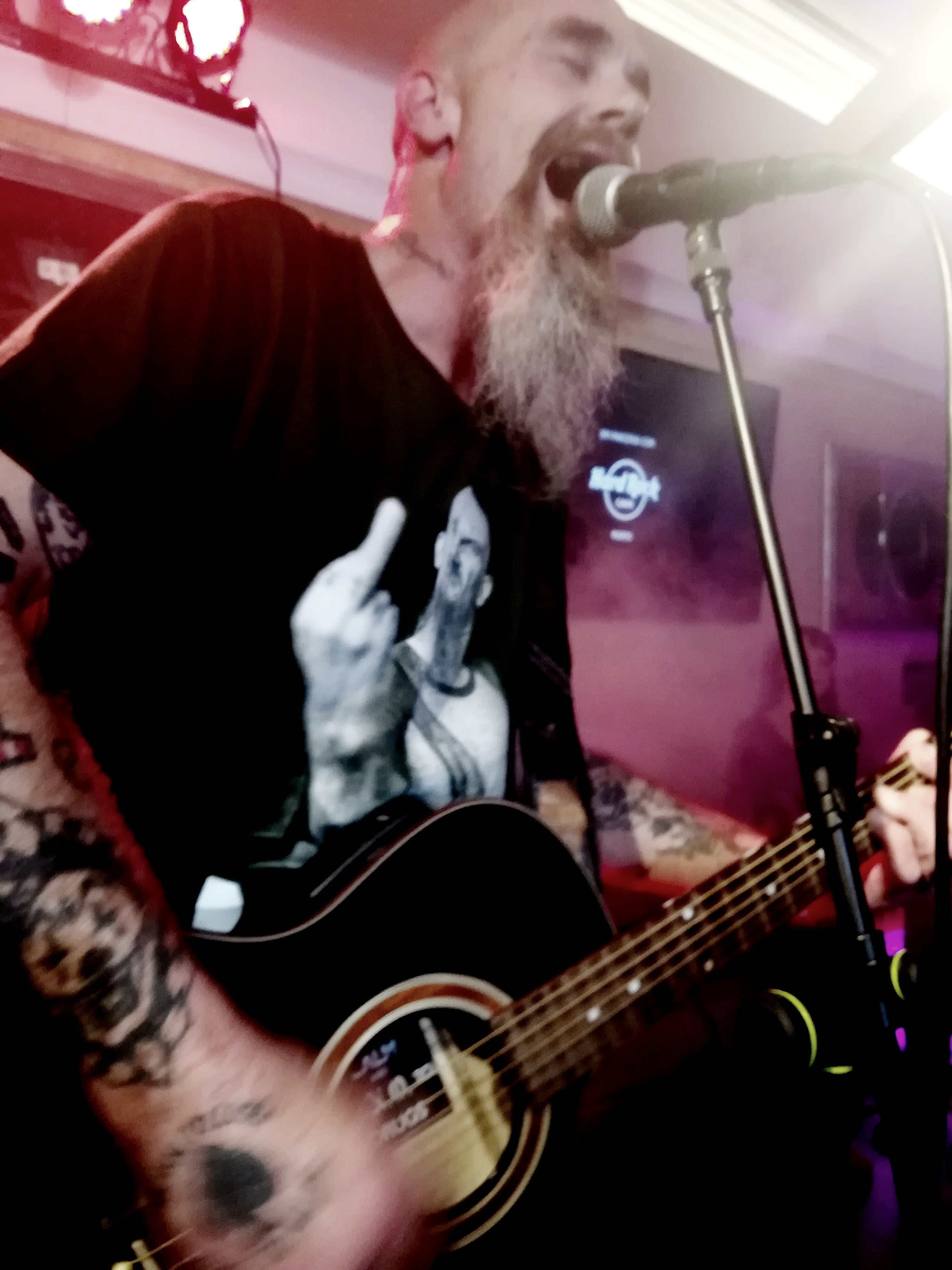
There are front row seats and then there is from row standing by the stage, almost upon it, with Nick Oliveri a few centimeters from you. Or crouched, leaning against the stage monitor that happens to be on the floor. Either way, surrounded by fellow concert goers, gathered in a semi-circle, all going with the flow (pun intended). Flow, in your face, straightforward, energetic, speed up, semi-calmness interrupted by loud, abrupt screams or a shouting shortly broken by some mellowness are some ways of describing Nick Oliveri’s concert at Hard Rock Cafe in Porto.
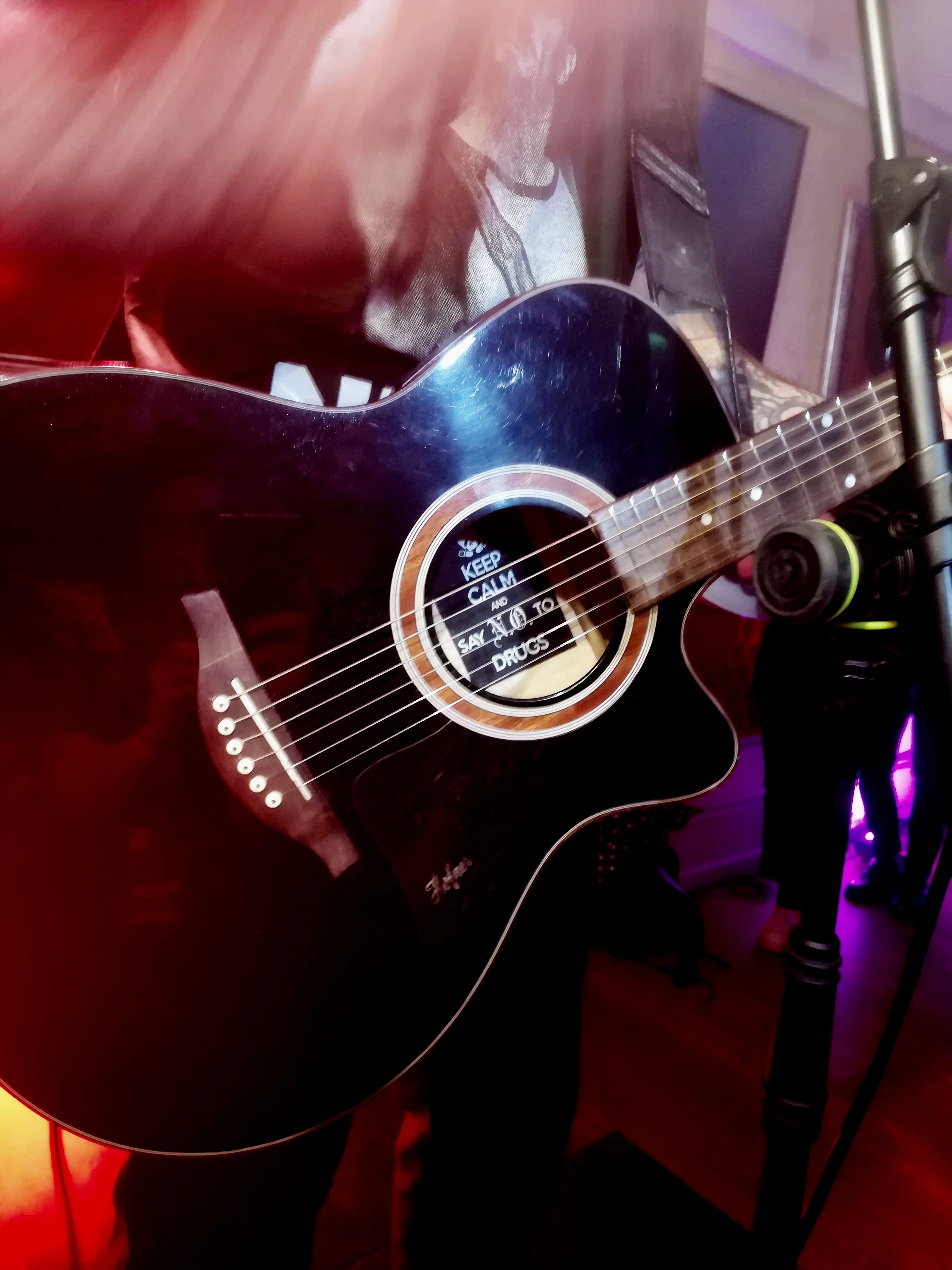
It is Nick, dressed in black trousers and trainers and dark green t-shirt with a Nick giving a middle finger salute, an acoustic-electric guitar, a microphone, a raspy voice, and us. There are no barriers, no middle-men. We’re there, absorbing the rawness, feeling the sway of the floor boards, our jumpiness and singing along, dancing, grooving as on full gear as the man on stage. It’s a give and take from both sides, feeding from each other energy.
From Kuyuss’ Green Machiche till the end of the encore, Nick’s head, forehead and guitar become increasingly wet and sweaty, glittering water lines running down the black wood body. Between beginning and end there are Kuyss, Mondo Generator, Queens of the Stone Age songs, and boy do those songs rock the boat and throw us for a loop. Oliveri’s delivery is fearless, down to earth, to the heights of true punkness veering into daredevilness, or totally diving into it. At a point, my notebook gets a spit, or was it a drop of sweat? Both?
By Feel Good Hit of The Summer we’re loud singing and screaming the hallucinated acceleration of Nicotine, Valium, Vicodin, marijuana, ecstasy and alcohol in a maniacal crescendo, then Nick picks it up, but we’re back to those words Nicotine, Valium, Vicodin, marijuana, ecstasy and alcohol that if the vice squad was around would have lead to an interesting evening. The floor seems to want to give, will there be a stage invasion? Not really, but we’re closer to the stage if such thing is possible since we’re pretty much clued to it.
But before we got there we had been through the night’s moving moment, the heartfelt and out-there-hello-psychedelia rendition of Nick and us singing Auto Pilot, us kind of being the spirit of Mark Lanegan to whom Oliveri dedicated the song both used to sang on Queens of the Stone Age.
The leave, lost and broken love songs Gonna Leave You and Another Love Song, also part of the menu, retained their directness. We sang more, Nick sang more too, and loud, and loud we too were, played on fire, fast and furious. As the end approached it all got rather explosive with the cover of G.G.Allin’s Outlaw Scumfuc. Roky Ericson’s Bloody Hammer, dedicated to Ricardo, from Sonic Blast was another shot of intensity. As it was the final Nick & Mick (as in microphone) frantic incantation and incarnation of the banshees leaving everyone breathless.
words: Paulo Carmona (freely translated by Raquel Pinheiro); photos: Paulo Carmona
In a cool April spring night the crows and blackbirds arranged a meeting which was also attended by white doves and hummingbirds.
What? Well, that’s right! Just as many see only grey shadows and melancholy in Matt Elliott’s songs, many others must feel what I felt last Saturday at Mouco. Among of all the dark musical semblance loaded with sarcasm, pain and loss, there are soft, slightly perfumed and bittersweet breezes passing by that, in a way, make everything lighter. Beauty appears between the shadows giving them some colour. Not much, not much, but enough to slightly warm souls. Like a paradox. Aren’t there people who order coffee in a cold cup? There you go.
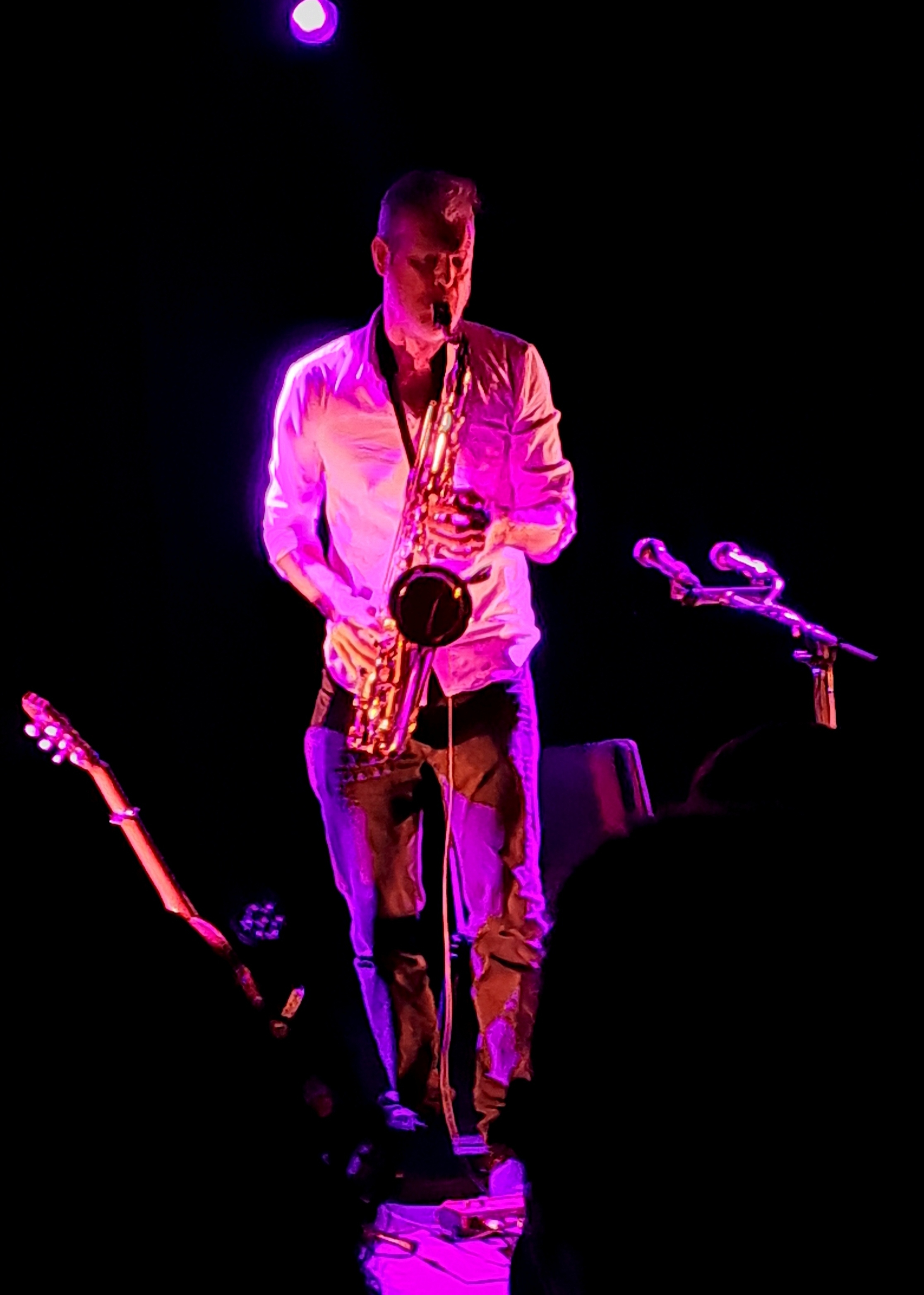
It all begins with a sketch of a solitary instrument, be it the folk guitar or the saxophone that complains to itself about its bad luck. Then it stays in a minimalist loop waiting for the following instrument to fill in the loose spaces of the music left adrift. And stays there jumping between the folk guitar and the sax and the sax and folk guitar, from where that dark and serious voice appears. But, of course, it doesn’t end there. Matt knows how to adorn the thing. If he does know, my friends. Supported by the diaphragm, he lets out screams as a lament and delirious verses in medium tones. And the guitar cries happily. Sometimes it’s flamenco, sometimes dark folk and classic. From time to time, a guitar distortion prolonged in space and time shows up, all very well executed. In The Day After That and Flowers for Bea it seems that we are wandering around in pencil drawings of an animation by Tim Burton.
Matt Elliott knows how to thank the surrendered crowd. He is affable with his audience and berates himself for talking too much. He also went as far as to apologize to future generations for his generation’s environmental blunders. There are laughs and smiles in the room because it’s funny, then back to the beginning. At the end Matt makes a cordial farewell with a bow and a farewell wave. The man is a sharp and scathing troubadour, pained and incisive, but also friendly and a gentleman. Just as I like it.
It’s past eleven and the night is cool. I am appeased with everything around me. I turn my coat’s collar up, put my hands in my pockets and count the cobblestones.
Os corvos e os melros marcaram um encontro, ao qual também compareceram pombas brancas e beija-flores na noite fresca deste Abril de Primavera.
O quê? Pois, é mesmo isso! Lá porque muitos só vêm sombras cinzentas e melancolia nas canções de Matt Elliott, muitos outros deverão sentir o que eu senti no passado Sábado no Mouco. No meio de todo aquele semblante musical sombrio carregado de sarcasmo, dor e perda, há brisas suaves, levemente perfumadas e agridoces que por ali passam e que, de um certo modo, tornam tudo mais leve. O belo surge por entre as sombras a dar-lhes um pouco de cor. Não muita, não muita, mas o suficiente para aquecer ao de leve as almas. A jeito de paradoxo, não há quem peça café em chávena fria? Então.
Tudo começa num esboço de um instrumento solitário que se queixa sozinho da sua má sorte, seja ele a guitarra folk ou o saxofone. Depois fica em loop minimalista à espera do instrumente que se segue e que vai preenchendo os espaços soltos da música deixada à deriva. E fica ali a saltitar entre viola e sax e sax e viola, de onde aparece aquela voz soturna e grave. Mas é claro que não se fica por ali. Ele sabe adornar a coisa. Se sabe, meus amigos. Apoiado no diafragma solta gritos em forma de lamento e versos delirantes em tons médios. E a guitarra chora alegremente. Às vezes é flamengo, outras folk escurinho e clássico. De quando em vez, aparece uma distorção de guitarra prolongada no espaço e no tempo. Tudo muito bem executado. Em The Day After That e Flowers for Bea, parece que andamos a deambular em desenhos a lápis de uma qualquer animação de Tim Burton.
Matt Elliott sabe agradecer às hostes rendidas. É afável com o seu público e auto repreende-se por falar de mais. Também chegou a pedir desculpa às gerações vindouras pelas asneiras ambientais da sua geração. Há risos e sorrisos na sala, porque é engraçado, mas depois volta tudo ao início. No final despede-se cordialmente com vénia e acenos de despedida. O homem é um trovador agudo e mordaz, dorido e incisivo, mas também simpático e um gentleman. Como eu gosto.
Passa das onze e a noite é fresca. Estou apaziguado com tudo o que me rodeia. Levanto a gola do casaco, meto as mãos nos bolsos e conto as pedras da calçada.
words & photos: João Vilares; editing: Raquel Pinheiro
More than two years since her last performance in Braga, Lucrecia Dalt landed again in gnration for the beginning of the 10th anniversary celebrations of the venue. In her suitcase the Colombian artist brought us ¡Ay!, her last album in which she makes an unlikely mix of classic South American genres with electronic experimentalism.
¡Ay!is the story of an extra-terrestrial entity, Preta, that arrives on our planet and challenges the conceptions of temporality, embodiment and the discovery of love, clearly inspired by Nicolas Roeg’s film The Man Who Fell To Earth (1976).
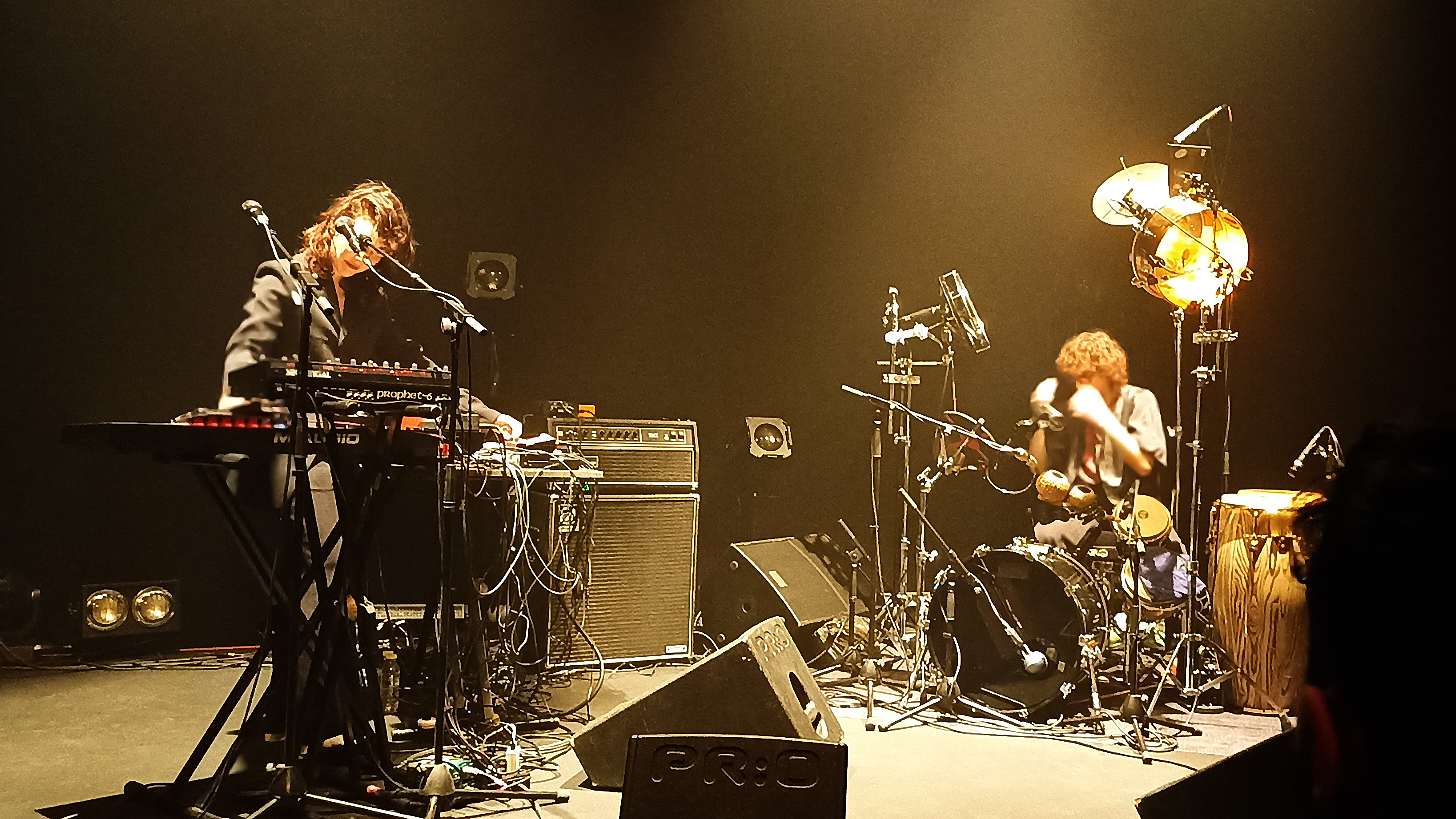
Accompanied by percussionist Alex Lazaro who Lucrecia describes as “an alien salsero who plays percussion like nobody’s business,”. The Berlin-based artist teleported us into a sci-fi universe where the sensuality of salsa, bolero or other genres acquire different textures mixed with the distortion and apparent dissonance of Dalt’s experimental mastery.
Lucrecia Dalt confessed that this is her favorite concert hall. Even if not totally true, gnration is certainly a place that consistently provides a quality programming of experimental music projects such as the present concert. It was her second time here and by the reaction of the audience no one left the room disappointed.
It is uncommon to be “welcomed” by one of the protagonists of the night at the merchandise stall. Owen Pallett was distributing shy smiles among records and t-shirts, hinting that the first half of the show would certainly be Joel Gibb’s responsibility.
With gnration’s Black Box full, the Berlin-based Canadian artist entered the stage, shortly after 10 pm. With just a guitar, a double-mic and a bass drum, Gibb took us on a journey, lasting over an hour, through some of the main themes of The Hidden Cameras’ church gay folk, like Bread For Brat, Ban Marriage, Redemption, Smells Like Happiness, Freedom, A Miracle, Breathe On It, or the electronica of Origin: Orphan. In between, there was still time for an Instagram moment with the crowd chorusing Awoo.
On Joel Gibb’s debut in Portugal, also unsurprisingly, in this more intimate one-man-show format, Owen Pallett joined him for a large part of the performance, but that did not affect the provocative intensity of the lyrics and the celebratory power of the sexual freedom with which The Hidden Cameras marked the Toronto music scene at the beginning of the century.
The night was only halfway through when Gibb lefted and the stage was exclusively dedicated to the music of Owen Palllett. The violinist, composer and producer brought us “a couple of depressing songs from the last album” (Islands, 2020), such as Lewis Gets Fucked Into Space or Fire-Mare.
Good-humored while tuning the guitar (clearly not his instrument of choice: “Guitar is a boring instrument.”) and following the same celebratory tone of the night, Pallet offered us a retrospective of his solo career since Has a Good Home”(2005) through He Poos Clouds (2006) and In Conflict (2014) before ending with a rock version of Lewis Takes Off His Shirt from Heartland (2010).
Owen Pallett and Joel Gibb would return for the encore with We Oh We from the Hidden Cameras album Mississauga Goddam (2004). The words “All I want is to be under his covers and not just be a time from Yesterday” summon up a concert that celebrated the past with a gaze into the future.
words Neno Costa (freely translated by Raquel Pinheiro); photos: Telma Mota
And Also The Trees performance began with the first chords of In A Bed In Yugoslavia jumping in the air an hypnotic invitation to a journey with several stops ialong the vast discography the band’s return to the stage on the Hard Club, in Porto, to the satisfaction of the audience that filled the room.
Captivated the audience with the recurrent opening on this tour, from their last album The Bone Craver (2022), the British quintet crossed over to Beyond Action and Reaction, with Grant Gordon’s bass, slow, with a doom tune to merge with Justin Jones’ guitar trill, lending to an exotic spice upon which Simon Jones’ languid voice evolved. Your Guess (Born Into the Waves, 2016) extended a certain atmospheric singularity from the initial lineup, from the last work, to other well-interpreted revisitations, flowing between temperance and rhythmic explosion.
Maps In Her Wrists And Arms and The Suffering Of The Stream followed with the undisguised neo-romantic black and melancholic aroma conveyed by Simon Jones’s impenetrable performance, in poetic prayer. The Book Burners, from their latest album, refreshed the landscape with a certain Balkan cabaret tone in a folk jazz link between Colin Ozanne’s clarinet and Justin Jones’ guitar. The themes flowed generously in a cohesive and intense interpretation, without blemish. A stage performance that was a certificate of vitality perfected by time.
A atuação iniciou com os primeiros acordes de In A Bed In Yugoslavia saltitando no ar, num convite hipnótico para uma viagem com várias paragens na muito vasta discografia dos And Also The Trees, regressados ao palco do Hard Club, no Porto, para satisfação do público que encheu a sala.
Cativada a audiência com a abertura recorrente nesta digressão, do seu último álbumThe Bone Craver (2022), o quinteto britânico fez a passagem para Beyond Action and Reaction, com o baixo de Grant Gordon, lento, com uma toada doom a fundir-se no trinado da guitarra de Justin Jones, emprestando um tempero exótico sobre o qual evoluiu a voz lânguida de Simon Jones. Your Guess (Born Into the Waves, 2016) prolongou uma certa singularidade atmosférica do alinhamento inicial, do último trabalho, para outras revisitações bem interpretadas, fluindo entre a temperança e a explosão rítmica.
Sucederam-se Maps In Her Wrists And Arms, The Suffering Of The Stream, com o indisfarçável aroma neo-romântico, negro e melancólico transportado pela atuação compenetrada, em oração poética, de Simon Jones. The Book Burners, do seu último trabalho, refrescou a paisagem com um certo tom de cabaret balcânico, num enlace folk jazz entre o clarinete de Colin Ozanne e a guitarra de Justin Jones. Os temas fluíram, generosos, numa interpretação coesa e intensa, sem mácula, num desempenho em palco que foi um certificado de vitalidade, que o tempo tem apurado.
words: Neno Costa (freely translated by Raquel Pinheiro); photos: Telma Mota
With a sold out box office the opening act was served by Robin Thomson, founder of the Twin Sons project. The glamorous lo-fi sound of the Berlin based Scottish musician revealed a multifaceted composer and performer, with an engaging voice and captivating soundscapes, evolving with well-seasoned guitar chords where the best references echo. Note for Can You Feel It as an introduction to closer listening by this musician who accompanies Michelle Gurevich on guitar.
Michelle Gurevich had an auspicious debut in Portugal in a room filled with an audience for whom this Canadian of Russian origin was not at all unknown. “Why did it took me so long to come here?” asks Michelle after starting with First Six Months Of Lov , a song with a Cohenian flavour, from the album New Decadence (2016). On a pre-recorded background sewn with Robin Thomson’s creative guitar, Michelle Gurevich captivated the audience with her ballads wrapped in the discreet theatricality of a non-diva diva, covering several titles from her six albums produced since 2006, such as: Vacation From Love, Party Girl, Aviva, Drugs Saved My Life, Mrs Robinson or her latest single Goodbye My Ditactor, whose sender seems to be a certain Vladimir.
Michelle Gurevich carries a well-resolved set of references, offering her own sound in lo-fi pop territory, which is not alien to her warm and engaging voice, supported by a solid and honest poetic construction, tempered by a certain tragicomedy of reality.
texto: Neno Costa (freely translated by Raquel Pinheiro); fotos: Telma Mota
Com a bilheteira esgotada, a primeira parte deste concerto foi servida pelo fundador do projeto Twin Sons, Robin Thomson. A sonoridade glamorosa lo-fi do músico escocês radicado em Berlim revelou um compositor e intérprete multifacetado, com uma voz envolvente e paisagens sonoras cativantes, evoluindo com acordes bem temperados de guitarra onde ecoam as melhores referências. Nota para “Can You Feel It” como introdução a audições mais atentas deste músico que acompanha na guitarra Michelle Gurevich.
Michelle Gurevich teve uma estreia auspiciosa em Portugal numa sala cheia de público para quem esta canadiana de origem russa não é, de todo, desconhecida. “Por que demorei tanto tempo a vir cá?”, pergunta depois da abertura com “First Six Months Of Love”, canção de sabor coheniano, do álbum New Decadence (2016). Sobre fundo pré-gravado costurado com a guitarra criativa de Robin Thomson, Michelle Gurevich cativou a assistência com as suas baladas envoltas em discreta teatralidade de diva não diva, percorrendo vários títulos dos seus seis álbuns produzidos desde 2006, tais como: Vacation From Love, Party Girl, Aviva, Drugs Saved My Life, Mrs Robinson ou o seu mais recente single Goodbye My Ditactor, cujo remetente parece ser um certo Vladimir.
Michelle Gurevich transporta um conjunto de referências bem resolvidas, oferecendo uma sonoridade própria em território pop lo-fi, à qual não é alheia a sua voz quente e envolvente, sustentada por uma construção poética sólida e honesta, temperada por uma certa tragicomédia da realidade.
words: Paulo Carmona (freely translated by Raquel Pinheiro); photos: Telma Mota
The most seasoned man in Porto had his birthday on the 28th of January and, as usual, he tried to do it with pomp and circumstance. From a cool, thematic, quaint and original celebration of years past, it turned into one more hell of a mess. If before, amidst smiles, greetings, sidelong glances and the likes one wandered from room to room, more or less calmly, today we moved with difficulty amid pushing, inevitable rubbing, insults, spilled beer, the smell of sweat and more or less less lawful aromas. However, also with peace of mind because the mood is celebratory. And it was all quite cute.
Let’s get down to business: the music and musical projects that were part of this year’s menu. And here I have to confess that it is completely impossible to cover all the performances decently, with deserving attention since concerts were taking place at the same time. I’m going to be a generalist and dwell a little more on some projects that I had the chance to savour more closely.
The aforementioned menu included: Paulo Cunha Martins, Tó Trips, Inês Malheiro, Clementine, Querido Lider, House Plants, Lefty, Travo, Sarnadas, Surma, O Gajo (The Guy) who did not caught covid last here (I did), The Black Wizards, Alex Silva, Ricardo Martins, Baleia Baleia Baleia, Otsoa, Kurtis Klaus Ensemble, A Boy Named Sue (records player) and on Mupi gallery, Azia. That is, a real Festival. Everyone gave their best contribution and from the lineup I highlight those I was able to see and hear more carefully given the circumstances.
I will start with Surma, Débora Umbelino’s project who presented herself as herself: irreverent, lascivious, among experimental electronics, at times minimalist, among samplers, frenetic guitars, distorted bass and unconventional instruments, song after song, always reinventing herself with a lot of grit and the attitude of someone who already does it for love and with lots of confidence. Very nice.
The Black Wizzard left me for dead. Okay, that’s it, pure and hard. They deliver Rock’n’Roll in such a powerful and electrifying way that puts any audience on alert. The nostalgic 70’s are impregnated in their melodies. Joana Brito’s voice, every now and then, reaches incredible notes, with a remarkable and consistent vocal range. The guitar is crazy, full of attitude, it breathes fire with grit and arrogance that will make any lover of the genre shiver. The bass is exuberant and super-competent, making bedding well with the drums while the guitar and the voice lie in a humid, agitated and adolescent dream. At times, reminding me of the Yeah Yeah Yeahs, other times of The Raconteurs. The first ones for the vocalizations, the second ones for the competent syncopes, starts and sound daydreams. An excellent surprise.
Baleia Baleia Baleia are beyond crazy every day. Which is good. Very good. Drums and vocals, Bass and vocals … and that’s it! Then it’s hearing and seeing all that. Yes, because it is to be seen. There are bands like this. It’s licking wounds from beginning to end of their performance. Of course there was first class pogo, slam and mosh. How not to? It seems that they are always ready to party and it inevitably happened. Punk, garage; power pop and everything you want to put on a pizza with an irreverent flavor.
Then it was over for some. For others the night carried on into another memorable night in Porto with a rhythmic base. Salgado!, mate, keep having a birthday!
O homem mais bem temperado do Porto fez anos no passado dia 28 de Janeiro e, como é habitual, tratou de o fazer com pompa e circunstância. De uma comemoração bacana, temática, catita e original de outros anos, passou a ser isso tudo, mais uma confusão do caraças. Se dantes entre sorrisos, cumprimentos, olhares de soslaio e afins, se ia deambulando de sala em sala, mais ao menos tranquilamente, hoje movemo-nos com dificuldade entre empurrões, roço inevitável, impropérios, cerveja entornada, cheiro a suor e aromas mais ou menos lícitos. Mas também com tranquilidade pois o estado de espírito é de festa. E foi tudo muito giro.
Mas vamos ao que interessa. A música e os projetos musicais que faziam parte do cardápio deste ano. E aqui tenho de confessar que é de todo impossível cobrir decentemente todas as atuações, com a atenção que todas merecem uma vez que os concertos decorriam ao mesmo tempo. Vou ser generalista e deter-me um pouco mais em alguns projetos que tive hipótese de degustar com mais atenção.
Do supracitado cardápio faziam parte: Paulo Cunha Martins; Tó Trips; Inês Malheiro; Clementine; Querido Lider; House Plants; Lefty; Travo; Sarnadas; Surma; O Gajo que não apanhou covid o ano passado (eu apanhei); The Black Wizards; Alex Silva; Ricardo Martins; Baleia Baleia Baleia; Otsoa; Kurtis Klaus Ensemble; A boy Named Sue (Bota discos) e no Mupi gallery, Azia. Ou seja, um verdadeiro Festival. Todos deram o seu melhor contributo e deste alinhamento destaco o que me foi possível ver e ouvir com mais atenção, dadas as circunstâncias.
Começo por Surma, projeto de Débora Umbelino que se apresentou igual a sí própria: irreverente, lasciva, entre uma eletrónica experimental, ás vezes minimalista, entre samplers, guitarras frenéticas, baixos distorcidos e instrumentos pouco convencionais, musica após música, reinventa-se sempre com muita garra e atitude de quem já o faz por amor e com muita confiança. Muito nice.
Os Black Wizzard partiram-me todo. Pronto, é assim, puro e duro. Debitam um Rock’n’Roll de tal maneira potente e eletrizante que põe qualquer audiência em estado de alerta. Os saudosos 70’s estão impregnados nas suas melodias. A voz da Joana Brito, volta e meia, atinge notas incríveis, com uma amplitude vocal notável e consistente. A guitarra é uma coisa louca, cheia de atitude, cospe fogo com garra e altivez que arrepiam qualquer amante do género. O baixo é exuberante e super-competente, fazendo bem a cama com a bateria onde se deitam a guitarra e a voz num sonho húmido, agitado e adolescente. Às vezes, aqui e ali, fez-me lembrar Yeah Yeah Yeahs, outras vezes, The Raconteurs. A primeira pelas vocalizações, a segunda pelas competentes sincopes, arranques e devaneios sonoros. Uma excelente surpresa.
Baleia Baleia Baleia é chanfradíssimo todos os dias. O que é bom. Muito bom. Bateria e voz; Baixo e voz… e chega! Depois, é ouvir e ver aquilo tudo. Sim, porque é para ser visto. Há bandas assim. É a lamber as feridas do princípio ao fim da atuação. Claro que houve pogo, slam e mosh do bom. Como não? Parece que estão sempre prontos para a festa e que acabava por acontecer, inevitavelmente. Punk; Garage; Power pop e tudo o que quiserem meter na pizza de sabor irreverente.
Depois acabou para alguns, para outros continuou noite fora e mais uma noite memorável Porto com base rítmica. Oh Salgado, continua a fazer anos, pá!
words: Neno Costa (freely translated by Raquel Pinheiro); photos Telma Mota
The Black Angels filled Hard Club for an intense psychedelic resuscitation with a pedagogical line-up, revisiting a two-decade career, highlighted by the promotion of their sixth and most recent album Wilderness of Mirrors (2022). In the second concert of the European tour that had started in Lisboa, the band from Austin, Texas, offered an impeccable rock’n’roll performance, more than a virtuous re-visitation of the psychedelic canons.
Alex Maas (vocals/bass), Christian Bland (guitar), Stephanie Bailey (drums), Jake Garcia (guitar), Ramiro Verdooren (multi-instrumentalist) opened with You On Te Run (Directions To See a Ghost, 2006) filling the air with elongated and lilting riffs, evoking the best sound collections that the sixties offered us, such as the Velvet Underground, Black Sabbath, Doors or Neil Young.
The Black Angels continued on an irreproachable journey through their discography, offering immersive and hypnotic, sometimes dark, acoustic scenarios. The voice of Alex Maas was another happy instrument of the quintet, well combined with the energetic dialogues of the guitars, well tempered with the proper doses of dissonances, droning, stoner or krautrock brushstrokes, summoned throughout the irreproachable performance that culminated with Empire Falling, from their latest album, served before a generous encore with which The Black Angels closed a memorable night.
Os Black Angels encheram o Hard Club para uma ressuscitação psicadélica intensa com um alinhamento pedagógico, revisitando uma carreira de duas décadas,com destaque para a promoção do seu sexto e último álbum ” Wilderness of Mirrors”(2022). Segundo concerto da digressão europeia que iniciaram em Lisboa, a banda de Austin, Texas, ofereceu uma atuação impecável de rock’n’roll, mais do que uma revisitação virtuosa dos cânones psicadélicos.
Alex Maas (vocalista/baixista), Christian Bland (guitarrista), Stephanie Bailey (baterista), Jake Garcia (guitarrista), Ramiro Verdooren (multi-instrumentista) abriram a atuação com You On Te Run(Directions To See a Ghost, 2006) a encher o ar com riffs alongados e cadenciados, evocando as melhores colheitas sonoras que os anos sessenta nos ofereceram , como os Velvet Underground, Black Sabbath, Doors ou Neil Young.
Os Black Angels prosseguiram numa viagem irrepreensível pela sua discografia, oferecendo cenários acústicos envolventes e hipnóticos, por vezes sombrios. A voz de Alex Maas foi mais um instrumento feliz deste quinteto, bem conjugada com os diálogos enérgicos das guitarras, bem temperadas com as devidas doses de dissonancias, droning, stoner ou pinceladas krautrock, convocadas ao longo do desempenho irrepreensivel que culminou com “Empire Falling”, do seu último trabalho, servido antes de um generoso encore com que fecharam uma noite memorável.
Dance! Dance! Dance! … to Fujiya & Miyagi! What a hell of a danceable party Fujiya & Miyagi’s concert at Mouco, in Porto, it was. A relentless assault of groove, intensity, joy and upbeatness.
Fujiya & Miyagi were presenting their new and ninth album Slight Variations of which they played an assortment of songs, including the opening one, Non-Essential Worker, as well as the title track, Digital Hangover or New Body Language.
Those and others songs, from previous albums, Freudian Slips, Ankle Injuries, Extended Dance Mix, Collarbone to name a few were all delivered with a ferocious mix of metronome precision and total freedom and abandonment. A singular mix of a blink of an eye to the symmetry and immaculate perfection of krautrock and the wildness of the most hedonistic dance floor.
The audience responded in kind to David Best (guitar, vocals), Stephen Lewis (synths, electronics), Ben Adamo (bass) and Ed Chivers (drums) by dancing like there was no tomorrow. They say an image is worth a thousand words and I feel like posting all the photos I took of the audience that illustrate such saying.
Oh!, by the way, did I mentioned the bass? No? Then, it was a thing of the Devil who, as it is well known, owns all the best grooves.
words: Neno Costa (freely translated by Raquel Pinheiro); photos: Telma Mota
GNration’s Blackbox in Braga held acoustic performances by Michael Gira and Kristof Hahn. Veterans of a unique musical expression condensed in the legendary Swans, Gira and Hahn performed in a more intimate format to a sold-out room, similar to Espinho, where their European tour ended.
Kristof Hahn
Opening with Ode to the city, followed by Erwachen, from the album Six Pieces (2021), saturating the space with a hypnotic and engaging awakening, reverberating Hahn’s experimental drive. The German musician and composer performed several of his songs and some covers, using a virtuously manipulated lap-steel guitar as his instrument of choice, creating almost drone-like soundscapes, interwoven with a deep voice, in a way, evoking the immortal Cash.
Michael Gira
It was an austere Michael Gira who took the stage under a reverential silence expectation. Armed with his baritone voice inflated with intensity, Gira sung several songs included in the album Is There Really a Mind? (The Parasite, Unforming ou The Beggar) in a sonic antechamber for the next Swans’ album, which clothing was served raw, dilated with abrasive and rhythmic acoustic mantras, cut with simple and wise chords, accentuating the poetic richness of the lyrics, a brilliant stronghold of disturbance and sensitivity.
A Blackbox do GNration em Braga foi palco das atuações em formato acústico Michael Gira e de Kristof Hahn. Veteranos de uma expressão musical singular condensada nos lendários Swans, Gira e Hahn apresentaram-se num formato mais intimista numa sala esgotada, à semelhança do que ocorreu em Espinho, onde encerraram a sua digressão europeia.
Kristof Hahn
Abertura com Ode à cidade, seguida de Erwachen, tema do ábum Six Pieces (2021), a saturar o espaço com um despertar hipnótico e envolvente, reverberando a pulsão experimentalista de Hahn. O músico e compositor alemão percorreu diversos temas seus e algumas covers, tendo como instrumento de eleição uma guitarra lap–steel virtuosamente manipulada, criando paisagens sonoras num registo quase drone, entretecidas com uma voz profunda evocando, de certo modo, o imortal Cash.
Michael Gira
Foi um Michael Gira austero a ocupar o palco sob um silêncio de expetativa reverencial. Armado com a sua voz de barítono insuflada de intensidade, Gira partilhou diversas canções incluídas no álbum Is There Really a Mind? (The Parasite, Unforming ou The Beggar), numa antecâmara sonora do próximo álbum dos Swans, cuja roupagem foi servida crua, dilatada com mantras acústicos abrasivos e compassados, recortada com acordes simples e sábios, acentuando a riqueza poética das letras, reduto brilhante de perturbação e sensibilidade.