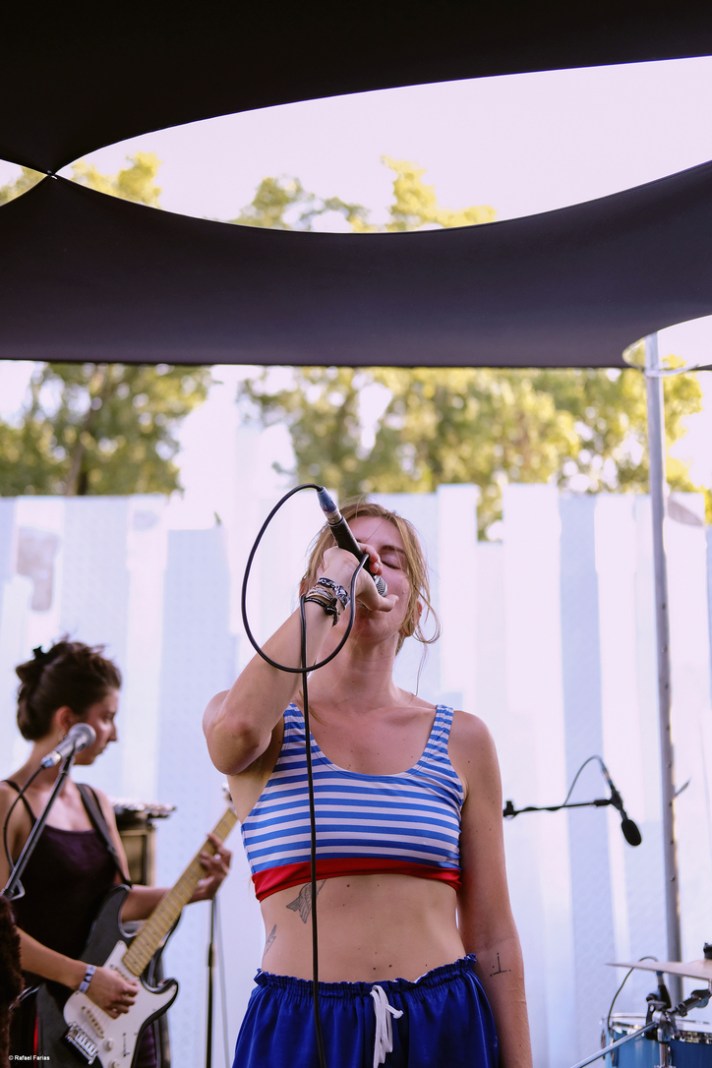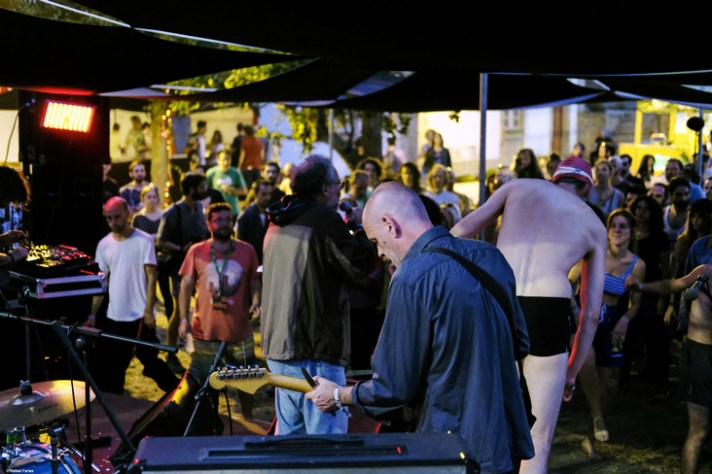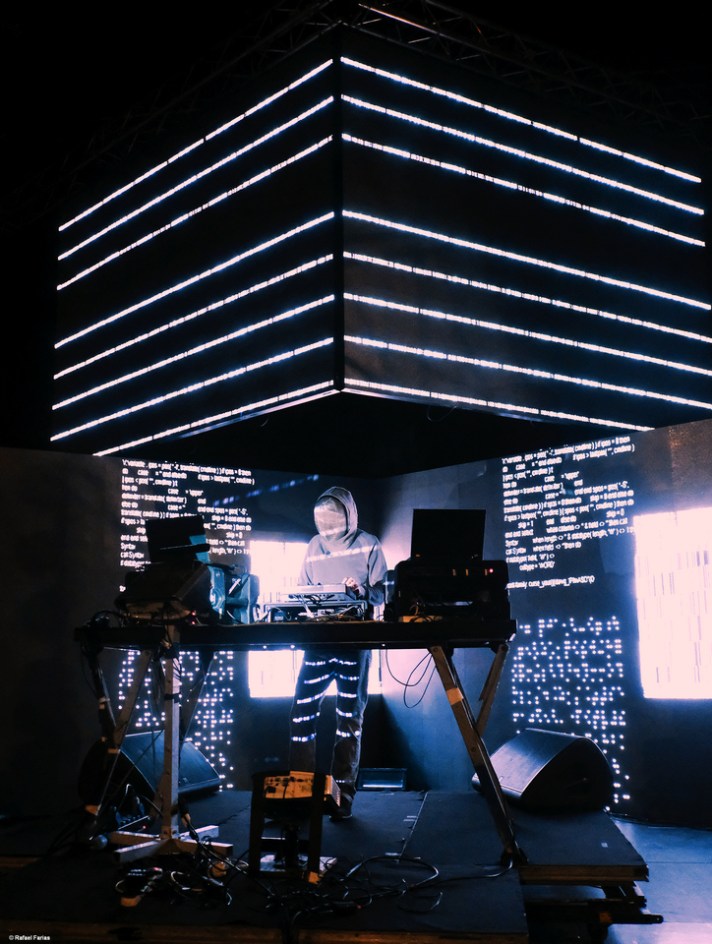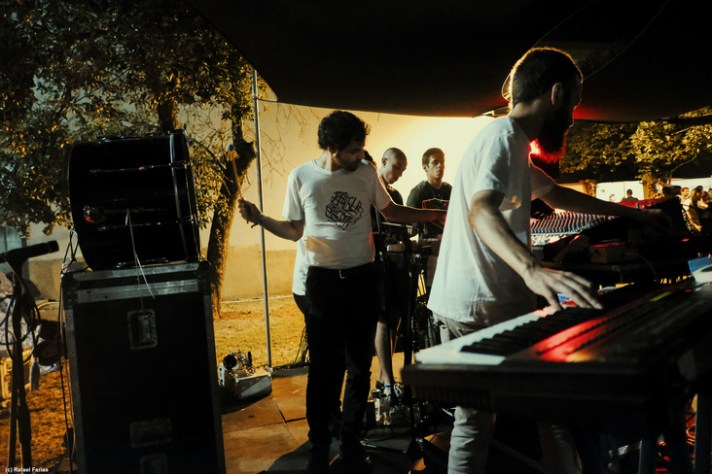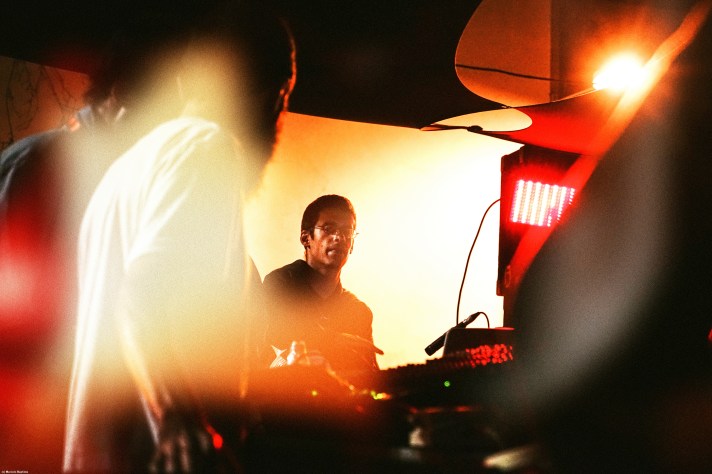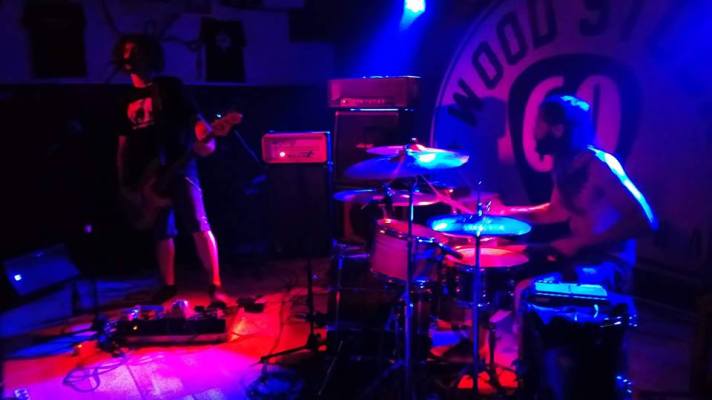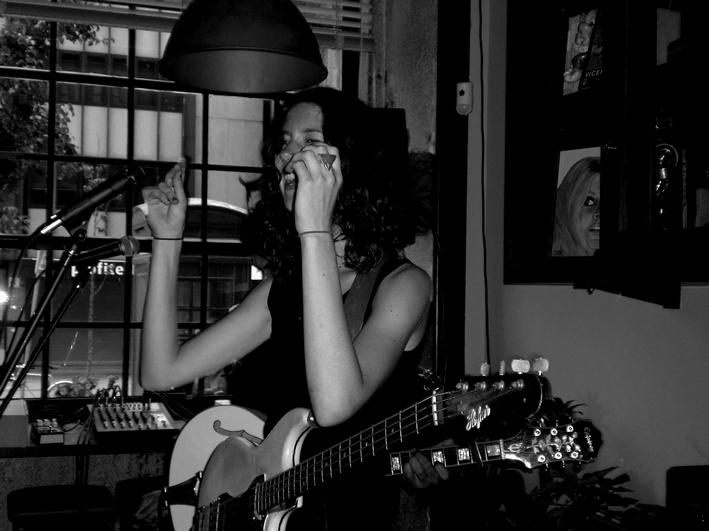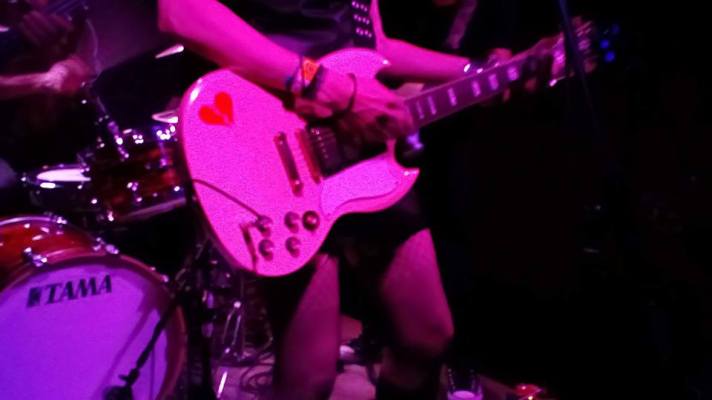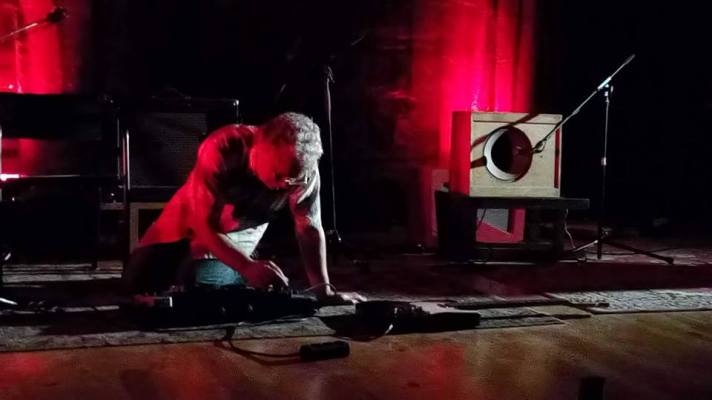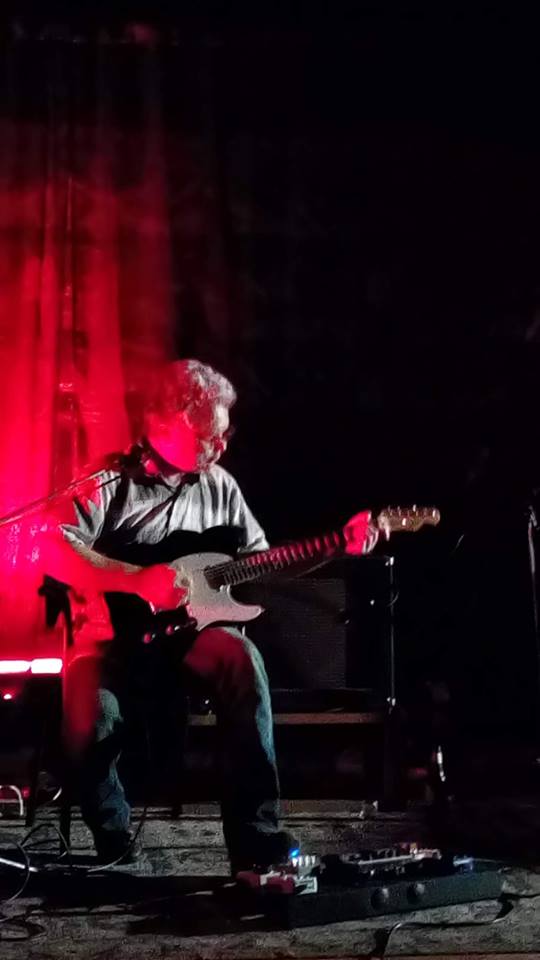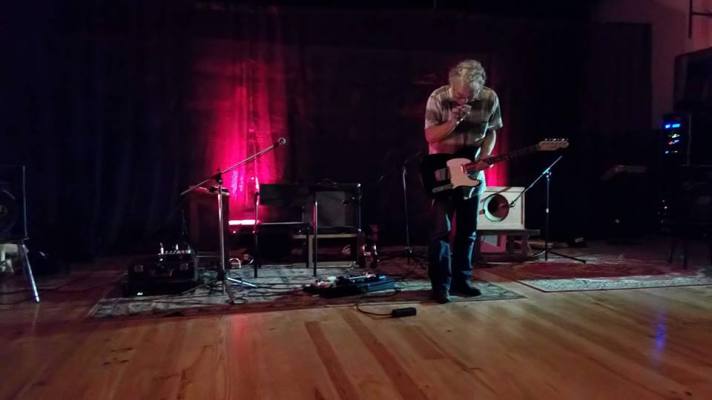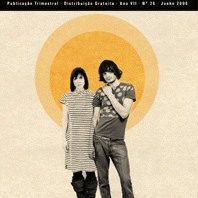
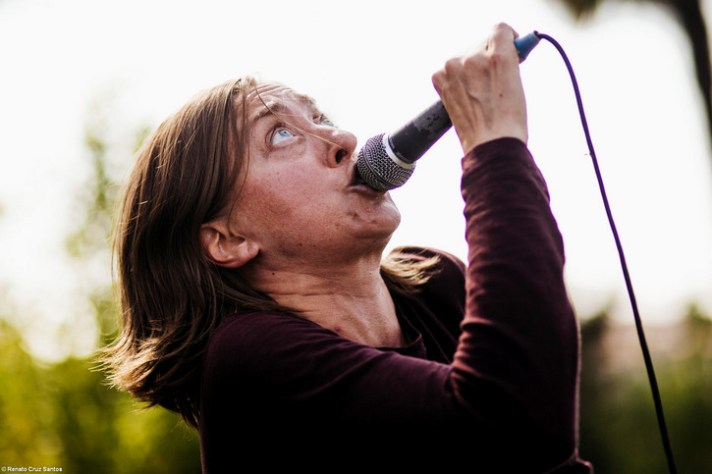
Alright Ghandi’s concert was the perfect one for a grey, misty late afternoon in Porto. The Berlin based trio presented their sophomore album Somewhere Else. Somewhere Else is an album filled with gentle pop songs, at times a little melancholic. Life it translates into a much more upbeat, rock sound with with a jazz undertones, thanks to Dominick Gray’s breaks and rhythms.
If on record Rosa Mercedes’ voice is evocative of Laura Veirs one, life it projects a different vibe, still remaining gentle, but also, at times, cheerful. And cheerfulness, even, at a point, Rosa said she wasn’t in a good mood – broke by the audience liveliness and joy, was not missing in Alright Ghandi’s concert.
Her bass, along with Pietro Fornara’s guitar, as well as his backing vocals, allow for a layered colourful mosaic of music. Towards the end, the mood in the room was so bright with people dancing and clapping that Rosa and Pietro come and played from the audience facing Dominick, and having as much as a time good time as anyone else in the room.
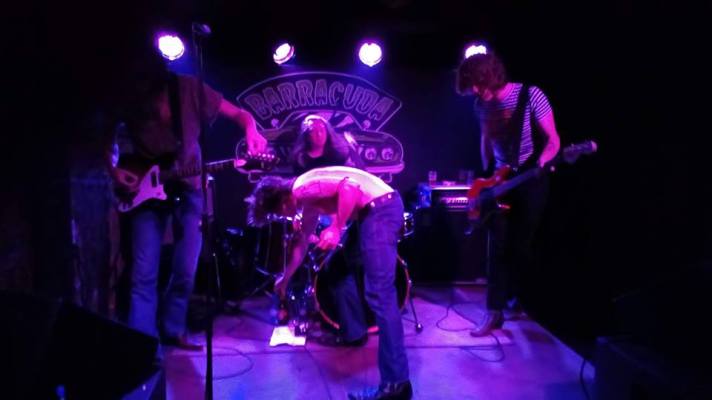
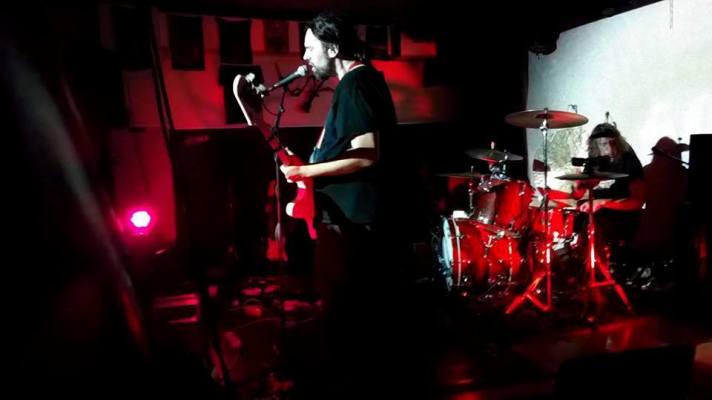
New Zealanders The Cavemen landed on Saturday night at Barracuda stage in Porto, where they greeted the natives with simply shattering concert from beginning to end. Musically the group lies within garage punk, but doesn’t stop there; there is something brutal, primitive and completely explosive in them, the raw themes and the band’s performance also reminds punk-hardcore by way of early Black Flag. At heart, the band’s sound is completely 70’s/80’s punk … but with a devastating performance reminiscent of the 90’s. If I classify them as a mix of Gun Club with Black Flag, I think it will more or less define them well.
The quartet emanates an onstage energy usually rarely seen, and while watching the The Cavemen concert I was only assailed by the memory of The Parkinsons’ performances because in my opinion they are very similar. I found it curious, as The Parkinsons are, as far as it concerns me, currently one of the most savage bands in the world. Therefore, I discovered, another one within the same register.
When the concert’s motto of is placed on such and high level of intensity, I think that there is nearly nothing of very substantial to say, besides mentioning that the audience loved to be violated and that a significant part it made the “party” with the rest of the band. It was a 100% catacombic and insane rock’n’roll show… and completely liberating.
Os neo-zelandeses The Cavemen (NZ) “aterraram” na noite de sábado passado no Porto, no palco do Barracuda, onde brindaram os nativos presentes com um concerto simplesmente demolidor, do início ao fim. O grupo está musicalmente inserido dentro do garage punk, mas estes não se ficam por aí; há neles algo de brutal, primitivo e completamente explosivo, que remete pela crueza dos seus temas, e da performance da banda, também para o punk-hardcore, via Black Flag dos primórdios. No fundo, o som da banda é completamente punk dos anos 70/80… mas com uma atuação devastadora que lembra anos 90. Se os classificar como uma mescla de Gun Club com Black Flag, penso que a coisa estará mais ou menos bem definida.
O quarteto emana uma energia em palco que é rara de se ver habitualmente, e enquanto assistia ao concerto dos The Cavemen só me assaltava a memória as atuações dos The Parkinsons, pois estas são muito semelhantes. Achei isso curioso, pois os The Parkinsons são, na minha opinião, das bandas da atualidade mais selvagens ao vivo a nível global. Descobri, por isso, mais uma dentro do mesmo registo.
Quando o mote do concerto é colocado nesta fasquia de intensidade, acho que não há praticamente quase nada a dizer de muito substancial, para além de referir que o público adorou ser violentado e que parte substancial deste fez a “festa” com o resto da banda. Foi um espetáculo 100% rock’n’roll catacúmbico e demencial… e completamente libertador.
Words: Guilherme Lucas (freely translated by Raquel Pinheiro); photos: Guilherme Lucas
Fur Dixon is part of my classic and primitive iconography of 80’s underground rock’n’roll, when “loving” The Cramps was an urgent need for any fan of the darkest sounds of that era. It was, among other possibilities, the courageous and unorthodox form of being on the other side of the barricade, facing other more pop and generalist sounds that was an assertion of independence, nonconformity, and adolescent anguish. Her presence on an UK a TV show (https://www.youtube.com/watch?v=r92XTMRy2gs), as The Cramps bass player, recorded on video for posterity, remained forever in my imagination, in the Summer of 1986. She represented to me (and to a few others), the ideal and sexy archetype of a desired girlfriend that, by then, any punk wished to have …
Fur Dixon and her Wtfukushima, her current new band- project is touring Europe to promote tour their debut album, Return 2 Sender, released this month (https://furdixon.bandcamp.com/), they played at Barracuda, Porto last Friday.
Surprisingly, Fur Dixon is a great singer, one of those we fell in love promptly with her melodic … and definitely sweet voice. Her songs lie within the great American rock’n’roll tradition, with approaches that at times are country, and at others blues, with a garage punk address, but always with the intention of doing something great that lasts throughout the years; that, in the end, only creates excellent songs to be listened in many occasions of life, beyond the genres and trends of the moment. There is a depth to many of Fur Dixon’s lyrics on this album that further enhances it, proof of its genuineness and commitment to the way she spreads her emotions and thoughts through music. That’s why she’s a talented songwriter.
Fur Dixon was very friendly towards the audience throughout the show, telling more or less painful moments the tour and how good it was to be in the beautiful city of Porto after a nightmare, somewhere in Spain, on muddy ground, at some festival and how she hates Trump and she was satisfeit with the public demonstrations against him while they were touring in the UK. She begged the audience to find a way to get rid of the man who that shames of her as an American citizen … There was no answer, but I only admired her more for her political stance and conscience. She also let the audience knew that the band was about to cancel the tour because the drummer had to cease his involvement in the band due to unavoidable family issues in the US … and that the present drummer playing with them had just been brought aboard a few hours after rehearsals … and that he was doing very well. I fully confirm it, and given the matter, he played excellently. It’s just rock’n’roll!
Supported by excellent musicians with due credits other renowned bands (The Fuzztones, The Dream Syndicate, etc.), the sort that without great technical virtuosity, always manage to make the perfect connection between the movements and the silences of the songs, it was a smouldering concert but to the point and in crescendo, ending in apotheosis with the performance of some The Cramps songs. And if the inclusion of themes from the legendary band in Wtfukushima’s concert were – for every conceivable reason one can – I was also convinced that Fur Dixon can clearly do without them, when it comes to her own repertoire, which is of great quality and enough in itself. Nowadays, she does not need the memories, to validate herself.
I really enjoyed Fur Dixon’s concert, it had something special for me, that was being achieved/conquered throughout, it won me. But not just that. I like her album, Return 2 Sender, its songs and I also really enjoyed their artistic stance live. Nowadays she is a rare artist. Therefore, precious. From now on, I will remember her as the punk country and blues diva.
Fur Dixon faz parte da minha iconografia clássica e primordial do rock’n’roll underground dos anos 80, quando “adorar” os The Cramps era uma necessidade urgente para qualquer fã dos sons mais obscuros dessa época. Era, entre outras possibilidades, a forma corajosa, e nada ortodoxa, de se estar do outro lado da barricada, face a outros sons mais pop e generalistas, feita qual afirmação de independência, inconformismo e angústia adolescente. A sua atuação num programa de TV no Reino Unido (https://www.youtube.com/watch?v=r92XTMRy2gs), como baixista dos The Cramps, registado em vídeo para a posterioridade, ficou para sempre retida no meu imaginário, nesse Verão de 1986. Ela representava para mim (e para alguns mais), o arquétipo ideal e sexy de uma desejada namorada que qualquer punk queria ter na época…
Fur Dixon e os seus Wtfukushima, a sua nova banda/projeto na atualidade, está em tour europeia de promoção ao seu primeiro álbum, lançado neste mês de Julho de nome Return 2 Sender (https://furdixon.bandcamp.com/), e na Sexta-feira passada apresentaram-se ao vivo na Invicta, no bar Barracuda.
Fur Dixon é surpreendentemente uma enorme cantora, daquelas com que nos apaixonamos de imediato pela sua voz de grande alcance melódico… e definitivamente doce. Os seus temas estão dentro da enorme tradição do rock’n’roll norte-americano, com abordagens ora country, ora blues, dentro de um discurso garage punk, mas sempre num seguimento intencional de fazer algo grande e que perdure ao longo dos anos; que no final apenas resultem excelentes canções para se ouvir em muitas ocasiões da vida, para além dos géneros e tendências do momento. Há profundidade em muitas das letras de Fur Dixon neste seu álbum, o que a engrandece mais, pois é prova da sua genuinidade e comprometimento com a forma como extravasa as suas emoções e pensamentos pela música. É por isso, uma talentosa compositora de verdadeiras canções.
Fur Dixon mostrou-se muito simpática, ao longo do espetáculo, com o público presente, expondo momentos mais ou menos penosos desta sua tour e de como era bom estar na bonita cidade do Porto, depois de passarem por um pesadelo, algures em Espanha, em terrenos lamacentos, num festival qualquer e de como odeia Trump e se congratulou com as manifestações públicas contra ele enquanto faziam a sua tour no Reino Unido. Implorou à audiência que se encontrasse um meio de se verem livre do homem, que tanto a envergonha, enquanto cidadã norte-americana… não houve resposta, mas só fiquei a admirá-la mais pela sua postura e consciência política. Informou também a audiência que a banda esteve para cancelar a presente tour, pois o seu baterista teve de suspender a sua participação no grupo devido a questões familiares inadiáveis nos EUA… e que o presente baterista a tocar com eles só tinha sido incorporado há umas poucas horas de ensaio… e que estava a sair-se muito bem. Confirmo plenamente, e considerando a questão, atuou de forma excelente. É só rock’n’roll!
Acompanhada por excelentes músicos com créditos firmados em outras bandas de renome (The Fuzztones, The Dream Syndicate, etc), daqueles que sem grandes virtuosismos técnicos, conseguem fazer sempre a ligação perfeita entre os andamentos e os silêncios das músicas, o concerto foi de combustão lenta, mas certeira e em crescendo, acabando na apoteose com a interpretação de alguns temas dos The Cramps. E se já era previsível a inclusão de repertório da lendária banda no concerto dos Wtfukushima – por todas as razões e mais uma que se possa imaginar – também fiquei convicto que Fur Dixon pode claramente prescindir deles, face ao seu próprio repertório, que é de grande qualidade e que se basta a si mesmo. Não precisa das memórias, para se validar por si mesma, na atualidade.
Gostei imenso deste concerto de Fur Dixon, teve algo de especial para mim e que foi sendo conseguido/conquistado a pulso ao longo do espetáculo. Mas não só por isso. Gosto deste seu álbum Return 2 Sender, das suas canções e porque apreciei bastante a sua postura artística ao vivo. É uma artista rara nos dias de hoje. Preciosa, por isso. Passarei a lembrar-me dela, a partir de agora, como a diva punk do country e do blues.
Words: Guilherme Lucas (freely translated by Raquel Pinheiro); photos Guilherme Lucas
Mars Red Sky a French trio from Bordeaux played last Saturday at Woodstock 69.
Musically the band places itself within a heavy psychedelic rock sound of 70’s matrix, but with a strong doom component. Therefore, one can consider them an interesting update, by means of renovation within stoner rock, with a very personalized path. The proof lies in their existing prolific discography of great quality with the very curious common feature of being listenable with pleasure and without added difficulties, definitely proof that there is a higher “pop” sense in constructing great psych-doom themes to reach larger audiences. It is no coincidence that they’re a band that has in its curriculum important performances in several international festivals within their style and similar ones.
Essentially, what I come out with from Porto’s concert was the confirmation of two peculiar aspects perceived in their discography, but that are fully confirmed live. Namely: the vocalista- guitarist, Julien Pras, owns a unique voice and a way of singing that makes the difference within this genre. Instead of the traditional rough vocals of the genre, he offers us a calm and fragile voice, in a very melodic, crystalline (and captivating) timbre, leading us into hypnotic and somewhat cinematic landscapes in many of the vocalized moments. That is possibly the biggest difference Mars Red Sky have in relation to many other bands of its ilk. Another retained aspect has to do with the form (which I classify as post-punk and economic) of performing the themes‘s solos. They are psychedelic, but not typically executed and cliché within the genre; there are no elaborate and endless scales to go through, but rather an excellent use of fuzz and wah-wah in a ripped and precise way. This is one of their characteristics that I appreciate a lot and that stems from the conceptual way the band approaches their themes.
In my opinion, there is, however, a less positive point that I have identified in the trio’s performance and that is purely performative: they offer a monotonous and very physically scant performance throughout their show, limiting themselves almost exclusively to “throw” their themes very precisely. If there are many moments in which this type of posture is understood, there are also many others that demand more intervention from the band. But this does not occur, that is, their performance is always at a single speed and emotion from the beginning to the end of the concert. Undoubtedly, in that regards, there is some “gaze” in their performance, and not so much in their music.
Aside from that, I can also conclude that both the audience present (who supposedly knew what they were getting themselves into), and the band, were satisfied enough at the end of the show. The many applause given to the group prove so.
O trio francês, da cidade de Bordeaux, Mars Red Sky, apresentou-se ao vivo no passado sábado, no Woodstock 69.
A banda está musicalmente inserida dentro de uma sonoridade rock psicadélica pesada, de matriz anos 70, mas com uma forte componente doom. Podemos, por isso, considerar que são uma interessante atualização, por via renovadora, dentro do stoner rock, numa direção muito personalizada. A prova disso é a já sua prolífica discografia de grande qualidade e com o muito curioso aspeto comum de que estas se escutam com agrado e sem dificuldades acrescidas, o que é definitivamente prova de que existe um elevado sentido “pop” de construir grandes temas psych-doom para atingir públicos maiores. Não é por acaso que são uma banda que conta já no seu currículo com atuações importantes em alguns festivais internacionais dentro do seu estilo e afins.
Essencialmente, o que retive deste seu concerto no Porto, foi a confirmação de dois aspetos peculiares que se percebem na sua discografia, mas que ao vivo se confirmam plenamente. A saber: o seu vocalista e guitarrista, Julien Pras, é senhor de uma voz muito singular e de uma forma de cantar que faz a diferença dentro deste género. Ao invés da tradicional vocalização rude e agreste do género, oferece-nos uma voz calma e frágil, num timbre muito melódico, cristalino (e cativante), conduzindo-nos para paragens hipnóticas e algo cinemáticas em muitos dos momentos vocalizados. Este é possivelmente o ponto mais diferenciador dos Mars Red Sky em relação a muitas outras bandas do seu género. Um outro aspeto retido tem a ver com a forma (que classifico de post-punk e económica) de executar os solos dos temas. Os solos são psicadélicos, mas não são executados de forma típica e cliché dentro deste género; não existem elaboradas e infinitas escalas a percorrer, mas sim um excelente uso do fuzz e do wah-wah, de forma rasgada e precisa. Esta é uma das suas características que aprecio bastante e que deriva na forma conceptual como a banda aborda os seus temas.
Há contudo, e na minha opinião, um ponto menos positivo que identifiquei na atuação do trio e que é de pendor exclusivamente performativo: estes oferecem uma atuação monótona e muito pouco física ao longo do seu espetáculo, limitando-se quase que exclusivamente a “debitar” os seus temas de forma muito precisa. Se há muitos momentos em que este tipo de postura se entende, há também muitos outros que se pedem mais interventivos por parte da banda. Mas isso não ocorre, ou seja, a sua atuação é sempre a uma única velocidade e a uma só emoção do início ao fim do concerto. Sem dúvida, que nesse aspeto, existe algo de “gaze” na sua performance, e não tanto na sua música.
Tirando este aspeto, posso também concluir que tanto o público presente (que supostamente sabia ao que ia), como a banda, se deram por bastante satisfeitos no final do espetáculo. Os muitos aplausos oferecidos ao grupo são prova disso
words: Guilherme Lucas (freely translated by Raquel Pinheiro); photos Guilherme Lucas
Lydia Lunch is one of the most important personalities of New York’s no-wave and post-punk music scene of the 1980s. She’s a pioneer and survivor of a passionate, literary genre, without aesthetic or ideological barriers, the best underground music has given us over the last few decades. She is part of a generation of geniuses and influential personalities when it comes to music, writing and performance, and for that very reason she is living history, or a legend, of popular underground music, depending on how you want to catalog her.
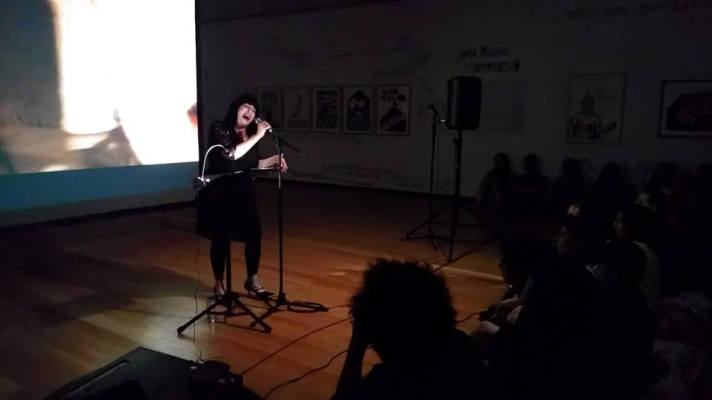
The artist presented herself to the public last Saturday at Galeria Municipal in Porto with her enthralling spoken word work named Dust and Shadows, following the exhibition O ontem morreu hoje, o hoje morre amanhã (Yesterday died today, today dies tomorrow) – an exhibitions of emerging local artists with works related to their nightlife experiences, using posters and images for electronic music events, DJ sets and others -, where the biggest name, and possibly the catalyst of this exhibition, is Raymond Pettibon the great American artist author of all the graphic aesthetics of the mighty Black Flag, one of the most important and seminal punk-hardcore world’s bands. In short, the black and white aesthetics of grotesque and crude proportions, often minimal and naively “poorly drawn” is what unites all these artists. I strongly a recommend to the exhibition.
Lydia Lunch hypnotically led us to a mind-boggling performance of the word, transformed into a psychedelic device of rambling the urgent and depressing thoughts that plague the mind of the artist and which that is simply astonishing, and leaves no one indifferent. Because what confronts us over 45 minutes is simply a person’s Life in every possible and conceivable way.
Initially focusing on freedom in its more politicized understanding of how the state and corporations control us all, from the mere use of a Visa card to TV or the Internet, it immediately moves into a closed attack on the US and its varied idiosyncrasies that are fulminantly bare naked, resorting to her personal concept of chaos and its liberating power, taking us to her obscure world of ghost-emotions that torment our memories, warning us in advance, that, one day we will also become one of them. There is an ecstatic dark humor, a violent convulsion in everything the artist approaches, as if there was no salvation. She claims to be a survivor, of all kinds of lives and drugs, real and imaginary. But it is precisely in this apparent negativity that lies all the love for Life, For Mother Nature, and people by Lydia Lunch. When she reveals to us, in an aggressive and defiant manner, that the true and only rebellion is pleasure, it is more than obvious that we are facing someone with huge substance; a rare mind with important things to be listened to. At the end of her show, she writes, in the form of a poignant eulogy, chilling and distressing, about what can be said to someone who only has 30 days of live an ends up only having 30 hours to live and that quickly changes to only 3 hours and only 3 more minute, poisoned with medication, trying to fight for life, trying at all costs to save the hope for a life that is ending … and there are only three seconds left to live and the only thing that can be done is to hold hands with the dying person say that they will quickly become a king and that, in a vortex of light, will enter another dimension, turned into subatomic particles in the ether, in ashes … this is a moment one can never forget, because it a very strong thing, an intensely evident visualization of how the artist publicly exposes herself abour end of life. This moment of the show is very shocking, made with a feeling that hundreds of noisy rock bands of and others will never be able to cross to an audience. The word, when well used, is very powerful … overwhelming.
What I essentially retained from the artist (who has visited us several times in the past) latest performance is that ostensibly, Lydia Lunch is a kind of up-to-date and very peculiar upgrade of the great blues and jazz singers of the past, a diva of debauchery and chaos, pleasure and lust; owner of a powerful voice with a great timbre reach, that proclaims freedom in a way that is neither obvious nor common sense. That is what makes her unique: one among billions. In addition, she is also someone with active political consciousness; always finding a way of relating eminently literary themes and emotive subjects with a hard and crude social reality, attacking in an vitriolic way what in her view of reality has to be destroyed.
Therefore, I believe, that watching one of her performances is always an unforgettable life experience, one of those that will last forever in our memories. At least that’s what happened to me.
Lydia Lunch Performance– Lydia Lunch é uma das mais importantes personalidades do meio musical da no-wave e do post-punk de Nova York dos anos 80. É uma pioneira e uma sobrevivente de um género apaixonante, literário, sem barreiras estéticas e ideológicas, do melhor que a música underground nos deu ao longo destas últimas décadas. Faz parte de uma geração de génios e de personalidades influentes, tanto a nível musical, de escrita e de performance, e por isso mesmo é história viva, ou lenda-viva, da música popular de pendor underground, conforme se a quiser catalogar.
A artista apresentou-se ao público, no passado sábado, na Galeria Municipal do Porto, com o seu apaixonante trabalho de tipologia spoken word de nome Dust and Shadows, no seguimento da exposição “O ontem morreu hoje, o hoje morre amanhã” (uma mostra de artistas locais emergentes com trabalhos orientados dentro da temática das suas experiências de vida noturna – através de cartazes e imagens para eventos de música eletrónica, DJ sets e outros), e onde o nome maior – e eventualmente o catalisador desta exposição – é o enorme artista norte-americano Raymond Pettibon, o autor de toda a estética gráfica dos grandiosos Black Flag, uma das mais importantes e seminais bandas do punk-hardcore global. De forma muito resumida, a estética do preto e branco de proporções grotescas e cruas, em muitos casos minimal e “mal desenhada” de forma naíf, é o que une todos estes artistas. Uma exposição que recomendo vivamente para ser visitada.
Lydia Lunch conduziu-nos de forma hipnótica para uma alucinante performance da palavra, transformada em qual artefacto psicadélico de divagação dos pensamentos urgentes e depressivos que assolam a mente da artista e que é simplesmente assombrosa, e não deixa ninguém indiferente. Porque o que esta nos confronta ao longo de 45 minutos é simplesmente a Vida em todas as vertentes possíveis e imagináveis do indivíduo.
Inicialmente focando-se sobre a liberdade no seu entendimento mais politizado, de como o Estado e as corporações nos controlam a todos, desde o mero uso de um cartão Visa até à tv e internet, de imediato passa para um ataque cerrado aos EUA nas suas mais variadas idiossincrasias que são, de forma fulminante, postas a cru, recorrendo para o seu conceito pessoal de caos e do seu poder libertador, levando-nos ao seu mundo obscuro dos fantasmas-emoções que nos atormentam as memórias, avisando-nos de antemão, de que um dia mais tarde, seremos também um deles. Há um extasiante humor negro, em violenta convulsão, em tudo o que a artista aborda, como se não houvesse salvação. Ela afirma-se uma sobrevivente, de todos os tipos de vidas e de drogas, reais e imaginárias. Mas é precisamente nesta aparente negatividade que reside todo o amor pela Vida, pela Mãe-Natureza, e pelo Indivíduo por parte de Lydia Lunch. Quando nos revela, de forma agressiva e desafiadora, que a verdadeira e única rebelião é o prazer, é mais do que óbvio que estamos perante alguém com imensa substância; uma mente rara com coisas importantes para ser escutada. No final do seu espetáculo, disserta, em forma pungente de elogio fúnebre, arrepiante e angustiante, sobre o que se pode dizer a alguém que só tem 30 dias de vida e que passa só a ter 30 horas de vida e que passa rapidamente a ter 3 horas e só mais 3 minutos, envenenado com medicação, a tentar lutar pela vida, a tentar a todo o custo salvar a esperança para uma vida que se apaga… e só restam mais 3 segundos de vida e a única coisa que se pode fazer é dar as mãos a quem morre e dizer que rapidamente passarás a ser um rei e num vórtex de luz entras numa outra dimensão, feito em partículas subatómicas no éter, em cinzas… este é um momento que jamais se esquece, porque é algo muito forte, de visualização intensamente evidente da forma como a artista se expôe publicamente nesta temática do fim da Vida. Este momento do espetáculo é muito impactante, feito num sentimento que jamais centenas de bandas barulhentas de rock e afins alguma vez conseguirão fazer passar para uma audiência. A palavra, quando bem usada, é muito poderosa… avassaladora.
O que retive essencialmente desta mais recente performance da artista (que já nos visitou por diversas vezes no passado), é que de forma ostensiva, Lydia Lunch é uma espécie de upgrade atualizado e muito peculiar das grandes cantoras de blues e do jazz do passado, uma diva da devassidão e do caos, do prazer e da luxúria; senhora de uma voz poderosa e de grande alcance tímbrico, que apregoa a liberdade de uma forma que não é óbvia nem do senso-comum. É nisso que é uma fora de série; uma entre biliões. Para além disso, é também alguém com consciência política ativa; encontra sempre uma forma de relacionar temas eminentemente literários e emotivos com uma realidade social dura e crua, atacando de forma ácida o que tiver de ser destruído na sua conceção do real.
Por isso, estou em crer, que assistir a uma sua performance, é sempre uma experiência de vida inesquecível, daquelas que perdurarão eternamente nas nossas memórias. Pelo menos foi isso que aconteceu comigo
words. Guilherme Lucas (freely translated by Raquel Pinheiro); photos: Guilherme Lucas
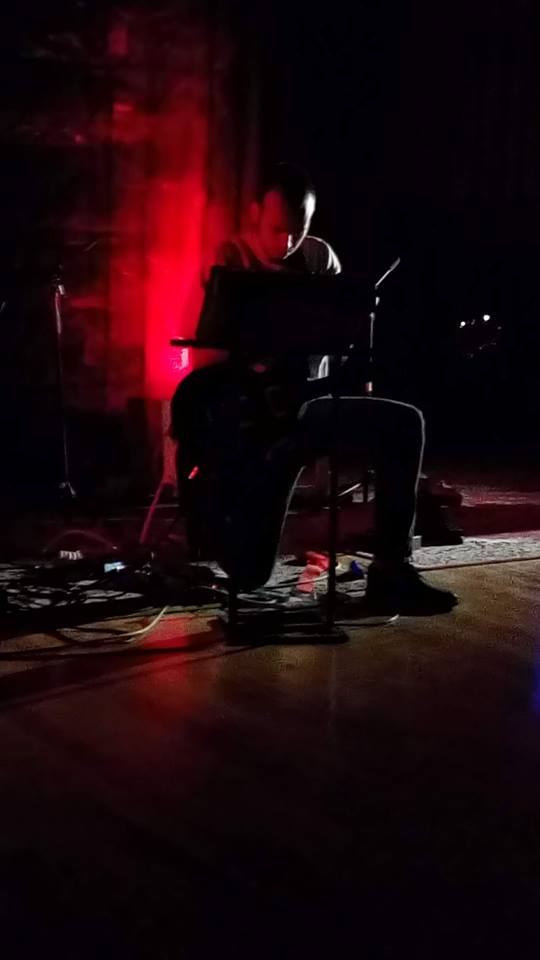
1 – Francisco Oliveira – I appreciated the conceptual approach with which this musician from Porto (also Terebentina‘s guitarist,) approached his concert. Retorting to cassettes with pre-recorded track(s) (at times in reverse), the musician, almost always within an apparent free experimentation and modulated sound acoustics register, managed, in many moments of his performance to execute (or create) imminently chaotic, but equally attractive sound textures within the context in which they were unfolding. I would say that, to a large extent, Francisco Oliveira’s sonic / experimental stance is eminently “rock’n’roll”; it derives in many quarters from Glenn Branca’s fundamental heritage through Sonic Youth re-adapted to the young musician’s taste and effort of constructing a personalized sound speech. The manipulation techniques of functional objects adapted to the electric guitar, to assist its reinterpretation, as well as its enormous potential when distorted, highlight it as a resource previously “discovered” by other musicians and bands of past avant-gardes.
However the musician’s work/performance doesn’t reduce itself to my initial point of view. Even because listening to his work on Holoscene 85 ‘(the name of his solo project), one easily perceives that a whole culture of influences far more wide than those already pointed live there. There is notoriously a taste of pop-rock bands and projects of the last decades that I consider influential, and that is, somehow, processed and re-adapted to Francisco Oliveira‘s experimental building discourse. If this multidisciplinary musician/artist still shows some connection to influences and forms of interpretation that can be /seem obvious. There already can be found many clues in his performances and there are very good sensations coming from someone that is starting to gave his own style and unique speech.
I found this concert almost always within two constant discourses, between the chaos of experimental distortion and the environmental background. There were times when both collided, and others where each of them had its own defined space, without conflict. I assume that, with time and live sharpening, this last path will prevail. To simplify my discourse and my thinking, I would say that what remains to be determined in this project are the guitar “arrangements”, since the compositional and aesthetic structure seems to me already well achieved and defined.
2- Filipe Felizardo – If I used an analogy with “rock’n’roll” to simplify the understanding Francisco Oliveira’s for Felipe Felizardo I will use “blues” as an analogy. This experimental musician from Lisboa has an action field that I consider risky, but equally challenging. Resorting solely to the distorted sound of the electric guitar, without any base or background support, Filipe Felizardo builds compositional movements between the chaos originated between the distorted feedback and the manipulation of the electric guitar effects pedal, working in the moment the chance of silences and of other sounds that occur from the way one plays/manipulate the guitar. For me there is an intrinsic connection to the blues in an experimental way and during his performance the image of Marc Ribot’s experimental work assaulted me permanently. Not that Filipe Felizardo might have an obvious direct link to Marc Ribot, but the approach he promotes is conventionally attractive for my subconscious to have related this reference.
Many times his sound slides into drone territory, resembling Sunn O)), and there are moments when the extremely loud and violent sound of his distorted guitar tortured us relentlessly only to, at once, get us back to more delicate ambiente outline sound textures. I will say that Filipe Felizardo has, from what he has shown, a practically unique field to progress. Not being my aim to predict the future in a field as fragile as experimental underground music, I am left curious to imagine how this musician can develop within his sound concept, because it is a difficult road, but, as I said before, challenging and interesting.
3 – GATE – (Michael Morley) – New Zealander Michael Morley, guitarist and lead singer of the mythical The Dead C, quite an influential noise rock avant-garde band from the late 80s to nowadays, within free improvisation experimental music narrow world, offered a very good concert with Gate, his personal project.
Continuing to resort to clarifying analogies, I will say that if before we had “rock’n’roll” with Francisco Oliveira and “blues” with Filipe Felizardo, with Michael Morley we had a dense and obscure symphony directed by an excellent conductor of rock experimental drone and noise. It is notorious, even evident, how this musician masterfully masters what, supposedly, is not manageable. Even when he turns to the declamation with his distressing, whispering or higher voice; a voice that is anything but captivating by common aesthetic standards, makes this customized connection work and in line with the ambient sound textures it builds.
Gate’s music acquires a greater sensory experience when we listen to it with closed eyes, centered solely on the sound (something, I think is recurrent to all experimental music), abstracted from the distracting movements offered by the manipulation of his guitar and laptop. When we attend a concert of a noise experimentalism living legend of, as in this case, we understand more clearly what years of endurance and improvement means within a style that is difficult to understand by most music lovers, but that shows us it is a very specific way that it is always possible to make compositional sounds and structures completely abstracted from the platitudes of formatted mass music. Without ever making a classic rock solo, without ever using a specific melody or harmony, Michaek Morley manages to do them all within his own aesthetic language, eventually using the same rules as others, but always adapted to his speech … showing that sound possibilities are endless.
The conviction that one can also make a long career within a very restricted landscape and world, offering quality and a very personalized sound diversity (because the musician’s work is anything but restricted to only one type of sound) is, possibly, the most important idea I have kept from his concert.
1 – Francisco Oliveira – Apreciei a abordagem conceptual com que este músico portuense (também guitarrista na banda Terebentina), abordou o seu concerto. Recorrendo a k7’s com(o) faixa(s) pré-gravada(s) (em algumas situações em reverse), o músico, quase sempre dentro de um registo de aparente experimentação livre e de acasos sonoros modulados, conseguiu, em muitos momentos da sua performance, realizar (ou criar) texturas sonoras iminentemente caóticas mas igualmente atraentes no contexto em que as mesmas iam progredindo. Diria que, em grande medida, a postura sónica/experimental de Francisco Oliveira é eminentemente “rock’n’roll”; deriva em muitos quadrantes da herança fundamental de um Glenn Branca por via de uns Sonic Youth readaptados ao gosto e na aposta do jovem músico em construir um discurso sonoro personalizado. As técnicas de manipulação com objetos de funcionalidade adaptada à guitarra elétrica, no sentido de auxiliar na reinterpretação da mesma, bem como das suas enormes potencialidades quando em distorção, evidenciam isso no sentido de um recurso já “descoberto” por outros músicos e bandas de vanguardas experimentais do passado.
No entanto o trabalho/performance do músico não se reduz só a este meu ponto de vista inicial. Até porque escutando o seu trabalho em Holoscene 85′(o nome do seu projeto a solo), facilmente se percebe que já reside lá toda uma cultura de influências muito mais abrangente do que aquelas que apontei. Há notoriamente um gosto que considero influente por via de algumas bandas/projetos pop/rock importantes e interessantes das últimas décadas, e que é – de alguma forma – trabalhado e readaptado ao discurso experimental que Francisco Oliveira está a construir. Se este músico/artista multidisciplinar ainda evidencia alguma ligação a influências e formas de interpretação que podem ser/parecer óbvias, também já se encontra em muitos momentos da sua atuação pistas e muito boas sensações de quem já começa igualmente a possuir uma forma própria e um discurso singular. Achei este seu concerto quase sempre dentro de dois discursos constantes, entre o caos da distorção experimental e o do fundo ambiental. Houve momentos em que ambos colidiram, e outros em que cada um deles teve o seu próprio espaço definido, sem conflito. Presumo que, com o tempo e o apuro ao vivo deste projeto, venha a ser este último caminho o mais prevalente. Para simplificar o meu discurso e o meu pensamento, diria que o que falta apurar neste projeto são os “arranjos” de guitarra, já que a estrutura composicional e estética parece-me já bem conseguida e definida.
2- Filipe Felizardo – Se usei uma analogia com o “rock’n’roll” para simplificar o entendimento sobre a atuação de Francisco Oliveira, para Filipe Felizardo usarei a analogia do “blues”. Este músico experimental lisboeta tem um campo de ação que considero arriscado mas igualmente desafiador. Recorrendo unicamente ao som distorcido da guitarra elétrica, sem qualquer apoio de base ou fundo, Filipe Felizardo constrói andamentos composicionais entre o caos originado entre o feedback distorcido e a manipulação do pedal de efeitos da guitarra elétrica, trabalhando no momento o acaso dos silêncios e de outros sons que ocorrem da forma como toca/manipula a sua guitarra. Há, para mim, uma intrínseca ligação ao blues de uma forma experimental e durante a sua prestação a imagem de um Marc Ribot assaltou-me permanentemente no que também ele tem de experimental na sua obra. Não que Filipe Felizardo possa ter uma uma óbvia ligação direta com Marc Ribot, mas a abordagem que promove é concetualmente atraente para o meu subconsciente ter relacionado esta referência.
Em muitos momentos o seu som resvala para o drone, lembrando uns Sunn O))), e não são poucos os momentos em que o som extremamente violento e alto da sua guitarra distorcida tortura-nos implacavelmente os sentidos para nos remeter de imediato para outras texturas sonoras mais delicadas e de perfil ambiental. Direi que Filipe Felizardo tem, pelo que demonstrou, um campo praticamente único para progredir e não estando nos meus propósitos fazer futurologia num campo tão frágil como é a música underground e de teor experimental, fico com a curiosidade de imaginar como este músico pode evoluir dentro deste seu conceito sonoro, porque é caminho difícil, mas como disse antes, desafiador e interessante.
3 – GATE – (Michael Morley) – o neozelandês Michael Morley, guitarrista e vocalista dos míticos The Dead C, uma banda de noise rock avant-garde, bastante influente, desde os finais dos anos 80 até à atualidade, dentro do restrito meio da música experimental de livre improvisação, ofereceu um muito bom concerto com o seu projeto pessoal Gate.
Continuando a recorrer a analogias elucidativas, direi que se tivemos antes “rock’n’roll” com Francisco Oliveira e “blues” com Filipe Felizardo, com Michael Morley tivemos uma densa e obscura sinfonia dirigida por um excelente maestro do drone e do noise rock experimental. É notória, evidente até, a forma como este músico domina com mestria o que não é, à partida, dominável. Mesmo quando recorre à declamação com a sua voz angustiante, em sussurro ou mais elevada; uma voz que é tudo menos cativante pelos padrões estéticos comuns, faz com que essa ligação funcione personalizada e em consonância com as texturas sonoras ambientais que vai construindo.
A música de Gate adquire uma experiência sensorial maior quando a escutamos de olhos fechados, centrados unicamente no som (é algo, acho, recorrente para toda a música experimental), abstraídos dos movimentos de distração que a manipulação da sua guitarra e laptop oferecem. Quando assistimos a um concerto de uma lenda viva do experimentalismo noise, como é o caso, entendemos mais claramente o que significam anos de endurance e de aprimoramento dentro de um estilo que é de difícil compreensão pela maior parte dos melómanos, mas que nos demonstra de forma muito concreta que é possível sempre fazer sons e estruturas composicionais completamente abstraídas dos lugares comuns formatados da música de massas. Sem nunca fazer um solo clássico de rock, sem nunca usar uma melodia ou harmonia concreta, Michaek Morley consegue fazer todas elas dentro da sua própria linguagem estética, eventualmente usando as mesmas regras que os outros, mas sempre adaptadas ao seu discurso…demonstrando que as possibilidades sonoras são inesgotáveis.
A convicção de que se pode também fazer uma longa carreira dentro de um panorama e de um meio muito restrito, oferecendo qualidade e uma diversidade sonora muito personalizada (porque o trabalho do músico é tudo menos taxativo com um só tipo de som), é, eventualmente, a mais importante ideia que retive do seu concerto.
Words: Guilherme Lucas (freely translated by Raquel Pinheiro; photos: Guilherme Lucas
Bronx New Yorkers, The Men, are anything but a predictable rock band. Their repertoire, condensed in their discography, reveals it: an enormous capacity and genuine interest of the n«band, in their different line-ups, over the years, in approaching their music from an experimental perspective and without musical barriers within an eminently rocky context . That means, musically and stylistically speaking, it is practically impossible to catalog The Men. But it can be said, without doubt that they are a great rock band.
The Men (currently on tour promoting their latest and most eclectic work called Drift), performed at Maus Hábitos stage showing precisely that: that they can equally start with a brutal and devastating theme that is nothing more than “punk- rock-hardcore-noise with solos like Dinossaur Jr”, and, right away, submerge themselves in an introspective, calm theme of country -folk ambience, with a somewhat irrepressible free jazz saxophone – at times reminding a few sentences from The Stooges’ Fun House – returning to punk-hardcore fulminating noise … once more followed by intimate themes, musically haunted by American rock memorabilia ranging from The Doors to Johnny Cash, (at times I even noticed something between Bruce Springsteen and Tom Petty) … therefore , it is virtually impossible to accurately identify all their influences; one can only rely on what is suggested by their compositions. The band offered a good concert, though, and as mentioned, with different speeds and very different intensities.
The idea one is left with is clear, The Men are a band, that if they so which, can act in any type of stage, for a very diverse audiences. They can both perform in the most fetid and underground hole of any city within punk, distilling the most violent and abrasive part part of their repertoire, but with the other part of their deeper and more diverse themes that interest more musically purportedly enlightened audiences also perfectly fitting within “charm” spaces like “Music Venues”. This time they performed at Maus Hábitos, the kind of perfect space, placed in between of the two I mentioned. It was, therefore, very worthwhile.
Os nova-iorquinos de Bronx, The Men, são tudo menos uma banda de rock previsível. O seu repertório, condensado na sua discografia, revela isso mesmo: a enorme capacidade e o genuíno interesse do grupo, nas suas diferentes formações ao longo dos anos, de abordar a sua música numa perspetiva experimental e sem barreiras musicais dentro de um contexto eminentemente rock. Isso significa que é praticamente impossível catalogar os The Men musical e estilisticamente falando. Mas podemos afirmar, sem margem de dúvidas, que são uma grande banda de rock.
Os The Men (que estão em tour de promoção do seu mais recente – e bastante eclético – trabalho, de nome Drift), que se apresentaram no palco dos Maus Hábitos demonstraram precisamente isso: tanto arrancam com um brutal e devastador tema que nada mais é do que “punk rock hardcore noise com solos à Dinossaur Jr”, para de seguida mergulharem num tema introspetivo, calmo, de ambiência country/folk, com um sax algo free jazz irrepreensível – a fazer lembrar a espaços algumas frases à la Stooges do Fun House – para regressarem ao punk hardcore noise fulminante… seguindo-se novamente mais uns temas intimistas, assombrados musicalmente por memorabilia rock norte-americana desde os Doors a Johnny Cash, (por momentos até percebi lá no meio qualquer coisa entre Bruce Springsteen com Tom Petty)… é por isso praticamente impossível identificar todas as suas influências com rigor; apenas nos podemos basear no que as suas composições nos sugerem. A banda ofereceu um bom concerto, embora, e como referi, com diferentes velocidades e de muito diferentes intensidades.
Fica claramente a ideia que os The Men são uma banda, que se quiserem, atuam em qualquer tipo de palco e para públicos muito diversos. Tanto podem atuar no buraco mais fétido e underground de qualquer cidade dentro do punk, destilando toda a parte do seu repertório mais violento e abrasivo, como perfeitamente encaixam em espaços de “charme” tipo “Casas da Música”, com a outra parte dos seus temas mais profundos e diversificados, que são do interesse de públicos pretensamente mais esclarecidos musicalmente. Desta vez atuaram nos Maus Hábitos, que é o tipo de espaço perfeito, situado a meio dos dois que referi. E valeu, por isso, muito a pena.
The plan was to partially photo capture the event from late afternoon onward, and to, at least include Terebentina and Ângela Polícia scheduled for 10:30pm and 10:20pm.
Rain, bands starting one hour, or more, later than scheduled, and a couple of minor foot injuries called for an early fold.
Talea Jacta, P A L M I E R S, The Lemon Lovers, Sereias and Madmess were captured.
words: Guilherme Lucas (freely translated by Raquel Pinheiro); photos: Raquel Pinheiro
Famous British composer, musician and producer John Parish was in Portugal, to present live, in two concerts – Porto and Lisboa – his film-concert, called Screenplay. Thursday he was at Hard Club in Porto and Friday at Culturgest in Lisboa, the last as part of IndieLisboa International Film Festival programme.
Screenplay, a Parish album released in 2013, made of soundtracks for a movie that does not really exist. The concept is based on the selection of several scenes from various films (nine altogether), of the musician ‘s taste, who decided to compose sequentially with the aim to produce soundtrack for all those excerpts, resulting in nineteen themes. The idea is curious, very valid and the proof is that, after being listened to, it works well in musical terms,.
John Parish performed on Hard Club’s stage accompanied by his private band made up of accomplices (I immediately recognized drummer and multi-instrumentalist Jean Marc Butty, who was part of Mick Harvey’s support band, since he played in Portugal, in 2015). Butty is the service drummer, along with Parish and Jeremy Hogg (another of the guitarists present) of PJ Harvey’s). Marta Collica (keys and vocals) and Giorgia Poli (bass and vocals), the other band members, also are usual musicians from John Parish Band.
In a conceptual and intimate concert, as was the, where fifteen of the nineteen songs were played (not on the album’s line-up), I have clearly and very objectively retained two points to comment:
– Although the projection of some of the film sequences is understandable, in order to provide the audience with more engagement and clarity about the music being played for that very footage, the fact is that in most cases it did not work effectively. If it is visually pleasing to see a band silhouetted in front of a film screen with films projection running, in this case there were many moments when the intensity of the music, and even its volume, could not harmoniously connect with the images, losing kinematic beam. Not always, but most times. Many of the band’s best musical moments happened when it played without the footage projection.
– The John Parish Band is a luxury band, made up of musicians that create excellent music, with extremely elegant and impeccable good taste. It is, therefore, always able to play variable quality material with the same commitment. All that to say that it was obvious to ascertainment that some of the album’s themes are quality rather inferior composition wise when compared to others that are simply excellent, of a touching melancholic beauty. It is, however, understandable that this oscillation (possibly caused by of Parish’s different moods during the creative act that brought them into being, certainly always variable and circumstantial), in the sense that there does not always have to be a perfect album with huge themes. The point is that Screenplay has excellent themes, but also offers so many that are only understood as Parish’s experimental approaches (or even reveries), possibly very valid for him … but that do not reach the greatness and depth of some of the others.
John Parish is a very friendly musician with the audience and was quite pleased with the warm reception he was receiving with clapping at the end of each theme. After the performance, the band returned once again to stage, as a farewell and encore, to play another composition called Buffalo.
In short, I will say that it was, without a doubt, a good concert, but with my best expectations were somewhat disappointed, because from John Parish I only expect nothing less than excellence.
O famoso compositor, músico e produtor britânico, John Parish está em Portugal, para apresentar ao vivo, em duas datas – Porto e Lisboa – o seu filme-concerto, de nome Screenplay. Ontem esteve no Hard Club, no Porto e hoje estará na Culturgest, em Lisboa, fazendo este último concerto parte da programação da IndieLisboa International Film Festival.
Screenplay é um álbum de Parish lançado em 2013, feito de bandas sonoras para um filme que não existe na realidade. O conceito parte da seleção de várias cenas de vários filmes (nove ao todo), da preferência do músico, que decidiu compor em forma sequencial com vista à realização de uma banda sonora totalizadora desses excertos, resultando em dezanove temas. A ideia é curiosa e muito válida e a prova é que resulta bem em termos musicais, após escuta.
John Parish apresentou-se no palco do Hard Club acompanhado da sua banda privativa feita de amizades cúmplices (reconheci de imediato o baterista e multinstrumentista Jean Marc Butty, que fez parte da banda de apoio de Mick Harvey, desde a última vez que este tocou no nosso país, em 2015). Butty é o baterista de serviço, conjuntamente com Parish e Jeremy Hogg (outro dos guitarristas presentes), de PJ Harvey). Marta Collica (teclas e voz) e Giorgia Poli (baixo e voz), os restantes elementos da banda, são também elas músicos habituais na John Parish Band.
Num concerto conceptual e de pendor intimista, como foi o caso deste, onde foram tocados quinze dos dezanove temas (fora do alinhamento do álbum), retive, clara e muito objetivamente, dois aspetos para comentar:
– Embora seja entendível a projeção de algumas das sequências dos filmes de forma a dar mais envolvência e esclarecimento ao público da música que era interpretada para essas mesmas cenas, o facto é que na maior parte das vezes não resultou de forma eficaz. Se visualmente é sempre agradável ver uma banda em silhueta à frente de um ecrã de cinema com projeção de filmes a decorrer, neste caso existiram muitos momentos em que a intensidade da música, e até o seu volume, não conseguiram ligar-se harmoniosamente com as imagens, perdendo fulgor cinemático. Não em todos os momentos, mas na maior parte deles. Muitos dos melhores registos musicais da banda, ocorreram quando a mesma atuava sem a projeção das cenas.
– A John Parish Band é uma banda de luxo, feita de instrumentistas que fazem excelente música, de forma extremamente elegante e de irrepreensível bom gosto. É, por isso, sempre capaz de interpretar material de qualidade variável com o mesmo empenho. Tudo isto para dizer que foi óbvia a constatação de que alguns dos temas do álbum são de qualidade composicional bastante inferior a outros que são simplesmente excelentes e de uma beleza melancólica tocante. Entende-se contudo esta oscilação (eventualmente por diferentes estados de espírito de Parish aquando do ato criativo que lhes deu origem, e que certamente são sempre variáveis e circunstanciais), no sentido de que não tem de haver sempre um álbum perfeito de enormes temas. A questão é que Screenplay tem excelentes temas, mas também oferece outros tantos que só se entendem como abordagens experimentais de Parish (ou até devaneios), eventualmente muito válidos para o músico… mas que não alcançam a grandeza e a profundidade de alguns outros.
John Parish é um músico muito simpático com o público e mostrou-se bastante contente com a receção calorosa que ia recebendo deste, em forma de aplausos no final de cada tema. Finalizada a atuação, a banda regressou mais uma vez a palco para, em jeito de despedida e de encore, interpretarem mais uma composição, Buffalo de seu nome.
Resumindo: direi que foi, sem sombra de dúvida, um bom concerto, mas com as minhas melhores expetativas algo defraudadas, pois de um John Parish só espero nada menos que a excelência.
words: Guilherme Lucas (freely translated by Raquel Pinheiro); photos: Raquel Pinheiro & Guilherme Lucas
Parva is a DIY concept of its mentor, musician and artist Pedro Centeno, which includes an independent publisher, project management and the organization of underground cultural events, but also has incursions in fine arts, from what I was able to deduce . And I say deduce, because I am writing this text without having yet managed to reach the informal conversation with its leader to get to know more about his ideas and future plans. There will certainly soon be an opportunity for it, but, and for that very reason, these short lines are only based on my research and interpretative analysis of what already proliferates on the internet about Parva.
All that to introduce a brief thought about the event organized last Monday, April 30 at Cedofeita Shopping Center, in a nightclub called Cantinho da Teresinha, a fado house, and that (as everyone knows ), is always a great, completely improbable, place, where true underground events always make history.
It was a long and fantastic evening, with lots of people participating and attending the concerts of the bands in the line-up, as well as the DJ Sets that followed them. It was a unique moment and that will remain for future memory, which, right now, I classify as a record of the possible post-punk scene (much because of the bands) currently in Porto. And I say it’s a possible post-punk, because there are things in it that are so, and many others that already escape this genre … but post punk always also lived without predefined aesthetic borders, which was always its great virtue. Do not confuse this post punk that I speak of with the post punk gothic variant or deathrock, depressive urban pop- rock from Manchester and the likes, (that also exists in a very representative manner in Porto) … this post-punk that I speak of is linked to Einsturzende Neubauten and Die Haut, 70s & 80s New York of Suicide and Lydia Lunch, or The Birthday Party and Rowland S. Howard’s Melbourne. It is the post-punk of artists, unbalanced geniuses, libertarians, anarchists, chaos and debauchery. It’s my post-punk, the one I’ve always loved.
But this (neo) post-punk that I point to already has its own discourse that goes beyond the musical subgenre I am referring to, and which is, therefore, musically diverse (both formally analogical and digital, or the two simultaneously) , and, when it comes to the bands, they themselves, and in their own way, are able to implant themselves in the city ‘s alternative circuit of the and beyond. And, in that sense, Parva has had an enormous importance, not only because of its catalog of published projects, but also because of the events it has held.
For now I have identified Sereias, Terbentina, Nu No & FT and Era uma vez um tímpano, as bands of this bearing. I also consider 10,000 Russos, Dreamweapon and Summer of Hate in the same league, but in a very different position, much of their sound being krautrock (this is the link they have with post-punk, since it is the greater influence of that genre) and the fact that, live, there ins’t in those three bands the aesthetics of violent and insane chaos, that happens with the other four mentioned above. Let’s say the last three are the disciplined psychedelics of post-punk. This is all very exciting for me, because I have always thought it difficult to find nowadays inheritance and continuity in the city to 80s-90s Guru Paraplégico e os Iconoclastas or Hospital. So if there are any more bands of the genre, I hope to discover and talk about them firsthand. Tha is what drives me.
texto: Guilherme Lucas, fotos: Raquel Pinheiro & Guilherme Lucas
P a r v a é um conceito DIY do seu mentor, o músico e artista Pedro Centeno, que incluí uma editora independente, management de projetos e organização de eventos de cultura underground, mas também tem incursões na área das artes plásticas, pelo que me foi dado deduzir. E digo deduzir, porque estou a escrever este texto sem ter ainda conseguido chegar à conversa informal com o seu responsável para conseguir saber mais sobre as suas ideias e planos futuros. Haverá certamente oportunidade em breve para tal, mas, e por isso mesmo, estas curtas linhas são só baseadas na minha pesquisa e análise interpretativa ao que já prolifera na net sobre a Parva.
Isto tudo para introduzir para um breve pensamento sobre o evento organizado na passada segunda-feira, dia 30 de Abril, no Centro Comercial de Cedofeita, numa discoteca de nome Cantinho da Teresinha, uma casa de fados, e que (como toda a gente sabe), é sempre um excelente local, completamente improvável, onde os verdadeiros eventos underground fazem sempre história.
Foi uma longa e fantástica madrugada, com muita gente a participar e a acorrer aos concertos das bandas em cartaz, bem como aos DJ Sets que se seguiram. Foi um momento único e que fica para memória futura, o qual classifico desde já como um registo do que é a cena post punk possível (muito por via das bandas), no momento atual na Invicta. E digo que é um post punk possível, porque há coisas nele que o são e muitas outras que já escapam a esse género… mas também o post punk sempre viveu sem fronteiras estéticas predefinidas, essa sempre foi a sua grande virtude. Não se confunda este post punk de que falo com o post punk da variante gótica ou deathrock, da pop/rock urbano depressiva de Manchester e afins, (que também existe de forma muito representativa no Porto)… este post punk de que falo está ligado à Berlin dos anos 80, dos Einsturzende Neubauten e dos Die Haut, à Nova York dos 70-80 dos Suicide e da Lydia Lunch, ou a Melbourne dos The Birthday Party e de Rowland S. Howard. É o post punk dos artistas, dos génios desequilibrados, dos libertários,dos anarquistas, do caos e da devassidão. É o meu post punk, aquele que sempre adorei.
Mas este (neo) post punk portuense que aponto tem já o seu próprio discurso que vai para além do subgénero musical que refiro, e que é, por isso, musicalmente diverso (tanto é formalmente analógico como digital, ou até os dois em simultâneo), e no caso das bandas, elas mesmo, e muito à sua maneira, estão a conseguir implantar-se no circuito alternativo da cidade e até já fora dela. E a Parva tem tido, neste sentido, uma importância enorme, não só pelo seu catálogo de projetos editados, mas também pelos eventos que tem realizado.
Por agora já identifiquei os Sereias, os Terebentina, o Nu No & FT e o Era uma vez um tímpano, como bandas desta safra. Considero também os 10 000 Russos, os dreamweapon e os Summer of Hate no mesmo campeonato, mas numa posição muito diferente, por muito do seu som ser krautrock (é essa a ligação que tem com o post punk, já que é para este uma influência maior) e não haver nestas três bandas ao vivo a estética de caos violento e demencial, que acontece com as outras quatro atrás referidas. Digamos que estes três últimos são os psicadélicos disciplinados do post punk. Tudo isto é para mim muito entusiasmante, porque pensei sempre difícil haver herança e continuidade na cidade a uns Guru Paraplégico e os Iconoclastas e a uns Hospital Psiquiátrico dos anos 80-90, nos dias de hoje. Por isso se houver mais algumas bandas do género, espero descobrir e falar delas em primeira mão. É isso que me move.