My latest post in The Listening Room HQ is about what happens when creative practice enters the space of men’s work.
Creative practice has a way of loosening what words alone can’t reach. It’s not about art as product, but about opening. A way men can meet themselves, each other, and others differently.
It’s not theory or performance, it’s a way of grounding, disarming, and opening what’s otherwise hard to reach.
In spirit, it sits not far from Nick Cave’s Red Hand Files, a place where correspondence becomes a kind of soul map. The Listening Room HQ works in a similar way though with men’s practice: gathering fragments, gestures, and creative practice into a field of shared soul work.
A couple of days after the first anchor, the Listening Room HQ is quietly taking shape.
Sunflowers and Van Gogh, my favourite painter, continue to be an inspiration. Each Sunflowers painting subtly shifts in light and energy — each one different.
The maps, the sessions, this craft is a side of me many of you haven’t seen before. A new way of holding presence, listening, and connecting, blending intuition, somatic practice, and knowledge from neuroscience and neurobiology.
Read the first post on the Listening Room HQ on Mondo here.
Vincent van Gogh, Sunflowers 4th version, Arles, 1888.
The Listening Room HQ is my men’s practice, readings, and maps — a side of me many of you may not yet be familiar with.
It is a dedicated space where I integrate my background in neurobiology, neuroscience, and genetics with intuitive, somatic practices, connecting the soul, the cosmic, the creative, and the other maps that guide this work.
It’s a new adventure, shaped by years of study and lived experience.
The sessions are designed specifically for men — thoughtful, often private individuals navigating challenges such as burnout, emotional numbness, or creative blocks. These are not therapy sessions, but they are grounded in presence, clarity, and a non-judgmental approach.
In addition to the sessions, I offer readings and maps that combine Human Design, Mayan Cosmology, and Western Astrology. These are available to all genders and serve as tools for self-reflection and guidance. You can learn more about the services here.
The Listening Room HQ blends science with intuition, offering a space for men to explore and connect with themselves in a meaningful way.
My work is shaped by an artistic lens, and INTJ’s clarity.
Today is World Poetry Day. Here is my favourite poem:
The Love Song of J. Alfred Prufrock by T.S. Eliot S’io credesse che mia risposta fosse A persona che mai tornasse al mondo, Questa fiamma staria senza piu scosse. Ma percioche giammai di questo fondo Non torno vivo alcun, s’i’odo il vero, Senza tema d’infamia ti rispondo.
Let us go then, you and I, When the evening is spread out against the sky Like a patient etherized upon a table; Let us go, through certain half-deserted streets, The muttering retreats Of restless nights in one-night cheap hotels And sawdust restaurants with oyster-shells: Streets that follow like a tedious argument Of insidious intent To lead you to an overwhelming question …
Oh, do not ask, “What is it?” Let us go and make our visit.
In the room the women come and go Talking of Michelangelo.
The yellow fog that rubs its back upon the window-panes, The yellow smoke that rubs its muzzle on the window-panes, Licked its tongue into the corners of the evening, Lingered upon the pools that stand in drains, Let fall upon its back the soot that falls from chimneys, Slipped by the terrace, made a sudden leap, And seeing that it was a soft October night, Curled once about the house, and fell asleep.
And indeed there will be time For the yellow smoke that slides along the street, Rubbing its back upon the window-panes; There will be time, there will be time To prepare a face to meet the faces that you meet; There will be time to murder and create, And time for all the works and days of hands That lift and drop a question on your plate; Time for you and time for me, And time yet for a hundred indecisions, And for a hundred visions and revisions, Before the taking of a toast and tea.
In the room the women come and go Talking of Michelangelo.
And indeed there will be time To wonder, “Do I dare?” and, “Do I dare?” Time to turn back and descend the stair, With a bald spot in the middle of my hair — (They will say: “How his hair is growing thin!”) My morning coat, my collar mounting firmly to the chin, My necktie rich and modest, but asserted by a simple pin — (They will say: “But how his arms and legs are thin!”) Do I dare Disturb the universe? In a minute there is time For decisions and revisions which a minute will reverse.
For I have known them all already, known them all: Have known the evenings, mornings, afternoons, I have measured out my life with coffee spoons; I know the voices dying with a dying fall Beneath the music from a farther room. So how should I presume?
And I have known the eyes already, known them all— The eyes that fix you in a formulated phrase, And when I am formulated, sprawling on a pin, When I am pinned and wriggling on the wall, Then how should I begin To spit out all the butt-ends of my days and ways? And how should I presume?
And I have known the arms already, known them all— Arms that are braceleted and white and bare (But in the lamplight, downed with light brown hair!) Is it perfume from a dress That makes me so digress? Arms that lie along a table, or wrap about a shawl. And should I then presume? And how should I begin?
Shall I say, I have gone at dusk through narrow streets And watched the smoke that rises from the pipes Of lonely men in shirt-sleeves, leaning out of windows? …
I should have been a pair of ragged claws Scuttling across the floors of silent seas.
And the afternoon, the evening, sleeps so peacefully! Smoothed by long fingers, Asleep … tired … or it malingers, Stretched on the floor, here beside you and me. Should I, after tea and cakes and ices, Have the strength to force the moment to its crisis? But though I have wept and fasted, wept and prayed, Though I have seen my head (grown slightly bald) brought in upon a platter, I am no prophet — and here’s no great matter; I have seen the moment of my greatness flicker, And I have seen the eternal Footman hold my coat, and snicker, And in short, I was afraid.
And would it have been worth it, after all, After the cups, the marmalade, the tea, Among the porcelain, among some talk of you and me, Would it have been worth while, To have bitten off the matter with a smile, To have squeezed the universe into a ball To roll it towards some overwhelming question, To say: “I am Lazarus, come from the dead, Come back to tell you all, I shall tell you all”— If one, settling a pillow by her head Should say: “That is not what I meant at all; That is not it, at all.”
And would it have been worth it, after all, Would it have been worth while, After the sunsets and the dooryards and the sprinkled streets, After the novels, after the teacups, after the skirts that trail along the floor— And this, and so much more?— It is impossible to say just what I mean! But as if a magic lantern threw the nerves in patterns on a screen: Would it have been worth while If one, settling a pillow or throwing off a shawl, And turning toward the window, should say: “That is not it at all, That is not what I meant, at all.”
No! I am not Prince Hamlet, nor was meant to be; Am an attendant lord, one that will do To swell a progress, start a scene or two, Advise the prince; no doubt, an easy tool, Deferential, glad to be of use, Politic, cautious, and meticulous; Full of high sentence, but a bit obtuse; At times, indeed, almost ridiculous— Almost, at times, the Fool.
I grow old … I grow old … I shall wear the bottoms of my trousers rolled.
Shall I part my hair behind? Do I dare to eat a peach? I shall wear white flannel trousers, and walk upon the beach. I have heard the mermaids singing, each to each.
I do not think that they will sing to me.
I have seen them riding seaward on the waves Combing the white hair of the waves blown back When the wind blows the water white and black. We have lingered in the chambers of the sea By sea-girls wreathed with seaweed red and brown Till human voices wake us, and we drown.
We have a beautiful photo display of exhibitions by Inês D’Orey, Inês Moura, Margarida Paiva & Anaïs Lalange, and Mafalda Santos on Mondo’s Instagram. Give it a look.
The Blues is a 2003 seven episodes documentary film produced by Martin Scorsese. In each episode a different different director goes into a step of the history of the Blues. It’s worthy every second of footage, stories, music.
01: Feel Like Going Home. directed by Martin Scorsese, featuring Ali Farka Touré, Corey Harris, Salif Keita, Son House, Taj Mahal, John Lee Hooker, Keb’ Mo’, Willie King
02: The Soul of a Man. directed by Wim Wenders with music by Skip James, Blind Willie Johnson and J. B. Lenoir.
03: The Road to Memphis. directed by Richard Pearce, featuring B. B. King, Bobby Rush, Rosco Gordon, Ike Turner.
04: Warming by the Devil’s Fire. directed by Charles Burnett, featuring: Tommy Hicks and Nathaniel Lee Jr., and performances by Big Bill Broonzy, Elizabeth Cotten, Reverend Gary Davis, Ida Cox, Willie Dixon, Jesse Fuller, John Lee Hooker, Lightnin’ Hopkins, Son House, Mississippi John Hurt, Vasti Jackson, Bessie Smith, Mamie Smith, Victoria Spivey, Sister Rosetta Tharpe, Dinah Washington, Muddy Waters and Sonny Boy Williamson.
Sister Rosetta Tharpe
05: Godfathers and Sons directed by Marc Levin, featuring Marshall Chess and Chuck D.
06: Red, White and Blues. directed by Mike Figgis. This episode is focused on the blues in Britain and the British Invasion effect on American blues.
07: Piano Blues. directed Clint Eastwood, featuring Marcia Ball, Dave Brubeck, Ray Charles and Pinetop Perkins.
The Blues A Musical Journey is a cd box-set companion of the documentary with recordings from August 10, 1920 to April 9, 2003. It’s over six hours of all sorts of blues! It goes from Othar Turner & the Rising Star Fife & Drum to Bonnie Raitt through Sun House, Jimmi Hendrix, Blind Willie McTell, Elvis Presley, Bob Dylan, Robert Johnson Howlin’ Wolf with dozens of blues players. The Blues A Musical Journey is more standard and geographically confined than my Amazing Songs & Other Delights #71 The Desert Blues and Not Just edition, but it’s an absolute joy.
Blind Willie McTell
My beloved Blind Willie McTell titles my favourite Bod Dylan song on Dylan’s voice because “… no one can sing the blues / Like Blind Willie McTell. Dylan is on piano and voice, Mark Knopfler on acoustic guitar. Blind Wille McTell, the song, has been providing endless hours of conversation with a musician friend. Is it a song? A poem? A criticism? A critique? An observation? What are the lyrics really about? To me, they’re about America and its History and ways. It’s also a testament to Dylan’s lyric brilliancy.
Blind Wille McTell I seen the arrow on the doorpost Saying this land is condemned All the way from New Orleans To Jerusalem Well, I travel through east Texas Where many martyrs fell And I know no one can sing the blues Like Blind Wille McTell
Mmm, I heard that hoot owl singing As they were taking down the tents The stars above the barren trees Was his only audience Them charcoal gypsy maidens Can strut their feathers well But nobody can sing the blues Like Blind Willie McTell
See them big plantations burning Hear the cracking of the whips Smell that sweet magnolia blooming See the ghosts of slavery ships I can hear them tribes a moaning Hear that undertaker’s bell And I know no one can sing the blues Like Blind Willie McTell
There’s a woman by the river With some fine young handsome man He’s dressed up like a squire Bootleg whiskey in his hand There’s a chain gang on the highway I can hear them rebels yell And I know no one can sing the blues Like Blind Willie McTell
God is in His heaven And we all want what’s His But power and greed and corruptible seed Seem to be all that there is I’m gazing out the window Of that old Saint James Hotel And I know no one can sing the blues Like Blind Willie McTell (Bob Dylan)
Stealing from The Legendary Tiger Man – the blues, like folk, is all about inspiration and ideas passed around – don’t firetruck Christmas, but I’ve got the Blues!
words: Raquel Pinheiro; photos: Renato Cruz Santos/Cultura em Expansão
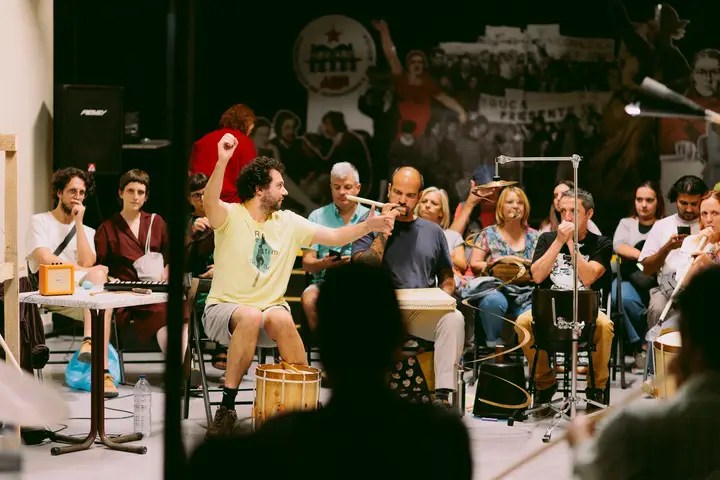
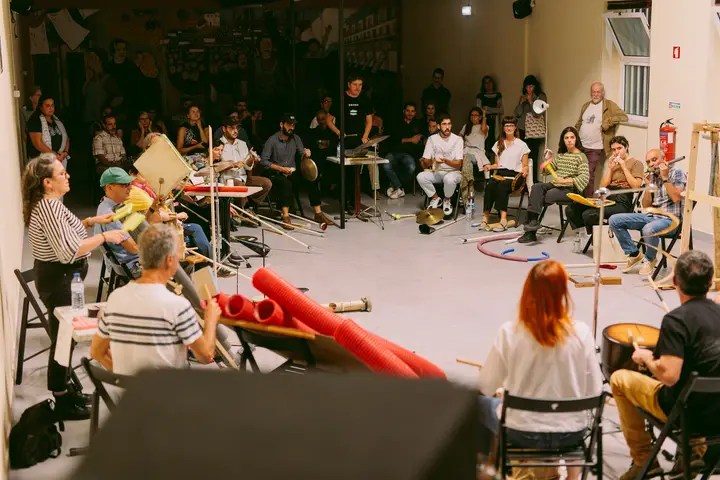
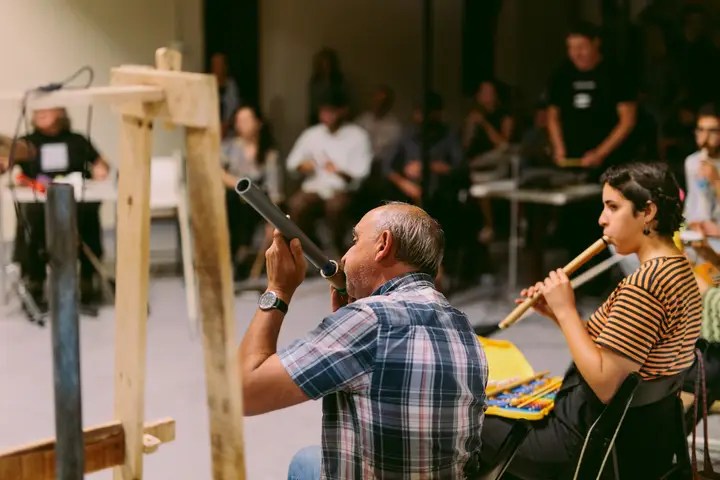
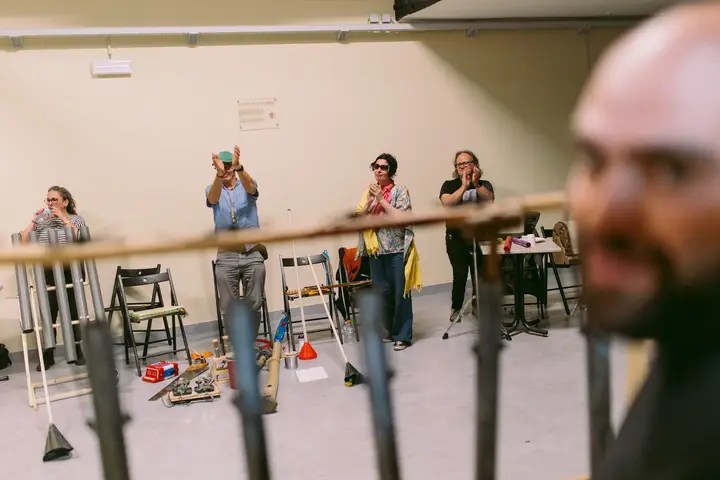
A week ago me and my colleagues from Grupo Operário do Ruído, a parte experimental-exploratory-avant ensemble connect to Sonoscopia were in the depths of our Open Rehearsal, after months of hours long reharsals.
Being part of the group has been a very interesting experience. I elected the electric guitar as my main instrument, in itself a challenge. I’m far more familiar with an electric bass than with an electric guitar. Most of my other instruments are as peculiar and unique as Grupo Operário do Ruído: a couple of plastic beads necklaces, a children’s melodica, mismatched drum sticks, empty spices bottles, and more, and our claribones, what I call our odd purpose build mix of trombone and clarinet.
Many instruments we use were build on previous years of the existence of Grupo Operário do Ruído, some like my guitar, the traditional drums, the tambourine are convencional. My use of the electric guitar is anything but convencional. We’re often asked what we do, what we play. We’re still working on the musical piece directed by António Serginho and Carlos Guerreiro, to which we all contribute.
I would say we’re much close to an orchestra than a rock band. The musical, sound, and other approaches are wide. As you can see on the photos we do not use staves. There are structured rhythm parts, solo and free style parts, corporal movement, a bit of singing. Each of us, one more than others depending of what we play, swap our instruments, according to the section we’re playing.
None of the above explains much other than a little of the mechanics of this year in Grupo Operário do Ruído. It’s not easy to explain as it is a sound experience composed of a million details.
I’ve been asked if I felt nervous playing in front of an audience. I didn’t. I didn’t even notice the audience that surrounded us. We’re concentrated on what we’re playing as well as in the hand instructions of António Serginho tailor made for us, and therefore different than standard conductor instructions.
Come and see me and my colleagues from GOR – Grupo Operário do Ruído – a large experimental-exploratory-avant ensemble – on our Open Reharsal, Friday, 13 at Associação de Moradores da Bouça in Porto, 9:30pm. Entry is free (2 tickets per person, at the door, from 8:30pm).
I’ll be on electric guitar, prepared, bass like or otherwise, and, most likely, on a few peculiar instruments too.
Yé Yé Radio: yeyeradio.com (or on the app) the radio where my Amazing Songs & Other Delights airs every other Monday turns 3 years old Monday 27th. We’re celebrating at Praia da Luz, in Porto, 7-11pm with DJ sets by Francisco Coelho, Francisco Esp, João Bruschy, José Amen, Maria Gambina, Pedro Tenreiro, Rui Pimenta and Tugalife.
Yé Yé came to be May 27th to signal one year of the departure of our friend Vicente Pinto de Abreu. Vicente was a music, books, film, tv shows, comics lover. Praia da Luz a place he liked and identified with. A place where he and the djs collective he was part of, 7 Magníficos – of which Pedro Tenreiro and Rui Pimenta were also part of – spinned records many times.
I still remember the day of Vicente’s death. The night before, as we often did, we had been talking about films, tv shows, comics. I both were meant to watch and read something to discuss with each other the following evening. There was no following eve.
We are celebration Vicente, Yé Yé, radio, music, life, the joy of life and living, the seaside. Come celebrate with us.







 Mondo Bizarre Magazine