words: Marcos Leal (edited by Raquel Pinheiro); photos: Telma Mota
Jim Jarmusch, the independent filmmaker behind iconic cinematic works with the soul of a musician, and Jozef van Wissem, the maestro of the lute, performed a concert that felt like it had drifted out of a somber yet beautiful dream.
With tracks like The Unclouded Day and Concerning Celestial Hierarchy, the concert opened as a kind of secular meditation, where van Wissem’s lute chords engaged in a delicate conversation with Jarmusch’s textured guitar layers.
The soundscape was meditative, with van Wissem’s fingerpicking bordering on hypnotic, and Jarmusch’s slow, dense guitar seeming suspended in time, adding waves of reverb and feedback to the folk serenity of the lute.
Their chemistry was defined by minimalism and transcendence: few notes, vast space, and a deeply cinematic aura. Tracks like The Unclouded Day and Only Lovers Left Alive pulled the audience into a world where the soundtrack itself was the lead character.
But the most surprising moment came during the encore.After a performance drenched in introspection, the two returned to the stage and, without warning, standing tall with guitars raised, launched into a track driven by an electronic beat—more pulsating, more visceral, almost danceable.
The audience stirred, though still somewhat restrained by the mood shaped earlier. It felt as if they had tugged us back to Earth, just to prove that even masters of silence know how to erupt in sound when they choose to.
Good morning with Preaching To The Choir (Live At The Green Note) by Bernard Butler. Have a nice weekend.
An essay, in the form of a tragicomedy letter is accompanying today’s song choice. It’s in the vein of what I, in my Picky INTJ Fairy incantation have been posting to Bernard on his Instagram.. It’s also a shout-out to my essay on Deep Emotions and to my note on Camber Sands.
Oh mine! Where did that super deep, manly, hoarse voice came from? Me thinking live at The Green Note was safe. You live on youtube or social media tend to be . It’s live, no risk. Turns out, it’s a minefield. Urg! Urg! Urg! Picky INTJ fairies don’t know what to do when we’re nearly in tears with emotion. There’s a glance at the guitar, a “maybe the bass?”, a “poem, write a poem, pour it on the page” I’m always doing it, like right now, writing this). But it’s too much, and too many hours of non-creative discomfort, and of being silent and still.
Preaching To The Choir gives me the chills, it’s too close to home. It’s home, times ago. Preaching To The Choir is, or is supposed, to be about politicians, rulers, their deceit and lies and hypocrisy. That’t not my meaning of the lyrics. Songs are this, they mean a different thing to each of us.
“… Oh I’ll reach across the covers to caress your skin / The memories we overcome could mean anything / The words I use to hurt you disappear / Their presence only lingers in your tears…”
Those words always, always, get to me. They cut deep, they have a multilayered, multi side meaning to me, and there are almost, if not really, tears. I don’t know the exact meaning Bernard had in mind when he wrote them. For personal purposes, it doesn’t matter. They bring me memories, they bring out a “good grief”, they’re touching.
“Isn’t it a good thing that you have emotions.” asks Bernard on the Super Deluxe Edition interview. It is. But… but I keep being amazed at how, why, Good Grief, the album, and now it’s companion Live At The Green Note bring out such emotions in me. It’s unusual.
Therefore, congratulations, Mr. Butler. You did it again! Fortunately I have forever cancelled you a few months ago because you don’t like to play bass! You may recall that from Instagram. It has now become hazardous to attend your concerts. However, you will not get away that easily. For purposes of practice and reharsals duty, coupled with protection I’ll most likely turn up with my guitar. It’s becoming something of a trademarks to show up at concerts with my guitar on my back. Don’t worry, I will not take to the stage. It’s all yours. But I will have my safety blanket. Dark glasses are also useful and a side blessing in disguise of photosensitive. Any possible tears Will be hidden.
The hallmark of a great artist is not measured in record sales, size of venues played or any other similar thing. It’s in how deep and truthfully how many hearts and souls are touched by the artist’s work. You’ve deeply touched and moved a few, if not a lot, of us, Mr. Butler.
Signed Picky INTJ fairy.
Bernard Butler is currently touring the UK. Bernard Butler plays in Portugal for the first time in November. 14 (Thursday), Casa da Cultura de Setúbal, Setúbal, 9:30pm 17 (Sunday) 1, Sala 2 Casa da Música, Porto, 9pm
words: Raquel Pinheiro; photos: João Octávio Peixoto/TMP
We’re literally seated, in the dark, in the Rivoli’s underbelly. My old friend Rafael Toral is presenting his new album Spectral Evolution. Spectral Evolution is a single continuous instrumental track. The concert follows the same format.
“There are already too many ruptures in the world, I’m more commited in peace, integration, healing, reconciliation, and this record assumes it.” said Rafael, on an interview, about Spectral Evolution. I wholeheartedly concur with him.
Spectral Evolution, one of my three favourite records of 2024 so far, does have an healing, a come together effect. It’s brings forward emotions, release, serenity.
Here, live, at least where I was seated, for me that was a little disturbed by the sound in itself. It’s part of the nature and the beauty of live music.
I’m not going into technical details or guitar approaches, many of which I’m not even sure or fully aware of. I’ll go with sensations, emotions, a report of how the sound and music reached me, what I made of it.
A piercing, erthquakerish, lound sound, under, or along which, church like and birdsong like music appears. Scratches, signals, noises. It moves towards gentleness, a slight return to higher intensity. There’s a coming and going, a departure, an arrival, a departure, an arrival, a departure. It goes up, higher, louder. It recesses. It floats. It pierces the heart, the muscles, the soul, the senses.
Hadn’t seen Rafael in person in a while it wasn’t no much a case of reconciliation, or even reconnection – we connect through his music, and in the usual current ways – more the joy, the affection, the hugs, the kind and godspeed farewell words in the now emptiness of a minutes before filled room. It was a good-bye matching the essence of Spectral Evolution.
Amazing Songs & Other Delights #71 is the The Desert Blues and Not Just edition airs Monday 7th, 3-4:30pm (gmt+1) on Yé Yé Radio: yeyeradio.com (or on the app). This a longer, special edition.
This programme opens with Imajighen by Mdou Moctar and closes with Tom Huddleston singing a live version on Hank Williams’ I Saw The Light. Once more, I’m travelling through connections, details, inspiration. And writing an essay.
Imajighen means free men in Berber. Although the lyrics specifically, or more specifically, address the free men of the Desert, the song’s words can be transposed to encompass us all. The chorus goes: “Imajighen, we can’t afford to be divided Imajighen, We can’t afford to be divided Imajighen We have no time for hate Imajighen Calling on you all wherever you are! We are all Imajighen” Full lyrics in English, Tamasheq and Tifinagh can be read here. Tom Hiddleston plays Hank Williams in the film I Saw The Light.
What do Mdou Moctar and Hank Williams have in common? Everything, I venture. Amazing Songs & Other Delights #71 the The Desert Blues and Not Just edition could be said to be part of my “self taught” guitar schooling, mostly related to what Grupo Operário do Ruído, of which I’m part of, have been working on music wise.
Desert and African blues often have clapping. Clapping, including Arab clapping, a dry, hand palm against hand palm, clap, along with the fat clapping, is also something we have been exploring on Grupo Operário do Ruído. The same goes for rhythm, space, speed, rests, tone, intensity, ambient, emotions, silence, continuous, abrupt or smooth changes.
Since I elected the electric guitar as my main instrument in Grupo do Ruído, I have been paying a different kind of attention to the many faces, possibilities, approaches of the instrument.
This year, on Grupo Operário do Ruído we even created our own blues. A not so standard one, nonetheless, a blues.
Which take us to, what is the blues, what is a standard blues? The answers may require a many volumes encyclopedia. Or music theory explanations. I’ll leave both aside. As my choices for this Amazing Songs & Other Delights show, the blues is many things, everything, often not what a rigid blues school would call blues. Yet, it’s precisely the richness, the uniqueness, the emotions, feeling, sentiment that make the blues. Not being a never-miss-a-note-i-can-play-it-at-1000-miles-per-second master of the mimor blues pentatonic scale, proper chords progression, and on. If that’s all you got, you don’t have the blues, you have technique.
On these blues choices of mine we go on a journey with stops on Niger to Portugal, through the United States, Argelia-France, Marocco, United Kingdom, France-Spain, Mali, Cyprus, Algeria. Or, as sang Mdou Moctar’s Imajighen “We can’t afford to be divided”. Therefore, let’s have, sing and play the blues!
Tracklist: 01 – Mdou Moctar – Imajighen 02 – ANOHNI & The Johnsons – Breaking 03 – Tiwiza – At u Azeka 04 – Bombino – Mahegagh (What Shall I Do) 05 – Rui Veloso – Sayago Blues 06 – R.L. Burnside – See My Jumper Hanging On the Line (live at home, 1978) 07 – Tarwa N-Tiniri – Taryet 08 – Tom Verlaine – 5 Hours From Calais 09 – Dead Combo – Lisboa Mulata 10 – Fatou Seidi Ghali (Les Filles de Illighadad) – Telilit (live from Story of Sahel Sounds) 11 – Manu Chao – Tu Te Vas Feat. Laeti 12 – Felt – The Stagnant Pool 13 – Boubacar Traoré & Ali Farka Touré – Duna Ma Yelema 14 – Buzz Ayaz – Buzzi Ayazi 15 – Soledad Brothers – This Guitar Says I’m Sorry 16 – The White Stripes – Suzy Lee 17 – Etran de L’Aïr – Imouha 18 – Ben Watt with Bernard Butler – New Year of Grace (Upstairs at the De La Warr Pavilion Bexhill 5th April 2016) 19 – The Legendary Tiger Man – Keep it Burning 20 – Majid Bekkas – Daymallah (feat. Rachid Zeroual, Khalid Kouhen, Paolo Radoni, Marc Lelangue) 21 – Tinariwen – Sastanàqqàm 22 – Tom Hiddleston – I Saw The Light (with Mark Kermode on double-bass, live in the Wittertainment studio)
words: Raquel Pinheiro; photos: Renato Cruz Santos/Cultura em Expansão
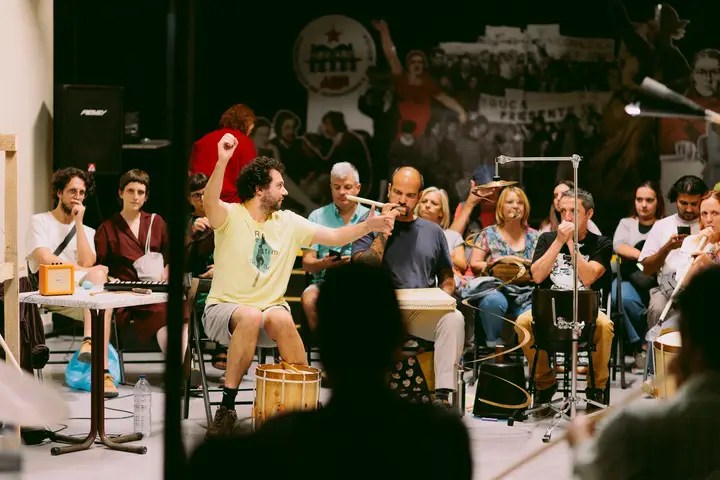
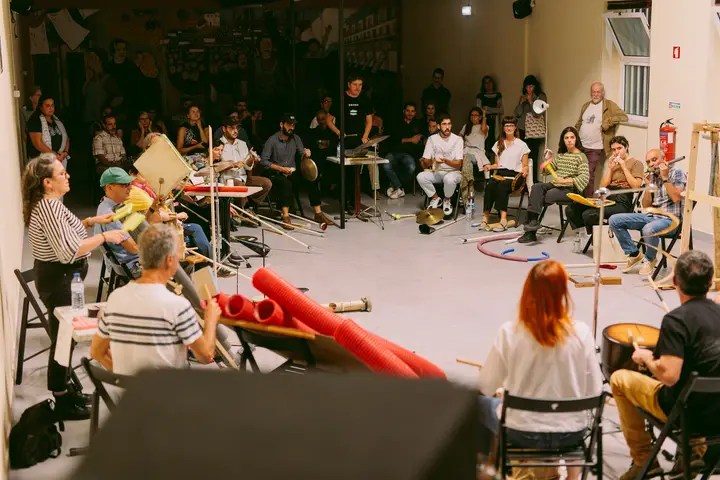
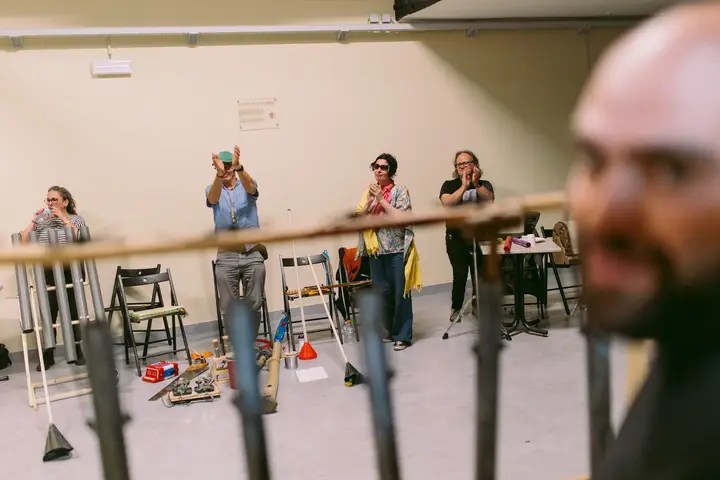
A week ago me and my colleagues from Grupo Operário do Ruído, a parte experimental-exploratory-avant ensemble connect to Sonoscopia were in the depths of our Open Rehearsal, after months of hours long reharsals.
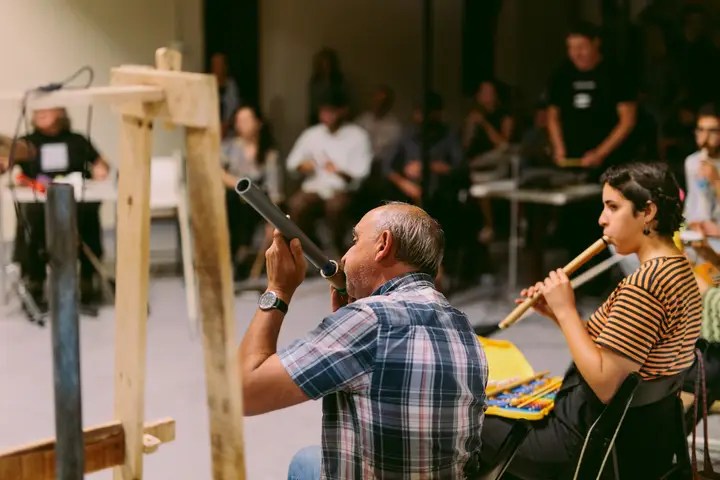
Being part of the group has been a very interesting experience. I elected the electric guitar as my main instrument, in itself a challenge. I’m far more familiar with an electric bass than with an electric guitar. Most of my other instruments are as peculiar and unique as Grupo Operário do Ruído: a couple of plastic beads necklaces, a children’s melodica, mismatched drum sticks, empty spices bottles, and more, and our claribones, what I call our odd purpose build mix of trombone and clarinet.
Many instruments we use were build on previous years of the existence of Grupo Operário do Ruído, some like my guitar, the traditional drums, the tambourine are convencional. My use of the electric guitar is anything but convencional. We’re often asked what we do, what we play. We’re still working on the musical piece directed by António Serginho and Carlos Guerreiro, to which we all contribute.
I would say we’re much close to an orchestra than a rock band. The musical, sound, and other approaches are wide. As you can see on the photos we do not use staves. There are structured rhythm parts, solo and free style parts, corporal movement, a bit of singing. Each of us, one more than others depending of what we play, swap our instruments, according to the section we’re playing.
None of the above explains much other than a little of the mechanics of this year in Grupo Operário do Ruído. It’s not easy to explain as it is a sound experience composed of a million details.
I’ve been asked if I felt nervous playing in front of an audience. I didn’t. I didn’t even notice the audience that surrounded us. We’re concentrated on what we’re playing as well as in the hand instructions of António Serginho tailor made for us, and therefore different than standard conductor instructions.
words & video by Raquel Pinheiro; photos: João Octávio Peixoto/TMP
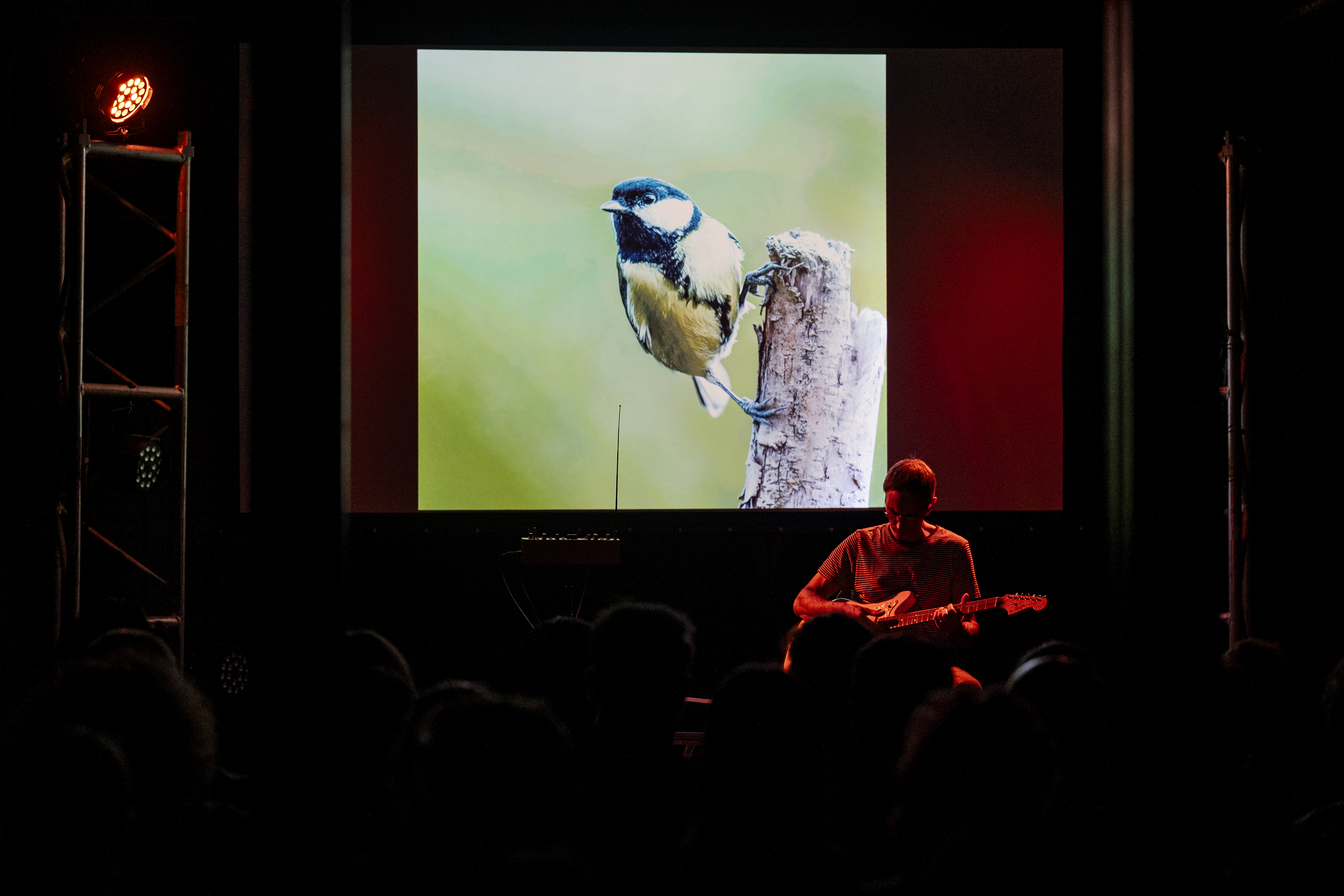
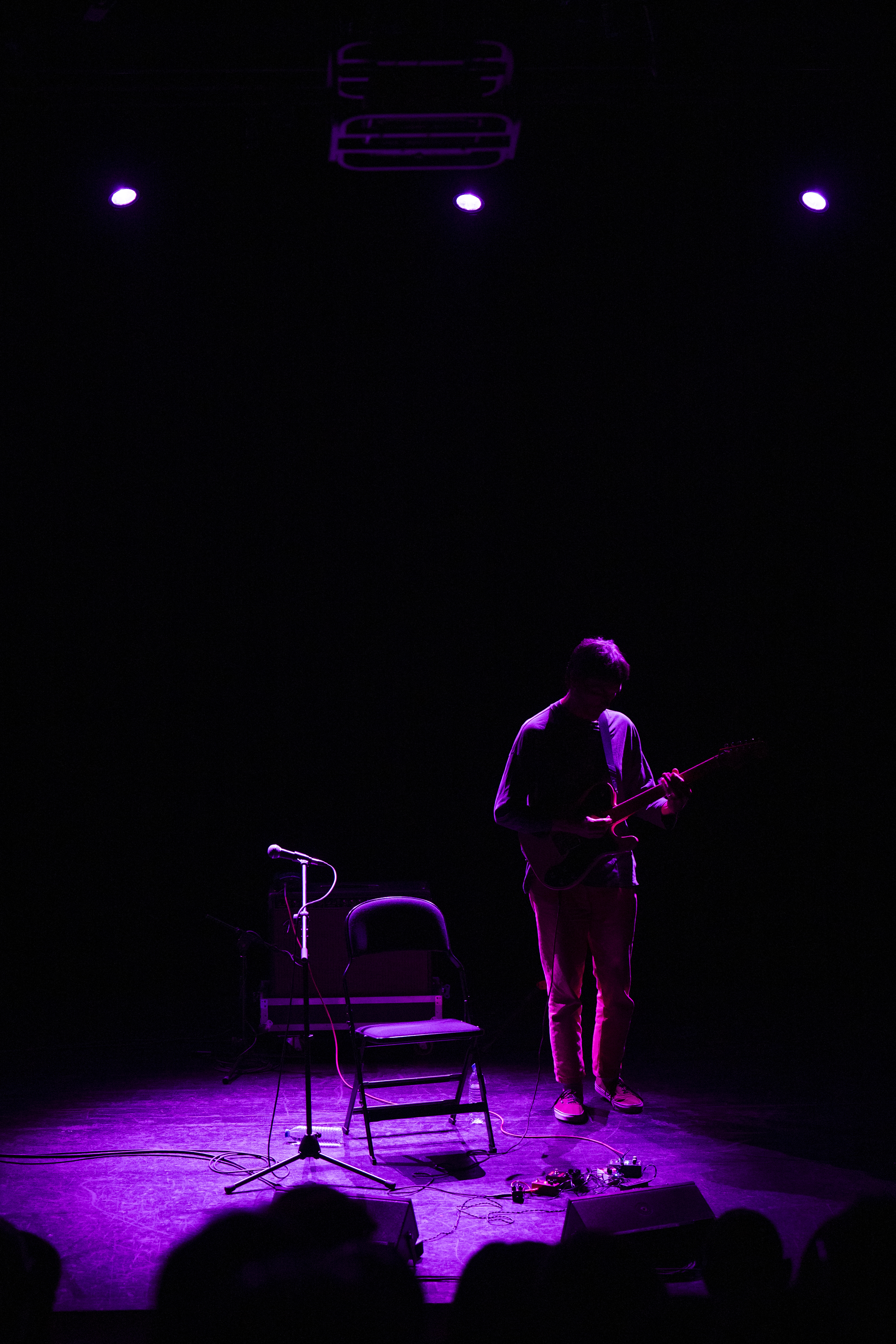
To say Bill MacKay’s concert was extraordinary, would be underwhelming. Sublime is a better word. Transcendental, another good one. Those words still don’t do justice to the music, guitar, playing, singing. In fact, being there is the only thing that would do it justice.
Beauty, poetry spoken with an electric guitar as I’ve seldom heard it. Bill sings too, and tells little stories about the songs, however, his visual, sound, poetic mastery of the guitar is the domain of few.
The songs from MacKay’s latest album Locus Land (by the way it’s Terra do Gafanhoto, Bill 🙂 ) gain a different, spiritual, otherworldly dimension live. They become a time within time. A time of gentleness, until the final piece served: Arcadia. Bill stood up to play Arcadia in full, distortion mode adding a sharp dramatic contrast to the tone of the concert.
Come and see me and my colleagues from GOR – Grupo Operário do Ruído – a large experimental-exploratory-avant ensemble – on our Open Reharsal, Friday, 13 at Associação de Moradores da Bouça in Porto, 9:30pm. Entry is free (2 tickets per person, at the door, from 8:30pm).
I’ll be on electric guitar, prepared, bass like or otherwise, and, most likely, on a few peculiar instruments too.








 Mondo Bizarre Magazine