A Love Story, a Television Screen and the Music of a Society in Contradiction
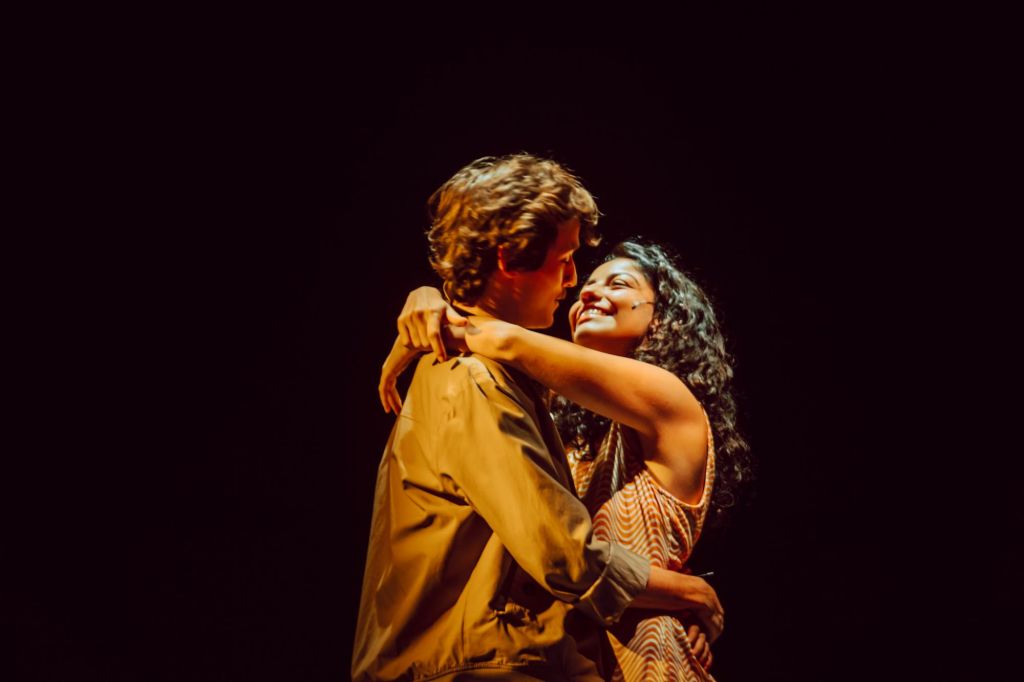
The performances of Esquecimento Global at Teatro Municipal de Matosinhos Constantino Nery take place on 6 and 7 November at 21:30, and on 8 November at 16:00. Tickets are €7.50.
Following its Matosinhos premiere, the play is scheduled to travel to Teatro Municipal da Covilhã on 27 November at 21:30 (9:30pm) and Centro Cultural Vila Flor, in Guimarães, on 12 December at 21:30 (9:30pm).
words: Raquel Pinheiro
photos: Ricardo Silva
Esquecimento Global (Global Forgetness) is the new production of Teatro Municipal de Matosinhos Constantino Nery, written by José Nunes and Luca Argel, with direction by José Nunes and an original score and pre-existing songs by Luca Argel. It draws freely on Bertolt Brecht and Kurt Weill’s The Threepenny Opera and Chico Buarque’s Ópera do Malandro, bringing elements of those works into an entirely new story set in contemporary Portugal.
We attended the press rehearsal on 29 October, where we saw the first five scenes, approximately 40 minutes of a two-hour production. What follows is therefore an introduction to the work based on that first encounter, rather than a review of the complete performance.
A familiar Scene, With an Unsettling Undertone
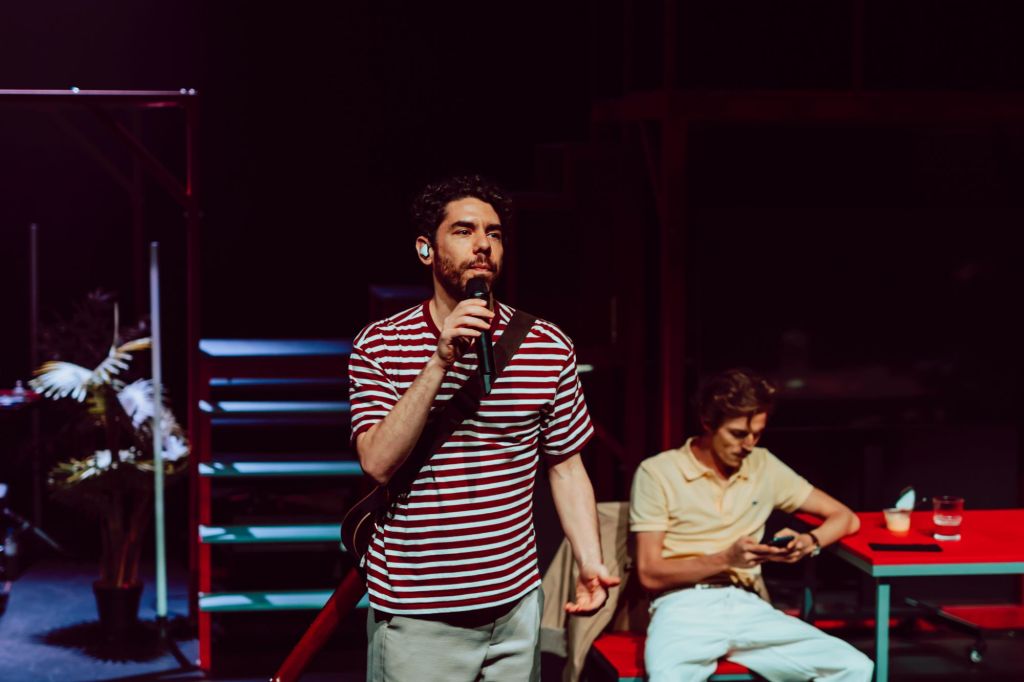
The production opens with a monologue that establishes the theatrical territory ahead. As Luca Argel explained during the rehearsal, the opening takes its cue from the way The Threepenny Opera and Ópera do Malandro introduce the world and events that are about to unfold.
Then the music begins.
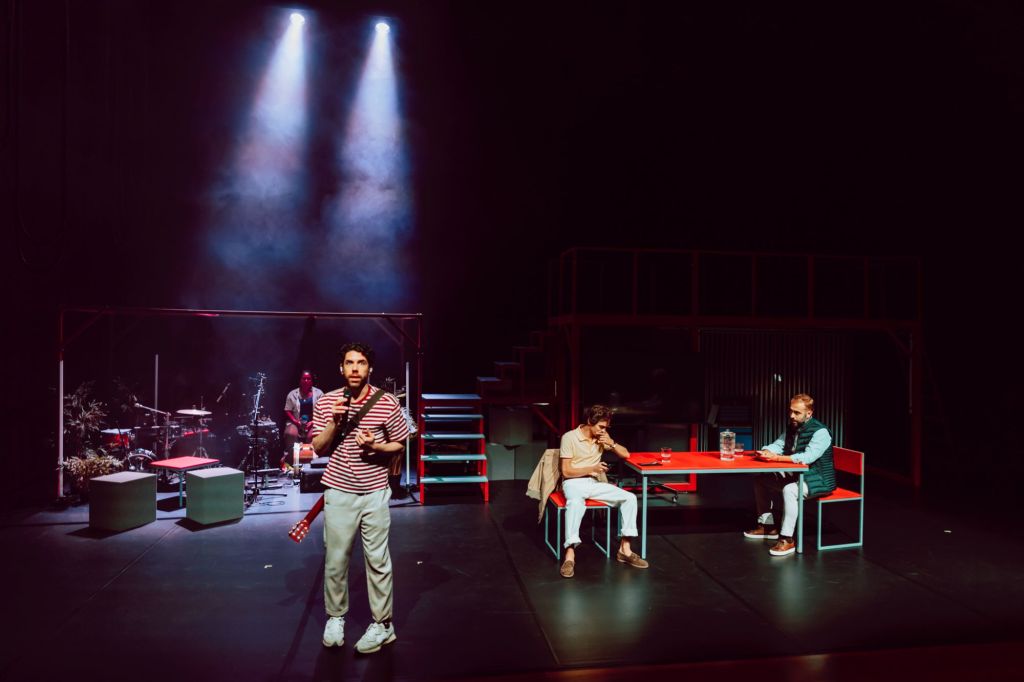
At a rectangular table, two actors sit in silence, looking at their mobile phones. One gradually turns towards the audience. When the song ends, a television screen comes to life with the news. One of the characters reacts with familiar indignation: “É uma vergonha” — it’s a disgrace. The conversation continues with complaints about the country, its direction and the state of public life.
It is an immediately recognisable scene. The exchanges have the texture of conversations overheard in a neighbourhood café or on the metro: snippets of news, opinions, complaints and observations, delivered with the confidence of people who know exactly what is wrong with the world.
The television is not simply a backdrop. It functions as another character in the production, repeatedly bringing the outside world into the room. News reports, political polls and stories of public disorder interrupt or accompany the action, creating a running dialogue between what is happening on screen and the behaviour of the people watching it.
That dialogue is often revealing.
The father and his son Vicente are quick to express outrage at dishonesty and corruption. Yet their own activities are hardly beyond reproach. The father helps arrange documents through acquaintances for his son’s construction projects and shop refurbishments. Their indignation sits alongside their participation in the very practices they appear to condemn.
The play begins to expose the distance between public declarations and private conduct without needing to underline every contradiction.
Vicente, His Father and Júlia
Vicente works in construction and has recently begun a relationship with Júlia. His father, who has lived alone for a long time, wants to meet her and invites his son to bring her home for dinner.
There is a personal history behind the father’s isolation. His wife died after a long period spent moving between hospitals, when eventually there was nothing more that could be done. His days have since followed a narrow routine of work, home, television and phone. The invitation to dinner appears, at first, to offer a welcome change.
But the meeting does not unfold as he might have expected.
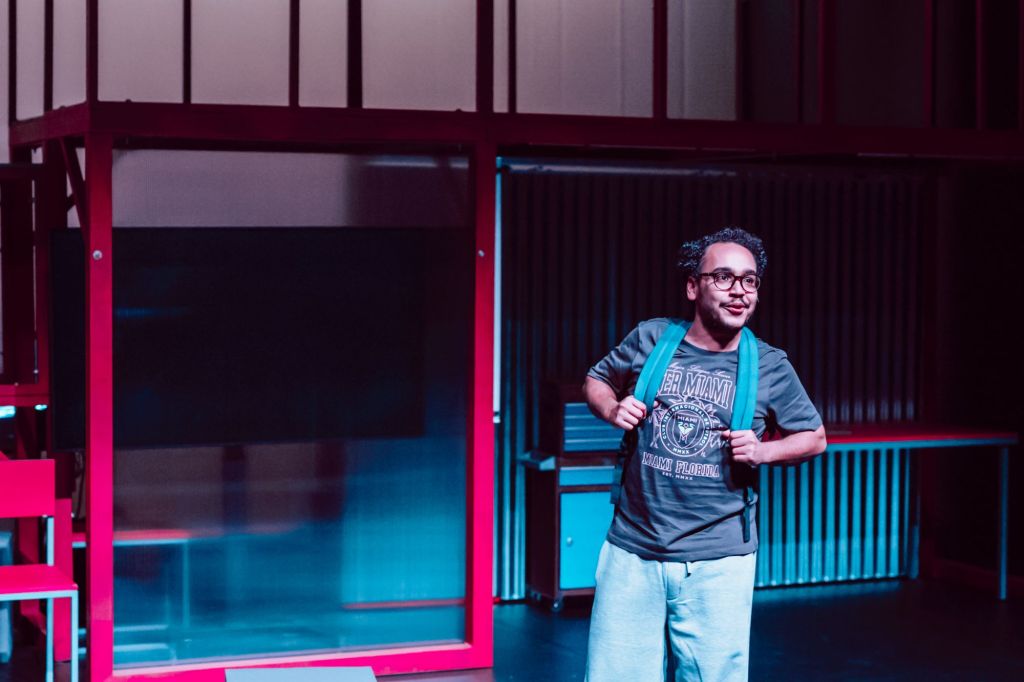
Júlia is Brazilian, an immigrant who studied architecture in Brazil but now works in a clothes shop in Portugal. Her arrival exposes the father’s prejudices, and the atmosphere changes. His discomfort is not hidden behind polite conversation for very long.
The contrast between Júlia’s education and her present employment also gives the character a particular dimension. Migration is not only about crossing a border or finding somewhere to live. It can involve a change in professional circumstances, the loss or interruption of an established career, and the effort of rebuilding a life in a different country.
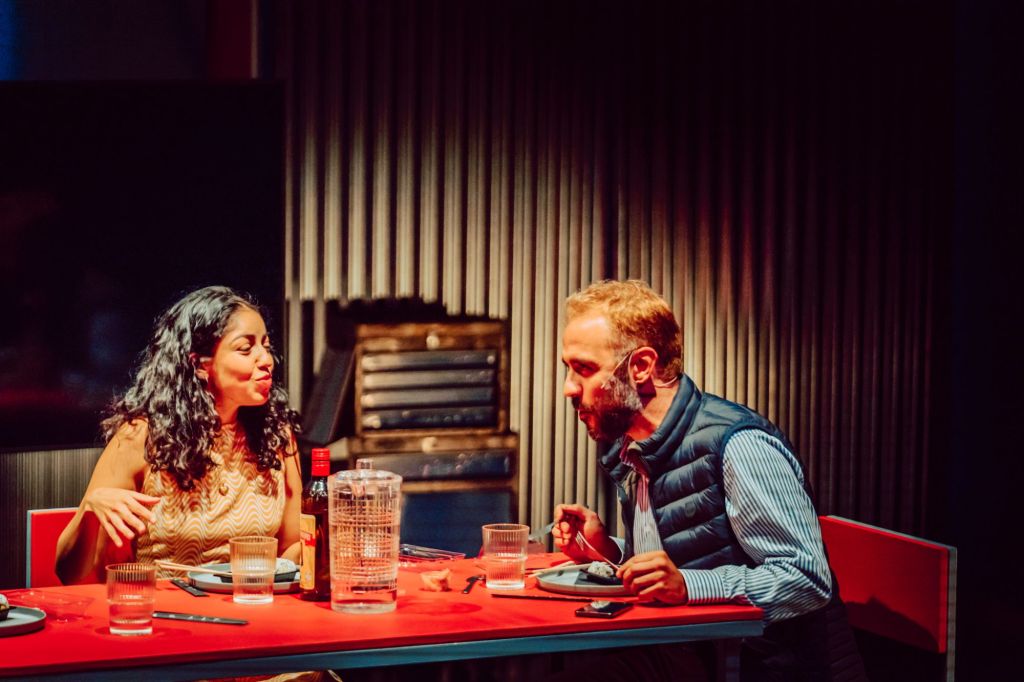
The production approaches these questions through the people involved rather than presenting them as abstract subjects for discussion.
The family exchanges also have their lighter moments. There is the awkward business of deciding what to eat, the absence of anything prepared at home, and the eventual solution of ordering food. The father’s insistence that it is modern, fresh and ready to eat before it gets cold provides room for humour amid the tension.
The cast is very good in these early scenes. The interactions have an ease that helps establish the characters as people with their own habits, assumptions and inconsistencies, rather than as simple illustrations of the issues the play addresses.
The Music is Part of the Argument
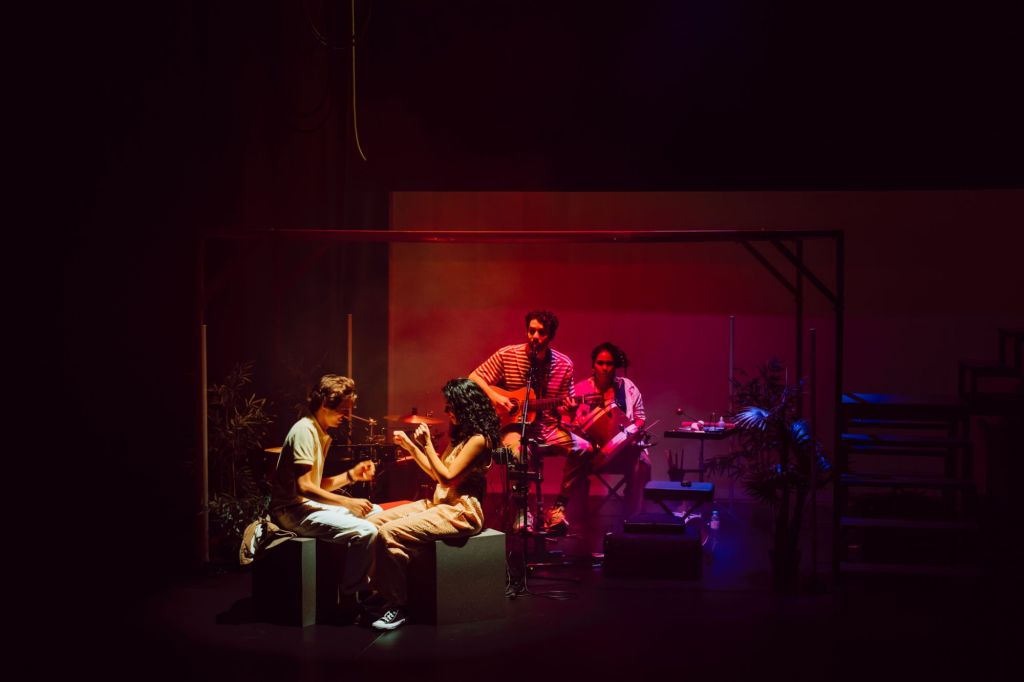
Music is central to Esquecimento Global. Luca Argel composed the original score, added by some of his pre-existing songs, performs it live, accompanied by Carlos Cesar Motta, Lizzie Marchi and Pri Azevedo.
The songs do more than provide musical interludes. They bring another perspective into the action, sometimes extending what the characters are saying and sometimes exposing what their words leave unsaid. The relationship between music, dialogue and the television screen gives the production several ways of approaching the same social reality.
The lyrics available to us from the production offer a glimpse of that range.
In ‘T1+1, the language of love and belonging takes on an unexpectedly material turn. The beloved becomes a country, a flag and a home, before the song arrives at the image of a renovated little house, with a balcony and a parking space. The movement between romantic ideal and domestic aspiration gives the song a playful edge.
Gentrificasamba’ turns to the transformation of neighbourhoods. Bookshops, grocers, florists, taverns and confectioners disappear, replaced by accommodation for tourists. Its cheerful, ironic refrain – the idea that the city is becoming one enormous hotel – contrasts with the disappearance of the places and relationships that once gave a neighbourhood its character. The narrator’s enthusiasm for becoming a tourist in their own city is an especially pointed piece of humour.
In Quem Foi?’, the questions become more direct. Who prepares the food we eat? Who plants and harvests what reaches our tables? Who entertains our children, builds our buildings and contributes to the places in which we live? The song draws attention to the people whose labour is present everywhere, even when their identities and contributions are overlooked. Its central question – who decided that I cannot stay here? – brings the subject of belonging into sharp focus.
Then there is Estrangeiro, which has a different musical and lyrical character. It brought to mind the atmosphere of Manu Chao’s Clandestino’, with its sense of movement, departure and displacement.
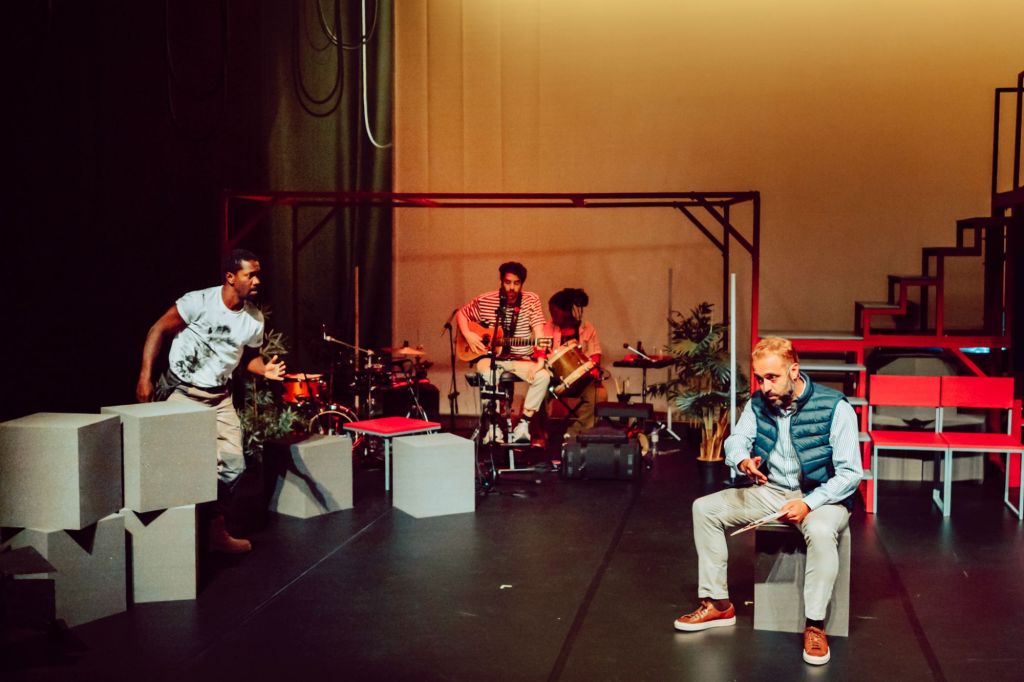
It is also the only one of these four lyrics structured around several distinct voices. Luca sings of leaving his father and home, uncertain when he will return. Genário takes us through the airport and the flight, saying goodbye to his city and trying to sleep until the aircraft lands. Allex’s perspective begins on the other side of the journey: crossing the ocean, arriving in a country of strangers, facing interrogation and scrutiny, and encountering the succession of labels imposed on people who move from one place to another.
The three perspectives give the song a wider emotional and geographical reach. Migration is not presented as one uniform experience. There is the person who leaves, the person who travels, and the person who arrives and discovers that arrival does not necessarily mean being accepted.
Together, these songs suggest how the musical writing moves between intimacy, irony, social observation and more direct questioning. They also show why the live music is so important to the production’s dramatic construction.
The People Behind the Story
The production’s point of departure in Brecht and Chico Buarque is significant. Both works offer ways of bringing social and political questions into musical theatre, and Esquecimento Global draws on that tradition while creating its own contemporary narrative.
The television reports, the conversations around the table, the relationships between the characters and the songs all contribute to a world in which personal behaviour cannot be separated from the society surrounding it.
During the rehearsal, the action also moved towards the world of construction and refurbishment, introducing workers and the relationships between those who commission work and those who carry it out. An exchange concerning the spaces in which people are willing to have work done – shops and commercial premises rather than private homes – brought another dimension to the question of trust and belonging.
These are details that matter because the play does not confine its concerns to public debate. They enter the characters’ homes, workplaces, relationships and everyday decisions.
The title, Esquecimento Global, invites questions of memory and forgetting, although the full scope of that idea can only be assessed after seeing the complete production. In the first five scenes, however, there is already a recurring concern with what society chooses to notice, what it overlooks, and whose presence it is prepared to accept.
A new Production at Constantino Nery
Esquecimento Global is a production of Teatro Municipal de Matosinhos Constantino Nery, written by José Nunes and Luca Argel. José Nunes directs, and Luca Argel composed the music.
The cast brings together Allex Miranda, Francisca Sobrinho, Genário Neto, Júlia Prado, Luca Argel, Rodrigo Santos and Vicente Gil. The live musicians are Carlos Cesar Motta, Luca Argel, Lizzie Marchi and Pri Azevedo.
The creative team also includes Filipe Azevedo and João Pedro Trindade (Teatro de Marionetas do Porto) for scenography; Jordann Santos for costumes; Bruno Santos for lighting design; Miguel Miranda for video; Vasco Zentzua for sound effects; Bruno Marques for sound design; and Carolina Oliveira as stage manager.
The production was conceived in May 2026 and the play was essentially written in August 2026.
The first five scenes establish a production in which the familiar rhythms of everyday life gradually reveal more complicated relationships between words, actions and social expectations. With its original live music, its television screen and its ensemble of characters, Esquecimento Global sets out to bring political theatre into the present, through the particular lives of the people on stage.
We look forward to seeing the complete production.
Esquecimento Global:
Text: José Nunes and Luca Argel
Direction: José Nunes
Music: Luca Argel
Cast: Allex Miranda, Francisca Sobrinho, Genário Neto, Júlia Prado, Luca Argel, Rodrigo Santos and Vicente Gil
Musicians: Carlos Cesar Motta, Luca Argel, Lizzie Marchi and Pri Azevedo
Production: Teatro Municipal de Matosinhos Constantino Nery, in co-production with A Oficina/Centro Cultural Vila Flor and Teatro Municipal da Covilhã.